Pentacles · Five
Five of Pentacles
The distance between help existing and help being available
The Five of Pentacles shows how material hardship affects a person's daily life. Cold and the cost of getting by can make asking for help difficult, even with someone beside you. The card draws attention to what would make support accessible. A person's needs deserve a response regardless of how they came to be in difficulty.
- Hardship
- Exclusion
- Unmet needs
- Solidarity
16 min read
In this guide
Life becomes smaller around an unmet need
A practical difficulty begins to organise the entire day. You calculate the journey before accepting an invitation, postpone something necessary, or avoid a conversation because explaining your circumstances feels more exposing than staying away. The Five of Pentacles describes the way a shortage can spread beyond the missing resource. Money, access, stability, and belonging become intertwined, and ordinary participation starts to require effort other people may not notice.
Upright, the card can reflect hardship, insecure conditions, exclusion, or the experience of being outside an arrangement that appears to support everyone else. The issue may be material, social, or both. A person can lack resources and still have companionship; they can also possess enough on paper while being unable to access care, cooperation, or a place where they are welcome as they are.
Begin with the actual need. Identify what the person lacks and what makes it difficult for them to obtain it. This is more useful than immediately asking what belief created the problem. Some circumstances require information, money, accommodation, institutional change, or practical assistance. Insight may help a person navigate them, but it does not replace the resource itself.
The Five can also name the emotional cost of comparison. Other people's ordinary purchases, plans, or easy assumptions make your limitations more visible. You may feel embarrassed by a difference that says little about your character. The card invites a more accurate account: unequal circumstances produce unequal options, and the effort required to remain afloat may be substantial even when nobody sees an impressive result.
There is companionship in the image, but it should not be romanticised into a claim that hardship improves people or that affection makes resources unnecessary. Walking beside someone can matter deeply. It can also leave both people needing shelter. A careful interpretation allows solidarity and practical need to remain equally real instead of asking one to cancel the other.
As a prompt for the next step, the Five asks where usable support might be found and what prevents access. Sometimes shame is one obstacle; sometimes the service is genuinely unavailable or unsuitable. Find out before deciding. The point is to make the situation less isolating and more specific, not to require optimism as the price of being helped.
Two people pass a bright window in the snow
Two figures move through falling snow beneath a lit stained-glass window containing five pentacles. One uses crutches; the other walks wrapped in a worn covering. Their bodies and clothing convey the immediate difficulty of the journey. The window offers a striking contrast: warmth and ordered beauty appear close to people whose conditions are precarious.
The picture does not show a door. This matters when interpreting the familiar claim that help is available if the figures would only look up. Without an entrance in view, we know neither the rules for entering nor whether these people would be admitted. The window may suggest the possibility of support, but its presence does not establish that access is easy or that failure to enter is the travellers' fault.
The figures remain near one another. We cannot know the exact nature of their relationship, yet the composition allows a reading of shared passage. One person's difficulty has not made the other disappear. This can symbolise companionship under strain without turning either figure into a rescuer who must somehow possess everything both need.
The pentacles are set into the building. Neither person outside holds any of them, so the image places visible wealth beside people who cannot use it. This raises a practical question about access: what would allow someone outside to receive support? An institution's prosperity matters to them only if its arrangements make participation possible.
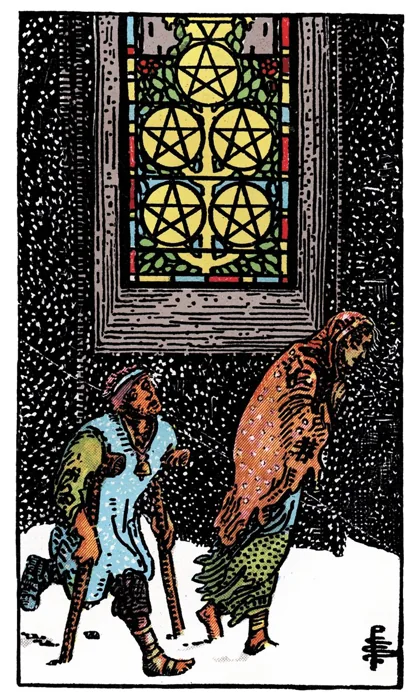
The window is illuminated, but no entrance is shown. Ask about the actual route, terms, and suitability of help before assuming that a person outside simply failed to notice what was available.
The figures share the scene without either being shown as a complete solution for the other. Solidarity can reduce isolation while leaving practical needs that still deserve resources and appropriate assistance.
Shame can add a second burden
The inner Five may tell you to become less visible until you have solved the problem. You decline contact, conceal the practical difficulty, or stop asking because you assume the answer will expose you as irresponsible. This can create a second burden around the original one: not only do you need something, you feel obliged to make the need invisible.
You may also feel that you have fallen out of the life you were supposed to be living. A setback changes your plans, and comparison supplies a cruel timeline on which everyone else seems to be progressing normally. Ask whose schedule is being used and what it leaves out. Lives do not begin with equal resources or encounter their difficulties in the same order.
As a temporary way of being, the card can describe a person who has learned to expect refusal. They prepare for rejection before making a request, sometimes by deciding not to ask at all. That expectation may have a real history. A useful response respects the history while examining whether this particular person, service, or setting might offer a different answer.
Another expression is fierce attachment to self-sufficiency. You would rather endure an avoidable difficulty than risk owing anyone or being seen as dependent. Consider the actual terms of the help being offered. Some assistance does carry unfair strings; some is a reasonable exchange, a shared resource, or care freely given. Distinguishing these possibilities creates more choice than refusing them as one undifferentiated category.
The card's more humane movement begins when need can be described without apology becoming the whole account. Describing the practical problem lets you ask an appropriate person a specific question they have a chance to answer. That does not guarantee an answer. It gives the situation a chance to become something other than a private conclusion that nobody would want to help.
Belonging has material conditions
The Five challenges the idea that belonging is only a feeling. Participation often requires transport, time, suitable clothing, accessible spaces, money, or permission to have needs without being humiliated. A group can sincerely call itself welcoming while overlooking the conditions that keep some people away. The card asks whether welcome has been translated into an actual route inside.
It also questions the moral stories attached to scarcity. A shortage can arise through many circumstances, and the card cannot determine how deserving anyone is. When the first response to need is a trial of character, support becomes harder to seek and harder to offer honestly. Accountability may matter in a particular situation; it should not erase the immediate reality of what is required.
There is a lesson for those standing inside the warm building. Good intentions are incomplete if the person outside cannot use what is offered. Find out whether the person can reach the support and understand its terms, and whether it meets their actual need. A changed time, a clear explanation, a practical accommodation, or help with the first step may matter more than a broad announcement that the door is open to everyone.
For the person experiencing hardship, the deeper task may be preserving an identity larger than the circumstances. You are still someone with preferences, humour, knowledge, and the right to make choices. Assistance that recognises only your need can feel diminishing. The best support helps you regain room to act without requiring you to become permanently defined by the moment you needed it.
Being outside the opportunity is different from lacking ability
At work, the Five can reflect insecurity, exclusion from useful networks, inadequate support, or a role in which essential needs are repeatedly overlooked. Ask what practical barrier is affecting participation. Is it access to information, training, equipment, a workable schedule, or a fair opportunity to contribute? A specific barrier is easier to discuss than a general feeling that you do not belong.
For someone seeking work, repeated refusals can make the search feel like an assessment of the whole person. A rejection may contain useful information, but it is rarely a complete account of your ability or future. Consider which part of the process can be improved and which factors remain outside your control. Relevant feedback is more useful than endless speculation about an employer's private opinion.
The card can also describe being employed while still materially insecure. Having a role does not automatically mean the terms are sufficient or the workload sustainable. Examine the actual arrangement and seek suitable information or support where needed. The reading should not turn the fact of having work into a reason to dismiss the conditions under which it is being done.
In a team, exclusion may be subtle: decisions happen elsewhere, assumptions are never explained, or a newcomer is expected to know an unwritten rule. If you hold influence, make access more explicit. Explain the context and expectations that others may take for granted. Then look for people whose contributions the current process makes difficult to recognise. Inclusion becomes practical through those ordinary changes.
Creative work has its own shortages. You may lack space, time, tools, or a community that understands the effort. Do not confuse limited conditions with limited seriousness. Find the smallest form in which the work can continue without pretending that constraints are secretly beneficial. A borrowed resource or a protected interval can matter while the larger need remains unresolved.
The professional possibility is appropriate connection. A colleague explains a process, someone points you towards a relevant opportunity, or an institution clarifies what support is actually available. Ask for the specific thing that would change the next step. Assistance is easier to use when it is concrete, and easier to offer when the request does not require someone to solve the whole future.
Do we stand together when life becomes inconvenient?
In relationships, the Five can show the strain created by practical hardship or the pain of feeling left outside a bond. These are different situations. Two people may be close while circumstances are difficult; a materially comfortable relationship may still leave one person feeling unsupported. Ask whether the hardship is being faced together or whether the relationship itself is adding to the isolation.
When money or time is scarce, ordinary differences can become emotionally charged. A suggestion meant as a treat may expose a limit; an invitation may require an explanation someone is tired of giving. Clear, considerate conversation helps. State the actual constraint and look for ways to remain connected that do not require one person to perform comfort they cannot afford.
The card can describe loyalty expressed through practical companionship. Someone helps with a journey, brings food, waits through an appointment, or stays in touch without demanding that you become cheerful first. These acts matter because they reduce the distance between care as a feeling and care as something a person can experience in the day.
It can also reflect a pattern of accepting too little because being alone appears worse. Need can make an unequal arrangement difficult to question, especially when resources are shared. Consider what support outside the relationship might increase your room to choose. The card cannot assess another person's intentions; the relevant evidence is how they treat your needs, limits, and independence.
If you are asking about feelings, the Five does not prove that someone misses you, regrets leaving, or feels rejected. It may invite attention to the experience of distance, but contact and conduct must supply the particulars. Avoid building a whole reconciliation around the possibility that another person is secretly suffering. Ask what relationship is actually available now.
For someone offering care, preserve dignity and choice. Ask what would help instead of assuming, and avoid making gratitude an ongoing performance. The person receiving support still has preferences and the right to decline an unsuitable offer. Compassion becomes more dependable when it helps someone participate in their own life rather than replacing their judgement with yours.
The need should be named at its real scale
Material difficulty deserves direct attention. Establish how far the available resources can meet the urgent need, and where reliable information could help you understand the remaining options. A tarot card cannot predict financial loss or select a course of action. Its useful role is to help you articulate the concern and the kind of assistance that might make the next decision better informed.
Avoid describing an actual shortage as merely a negative attitude. If the numbers do not cover the essentials, the issue needs a practical response suited to the circumstances. Conversely, uncertainty can sometimes be reduced by checking a term, a date, or an entitlement rather than assuming the most discouraging answer. Accurate information may not solve everything, but it can change the map.
At home, the Five can concern instability or a space that does not adequately support the people living in it. Warmth, privacy, access, and basic functionality are legitimate needs. A person need not be in the worst imaginable situation before a difficulty counts. Naming the problem precisely can help distinguish what requires immediate attention from what can be addressed over time.
If you share a household, discuss constraints without turning the discussion into a competition over who deserves less. The aim is to understand needs and responsibilities clearly enough to make workable choices. Where outside expertise or assistance is necessary, treat seeking it as part of responding to the situation, not as evidence that the household has failed a moral test.
Managing a shortage takes work
An unmet need can occupy attention far beyond the task itself. Calculating what is possible and anticipating the next difficulty takes time, as does improvising a solution and keeping track of its consequences. This effort may leave little visible output, yet it still uses capacity. The Five asks you to count that hidden work before judging yourself for not also progressing at the pace of someone whose basic conditions are more secure.
The image includes bodily difficulty, but it is not a diagnosis or a forecast of illness. Actual health or access concerns need support grounded in the person's circumstances. Within reflection, ask what adjustment would make participation less costly: a different pace, practical assistance, an accessible setting, or permission to say what is difficult without being dismissed.
Do not turn every rest into another task of proving resilience. Sometimes the appropriate response is simply a manageable interval in which the shortage is not the only subject. Company, humour, or ordinary pleasure can coexist with a serious problem. They do not make the problem less deserving of attention.
Make one route to support more concrete
Choose one need and describe it in practical terms. What would help, where might it be available, and what prevents access? If the obstacle is information, seek a reliable answer. If it is a resource, identify suitable support. If it is shame, consider one person with whom the request could be made without turning the whole situation into a confession.
When helping, reduce friction rather than adding conditions. Make a specific offer with clear limits, so the person can decide whether it would help them. A clear limited offer may be more useful than a sweeping promise that cannot be kept. Support should make the next step easier to take, not create another uncertain arrangement to manage.
The shadow is romanticising deprivation or blaming the person experiencing it. Both avoid the practical question of what is needed. Another shadow is deciding that exclusion is permanent before every relevant route has been examined. The Five asks for neither forced hope nor a final verdict. It asks for an accurate account and one usable connection where possible.
The threshold begins to become reachable
Reversed, the Five can suggest improved access, a request answered, or the first easing of a difficult period. The change may be small: clearer information, a reliable contact, a practical accommodation. Its value lies in making a part of daily life less precarious. Relief does not have to be dramatic to change what becomes possible next.
It may also describe the willingness to be seen. You stop concealing a need from someone able to respond and discover that the conversation is more manageable than anticipated. This does not mean every refusal was imagined. It means one present interaction has supplied new evidence, which can be allowed to matter without rewriting the whole history of being let down.
Another expression is deeper isolation. A person withdraws, an offer proves inaccessible, or the shortage remains hidden behind a reassuring surface. The reversal alone cannot decide whether conditions are improving. Look at concrete changes in resources, access, support, and the person's ability to choose. Those details tell you more than the orientation.
Receiving help can bring mixed feelings. Gratitude may coexist with embarrassment, distrust, or concern about obligations. Clarify the terms instead of requiring yourself to feel uncomplicated relief. A good arrangement can make those terms understandable and leave room for your preferences. You do not owe the giver a different emotional history in order to receive appropriate support.
The constructive reversed Five moves towards participation. You have a little more access, a clearer route, or a less solitary account of the difficulty. Keep attending to the conditions that make the improvement usable. The aim is not simply to be admitted once, but to build a more dependable relationship with the resources and people that support your life.
What would make support usable?
These combinations explore hardship, access, and solidarity. They do not predict poverty, diagnose a condition, or establish that someone has deliberately excluded you.
With Six of Pentacles
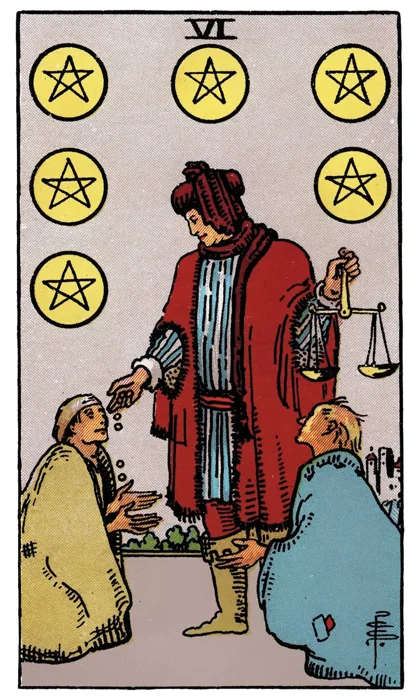
With the Six of Pentacles, examine how support is offered and received. Clear terms and respect for choice matter alongside the resource itself. A useful exchange reduces the immediate difficulty without creating a hidden obligation to surrender privacy, autonomy, or permanent gratitude to the giver.
With Eight of Swords
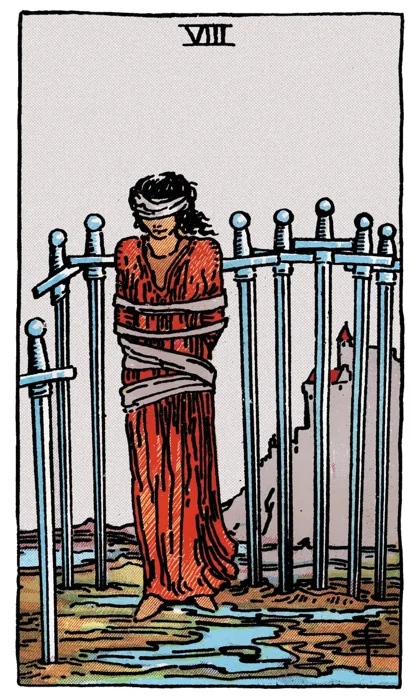
With the Eight of Swords, an option may exist in theory while remaining difficult to use. Identify the material and informational barriers separately. A practical adjustment or trusted guide may help more than insisting the person is free to choose before the conditions of choice are present.

With Two of Cups
With the Two of Cups, mutual care may be a real source of support during difficulty. Notice the actions through which that care becomes usable. Keep the practical problem visible as well; a loving connection need not prove its depth by enduring avoidable hardship without outside assistance.

With Four of Pentacles
With the Four of Pentacles, a tight grip may have an understandable basis in insecurity. Distinguish essential protection from fear that has become broader than the current facts. Do not pressure someone to give up a necessary reserve merely to demonstrate a more generous attitude.

With The Hierophant
With the Hierophant, an institution, community, or formal process may shape access to help. Find out what is actually available and what requirements apply. A familiar rule may contain alternatives, while a welcoming statement may still need practical changes before it can include the person concerned.

With The Star
With the Star, hope may return through a modest sign that the situation is not entirely closed. Let that sign be concrete: a response, an opening, a person who follows through. Hope becomes more credible when it accompanies usable support instead of replacing the need for it.
With Three of Pentacles
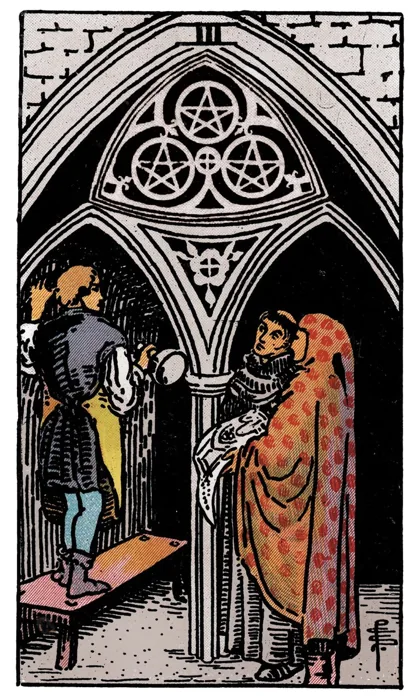
With the Three of Pentacles, relevant expertise or a collaborative arrangement may improve access. Ask who understands the practical barrier and whose contribution has been overlooked. A good solution includes the knowledge of the person living with the difficulty, rather than designing help entirely from outside.
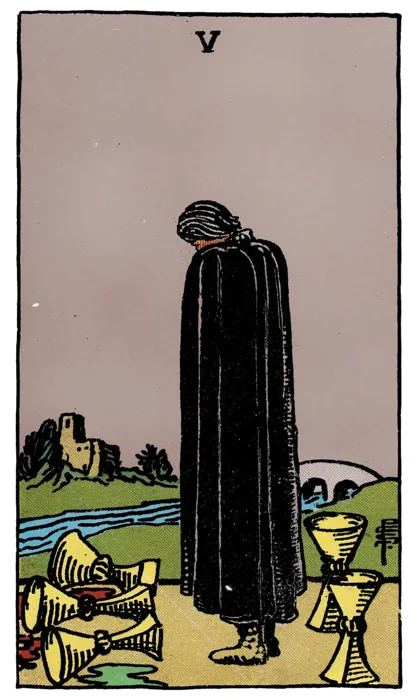
With Five of Cups
With the Five of Cups, material strain and emotional loss may be occurring together. Give each its own attention. Practical assistance does not automatically resolve grief, and emotional acknowledgement does not pay the practical cost. A fuller response recognises both without asking either to stand in for the other.
The threshold and the companion on the road
A public building announces that everyone is welcome, but the only entrance is difficult for some visitors to use. The welcome is sincere and incomplete. The Five asks what must change so that the statement becomes a practical reality, and whose experience needs to be heard before that change can be understood.
Two travellers share a difficult road. Neither can abolish the weather, yet company changes the experience of crossing it. This image honours solidarity without asking it to replace shelter. The travellers can value one another and still deserve conditions that make the journey less punishing.
A person keeps an invitation unanswered because attending would expose a shortage nobody knows about. A thoughtful friend offers an ordinary alternative without making the adjustment humiliating. Belonging sometimes grows through this kind of detail: someone notices the barrier and changes the arrangement instead of demanding that the excluded person become easier to include.
Identify a barrier, not a defect
Choose a manageable situation in which you or someone else has difficulty participating. Describe the barrier in concrete language: cost, access, time, information, uncertainty, or an unspoken expectation. Identify one change that would make the next step more usable. Ask or offer within the limits of your actual role and resources.
Afterwards, assess the conditions rather than the person's worth. Consider whether the change made the route clearer and the offer suitable, including any need that remains unmet. The Five of Pentacles becomes useful when need can be met with practical attention, and a person gains a little more room to participate without having to apologise for being a person with needs.
Artwork & interpretation
The historical image depicts two figures in hardship outside an illuminated window. This original essay develops questions of access, dignity, and practical support without adopting fatalistic predictions about health or material loss. A. E. Waite, The Pictorial Key to the Tarot: Five of Pentacles.
The symbolic associations and examples offer ways to read a situation. They do not establish another person’s thoughts or fix an outcome.
A light in the window is not yet shelter; support matters when someone can actually reach and use it.
Use the cards in a spread →