Pentacles · Four
Four of Pentacles
Keeping what matters without being held in place by it
The Four of Pentacles holds on to the stability that took effort to build. Protecting your resources can be sensible, especially when losing them would put your home or independence at risk. Consider what that protection makes possible. If nothing can ever be used or shared, preserving the arrangement may have become more important than the life it supports.
- Security
- Conservation
- Ownership
- A guarded position
16 min read
In this guide
This much is mine, and I need it to remain mine
After uncertainty, there can be deep relief in having something you do not need to negotiate every day. A little money set aside, a room of your own, a stable routine, or the right to refuse a demand becomes worth protecting. The Four of Pentacles begins with that understandable wish for security. It should not be reduced immediately to an accusation of selfishness.
Upright, the card can describe conserving resources, establishing boundaries, maintaining a secure position, or holding tightly to what has been gained. The same behaviour can have different meanings under different conditions. A cautious decision may protect someone with very little margin. In another situation, it may preserve comfort at the cost of every reasonable change. Context determines which account is more accurate.
The Four asks what is being protected and what protection costs. Consider the practical need the reserve supports and whether the boundary is proportionate to it. The arrangement should still let you use what you worked to obtain. Security becomes less satisfying when all available attention is devoted to preventing its loss and none remains for living within it.
There may be a wish to keep control of a process, relationship, or role. You know how things work when you manage every part, and delegation introduces uncertainty. Some control may be appropriate. But if others cannot contribute, choose, or grow without your permission, protection has begun to extend beyond your own resources into their autonomy.
You may have enough commitments for now and need time to learn how to maintain them. Consolidating what you have can make daily life more manageable. Decide what this pause is meant to accomplish, then give yourself a chance to reassess once it has done that work. A period of stability can be restorative while still allowing unfamiliar possibilities to enter later.
Its invitation is to define enough. What level of security are you trying to establish, and what would it permit you to do? Without an answer, every gain may only create a larger amount to guard. A useful boundary has a purpose in the life it protects, not merely a demand that nothing should ever be lost or changed.
Every point of contact is occupied
A crowned figure sits holding a pentacle against the chest. Another pentacle rests above the crown, and two lie beneath the feet. A city stretches behind the seated figure. The composition is compact and closed: hands, head, and feet all appear involved in keeping the coins in position.
The held coin can suggest something precious being guarded close to the body. It may represent money, privacy, a role, or an emotional position. The image does not tell us how the resource was obtained or what losing it would mean. Those missing facts matter before deciding whether the grip is prudent, fearful, possessive, or some combination.
The coins beneath the feet make security and immobility visually related. To move, the figure would have to change the arrangement. This offers a useful reflective question: which forms of stability support your movement, and which now require you to remain in exactly the same place? A secure base should ideally make some chosen action possible.
The city remains nearby but separate. The figure has resources and a position, yet is not visibly participating in the activity beyond. A contemporary reading can explore the cost of isolation without assuming that solitude itself is a problem. The question is whether distance is chosen and nourishing, or maintained because contact has come to feel like an unacceptable risk to what is held.

Before judging the grip, ask what the resource means and what losing it would cost. Protection may be reasonable. Its usefulness depends on the actual need and whether the method still serves that need.
The feet keep the coins in place, making motion difficult without adjustment. Consider whether your present security gives you a base from which to act or requires every part of life to remain arranged exactly as it is.
The relief of control can become a habit
The inner Four may feel like finally being able to exhale because something is under your own control. You know where the money is, who can enter the space, or what the day will contain. If stability has been difficult to obtain, this relief deserves respect. A demand to loosen up can sound careless when the person making it does not understand what uncertainty has cost you.
As a temporary temperament, the card can be careful, private, loyal to familiar things, and reluctant to waste resources. The person may be dependable precisely because they do not promise casually. They remember what is available and protect commitments already made. Their caution becomes an asset when others are carried away by possibilities that have not been thought through.
The difficulty begins when the protective response no longer updates. Conditions improve, but every request still feels like the first step towards having nothing. You may know intellectually that a small change is manageable while feeling unable to permit it. Rather than mocking the fear, ask what present evidence could help distinguish today's situation from the one that taught the grip.
Pride can attach to needing very little. By avoiding requests and keeping spending to a minimum, you try to depend on nobody. That can seem to remove other people's opportunities to disappoint you. That identity may feel strong while making ordinary desire difficult to admit. Wanting comfort, company, or something beautiful does not automatically mean your judgement has failed.
The more flexible Four can choose where to remain firm and where to experiment. You can use a modest amount of what is available while preserving the essential reserve and the boundary that protects it. Understanding what each resource is for lets you remain cautious without treating every use as the same kind of risk.
Ownership is not the same as safety
The Four explores a promise often attached to possession: if enough can be secured, uncertainty will finally end. Resources do create real options and protection. Yet no amount can remove every possibility of change. The deeper question is how to build reasonable security without requiring it to deliver an impossible guarantee before you allow yourself to live.
It also distinguishes a resource from the identity built around it. You may have money, a title, knowledge, or a role, then begin to feel that losing any part would mean losing yourself. The grip intensifies because the stakes have become existential. Ask what qualities and relationships remain yours even when a particular possession or position changes.
There is an ethical boundary around ownership. Your time, belongings, and participation deserve respect. Another person's choices do not become yours because you love them, support them, or fear losing them. The Four becomes controlling when a legitimate wish for security is used to justify managing someone else's freedom as if it were another object under your feet.
The card invites you to consider how caring for a resource can include putting it to use. Something protected can also be used, maintained, enjoyed, or shared by choice. The aim is not indiscriminate generosity. It is a relationship with resources in which their value reaches the life they were meant to support, rather than being continually postponed until security becomes absolute.
Keep the foundation without freezing the work
At work, the Four can describe protecting a stable role, conserving a budget, maintaining a proven process, or controlling access to information. These can be sensible responsibilities. Ask what the protection serves and whether the current method remains proportionate to the risk. A rule that once prevented a real problem may now be slowing work without providing the same benefit.
The card may appear when you are reluctant to delegate. Knowing the details, including mistakes you have previously corrected, can leave you fearing that a handover will create more work. Start by distinguishing the parts requiring your expertise from the parts another person could learn. Clear standards, documentation, and a bounded handover can reduce dependence without demanding blind trust.
There is a shadow in becoming indispensable through withheld knowledge. It may protect your position temporarily while making the wider system fragile. If only you can perform or explain a process, absence becomes difficult and every problem returns to you. Consider whether sharing knowledge would actually reduce your value, or allow your value to move towards work that needs your judgement more.
For a project, consolidation may be the right next stage. Stabilise what has been built, resolve recurring defects, and understand the ongoing cost before adding more. Expansion is not always progress. The Four can support the unglamorous work that makes a result dependable enough for people to use without continual emergency intervention.
In creative work, the grip may concern ownership of an idea. Sharing it may feel exposing, especially if feedback seems likely to dilute the idea. Revision can then feel like a threat to the part that made the work yours. Protect the core intention while testing the actual effect of changes. A work can become more fully itself through revision; preserving every first choice is not the only way to remain its author.
The professional question is whether security has become a reason to remain indefinitely in an arrangement that no longer fits. Stability can be valuable enough to justify staying. It can also be evaluated alongside cost, alternatives, and preparation. You do not have to leap to prove freedom, but you can gather information without treating the act of looking as a betrayal of the present role.
A bond cannot be secured by removing its freedom
In love, the Four can describe a strong wish to preserve a connection, guarded feelings, or difficulty allowing change within an established bond. Familiarity may feel precious. You want the person to remain part of your life, with the familiar routine and future you have imagined together. The card asks how that wish is expressed: through dependable care and clear agreements, or through restrictions intended to remove every source of uncertainty.
Personal boundaries can support intimacy. You may need private time, separate interests, or clarity about shared resources. These are not automatic signs of withholding love. A workable relationship allows both people to discuss what belongs to the shared life and what remains individual, without treating every separate preference as evidence of rejection.
The difficult expression is possessiveness. Monitoring, controlling access, or demanding proof of loyalty may offer temporary reassurance while making the relationship less free and less trustworthy. The card cannot establish that such behaviour is occurring; look at actual conduct. If it is, the issue deserves direct attention rather than being romanticised as the intensity of someone's attachment.
For someone who is emotionally guarded, the Four may show affection held so carefully that it becomes difficult to receive. You wait until the response is guaranteed before offering anything vulnerable. Yet closeness usually contains some uncertainty. Consider a small, chosen disclosure or request in a relationship that has shown itself capable of respecting your limits. Openness need not be all-or-nothing.
Asked about another person's feelings, the card cannot confirm that they are secretly attached, jealous, or unable to let go. It may invite a question about the pattern of access and expression. What do they actually offer? What boundaries have they stated? Do their actions allow a mutual relationship, or leave you trying to infer commitment from the fact that they do not fully release contact?
In a continuing partnership, change may feel like a threat even when it could improve both lives. A new interest, schedule, or ambition does not automatically diminish the bond. Discuss what the change affects and what reassurance is reasonable. The aim is a connection secure enough to contain development, not one that remains intact only if neither person is allowed to become different.
Security needs a purpose and a scale
The Four has a direct material theme: preserving what is available. A reserve, a spending limit, or careful stewardship may be appropriate to real conditions. Do not let a generic instruction to be generous erase the importance of having enough for your needs. The card invites reflection on your relationship with security, not a financial recommendation to save or spend a particular amount.
Use actual information to distinguish a necessary limit from a fear with no defined endpoint. What obligations must be covered, what uncertainty matters, and what decisions require qualified advice? A clear picture can support reasonable caution. It can also reveal when every available resource is being treated as untouchable despite having been accumulated to serve a specific need.
At home, the card can describe attachment to familiar space and possessions. Objects may represent continuity, achievement, or a period of life you do not want to lose. Sorting them is not simply a test of tidiness. Ask what function or meaning each still has, and whether keeping it supports the present household or mainly postpones a difficult acknowledgement.
Shared ownership requires explicit terms. Who can use the resource, who maintains it, and how are changes decided? Ambiguity can encourage either overreach or silent resentment. A clear agreement protects legitimate boundaries while making ordinary use possible. The point of having something together is not that one person becomes its permanent gatekeeper by default.
Notice the effort of keeping everything unchanged
Maintaining control can become a substantial task in itself. Even without an immediate problem, you may keep checking arrangements and anticipating what could go wrong so that you can prevent it. Ask which routines provide useful protection and which mainly renew the feeling that protection is urgently needed. The distinction may become clearer when you identify what each check is meant to establish.
Privacy and predictability can be real supports. You do not need to become constantly available or spontaneous to satisfy an ideal of openness. The question is whether the pattern gives you more usable life or progressively narrows it. A boundary that creates room for rest differs from a rule that makes every possible interruption feel intolerable.
Choose experiments with a scale appropriate to your circumstances. Let a low-stakes task be done differently, leave a minor preference undecided, or use a resource for its intended purpose. The card does not require a dramatic surrender of control. Small experiences can help you discover where firmness remains useful and where flexibility is affordable.
Name what the grip is protecting
Identify the resource, role, or relationship you are holding most tightly. Ask what loss you fear and what actual conditions make that fear relevant. Then distinguish the part requiring protection from the part that might safely move. This keeps the question practical and avoids treating all caution as a character flaw.
Define what enough security would allow. Perhaps you want time to create, the ability to refuse unsuitable work, or a home where you can settle. Let that purpose inform the way resources are used. Otherwise the goal may keep receding, with every gain becoming another reason to postpone the life the gain was meant to support.
The shadow is confusing preservation with care. An unchanged possession may become less useful over time. Similarly, a relationship can survive formally while allowing less freedom, or a secure role can continue at the expense of the person doing it. Care sometimes requires adjustment. Protect the underlying value, rather than assuming that its present form must be kept forever.
When the familiar grip begins to change
Reversed, the Four can describe loosening a grip: using a resource, sharing responsibility, allowing a change, or discovering that a boundary can become more flexible without disappearing. The release may be small. What matters is whether it increases your ability to live according to your values rather than simply making you more available to other people's demands.
Another expression is fear of loss becoming more intense. You hold tighter because circumstances are uncertain or because earlier insecurity has been activated. Begin with the actual situation. Some uncertainty requires practical protection; some calls for a clearer distinction between present facts and anticipated catastrophe. The reversal alone cannot tell you which resources are safe to risk.
It can also indicate a grip broken by circumstances: an arrangement changes, a role becomes less secure, or something cannot be maintained as before. That can be painful even when change later creates possibilities. Attend to practical consequences and suitable support. Do not rush to describe involuntary loss as liberation on behalf of the person experiencing it.
Sometimes the reversal swings towards overcorrection. You spend, disclose, give away, or agree to something mainly to prove that you are no longer afraid. Freedom does not require abandoning every sensible limit. Check whether the action serves a considered purpose and whether its consequences are acceptable under your actual conditions.
A constructive reversed Four becomes selective about protection. An unnecessary rule can be dropped while the essential boundary remains. Resources can then serve the purposes they were kept for. Security becomes a foundation rather than a full-time occupation. The change is measured by increased choice, not by how dramatically you can demonstrate that nothing matters enough to hold.
What is being kept safe, and at what cost?
These pairings explore security, ownership, and flexibility. They should direct attention to real agreements and conditions, not diagnose greed or justify predictions about another person's attachment.
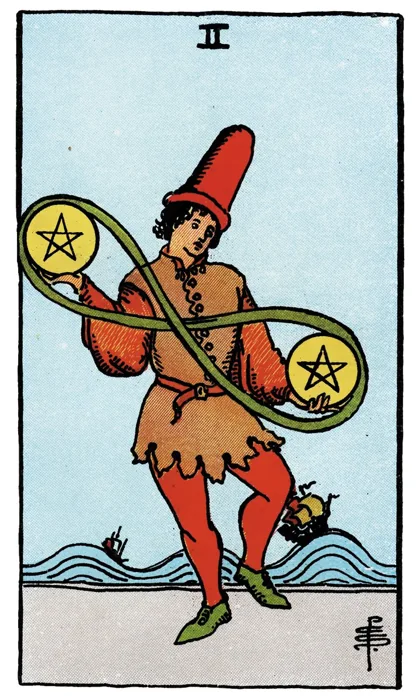
With Two of Pentacles
With the Two of Pentacles, a fixed reserve meets changing demands. Identify what must remain protected and what can be adjusted. A workable rhythm needs both a secure foundation and some flexibility; treating every resource as either entirely untouchable or freely available misses the useful distinctions between them.

With Five of Pentacles
With the Five of Pentacles, caution may be connected to real hardship or exclusion. Take material conditions seriously before interpreting the grip as greed. Reliable information and practical support may be more useful than encouragement to become less attached to resources that are genuinely necessary.
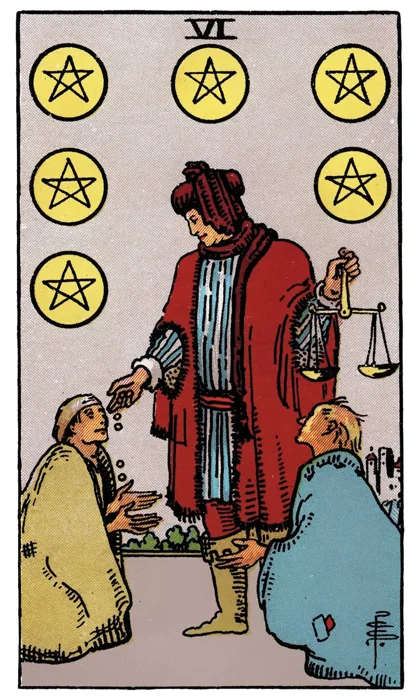
With Six of Pentacles
With the Six of Pentacles, examine the terms of giving and receiving. Generosity should respect the giver’s limits and the recipient’s autonomy. Ask whether support is freely offered, clearly agreed, or being used to create a debt of obedience that was never openly discussed.

With The Devil
With the Devil, protection may be entangled with dependence or control. Look at observable conditions: who can choose, access resources, disagree, or leave? The pairing invites scrutiny of the arrangement, but it does not prove a hidden motive or make a dramatic confrontation the right first step.

With Death
With Death, a familiar arrangement may need to change despite the wish to preserve it. Identify what can no longer continue and what underlying value can be protected in another form. Let practical preparation and acknowledgement of loss accompany the change, rather than demanding immediate enthusiasm.
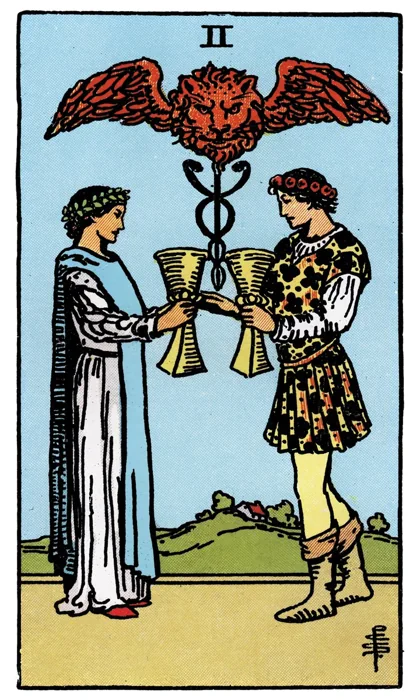
With Two of Cups
With the Two of Cups, closeness and personal boundaries need a shared understanding. Discuss what is individual, what is mutual, and what reassurance is reasonable. A bond becomes more secure when both people retain meaningful choice, rather than when one person succeeds in removing every uncertainty.

With The Emperor
With the Emperor, stability can be supported by clear structure and ownership. Review whether the rules serve the people they are meant to protect. A dependable system allows appropriate adaptation; a rigid one may preserve its original form while making ordinary life increasingly difficult within it.

With Nine of Pentacles
With the Nine of Pentacles, consider whether you are able to enjoy the independence or comfort you have worked to establish. Stewardship remains important, but the resource should reach your life in some usable form. Achievement need not be kept permanently behind glass to remain respected.
The locked pantry and the carefully kept key
A pantry is stocked for a difficult season. The reserve is useful because there may be real need ahead. If nobody is ever allowed to use it, preservation has become detached from its purpose. The Four asks when protection supports life and when the rule of keeping begins to outrank the reason anything was kept.
A person carries the key to a room that is finally their own. They have good reasons to choose who enters. Over time, they may also decide whom they want to welcome. The right to close the door and the freedom to open it belong to the same person; neither must be surrendered to prove the other is real.
A museum preserves an object so carefully that it can no longer be seen, studied, or understood. Sometimes exceptional protection is necessary. Sometimes the institution has lost sight of why preservation matters. This image captures the card's wider question: what relationship between keeping and use allows value to remain alive?
Test one small degree of flexibility
Choose a low-stakes area where your grip feels stronger than the current situation may require. Write what you are protecting and what would count as an acceptable experiment. Keep essential resources, privacy, and safety outside the exercise. The aim is not to expose yourself dramatically, but to learn something about a specific limit.
Try the bounded change and review what actually happened. Did the feared cost occur? Did anything become easier or more enjoyable? Perhaps the original boundary remains appropriate; perhaps a little room is now available. The Four of Pentacles becomes more useful when protection is a choice you can assess, rather than a position your whole life must hold indefinitely.
Artwork & interpretation
The historical description emphasises holding possessions. This original essay examines both the legitimate need for security and the costs of an inflexible grip, without treating conservation as inherently wrong or giving financial instructions. A. E. Waite, The Pictorial Key to the Tarot: Four of Pentacles.
The symbolic associations and examples offer ways to read a situation. They do not establish another person’s thoughts or fix an outcome.
A boundary can protect your life; a grip that never relaxes can begin to organise the whole life around protection.
Use the cards in a spread →