Major arcana · 4
The Emperor
The arrangements people need to be able to trust
The Emperor gives an intention a structure people can rely on. An agreement establishes a boundary, and someone takes responsibility for maintaining it. The danger comes when preserving that structure takes precedence over the people it serves.
- Authority
- Structure
- Responsibility
- Boundaries
14 min read
In this guide
Someone has to stand behind the decision
A difficult situation can contain plenty of goodwill and still need someone to decide what happens next. An agreement needs someone to take responsibility for keeping it. That becomes especially apparent when maintaining a limit is inconvenient. The Emperor enters where intention needs a dependable shape, and where a decision must outlast the mood in which it was made.
In a reading, the Emperor can concern how authority is exercised within an arrangement. Clear responsibilities and boundaries can offer people protection they are able to rely on. A scattered situation may benefit from a clear plan and an accountable person. The card asks what will make the next step reliable enough for others to build on it.
His strength is continuity. You should not have to renegotiate every basic agreement each morning or guess whether a rule will apply according to someone's temper. A good structure reduces that uncertainty. People can give more attention to what the arrangement supports, whether that is their work or the daily life they share.
The Emperor may describe someone whose experience helps them make difficult decisions. Their willingness to take an unpopular position can steady a group during a demanding period. You have more reason to trust that confidence when they explain how they reached a decision, including what it may cost, and remain answerable for what happens after it is put into practice.
The difficulty begins when order becomes an end in itself. An arrangement can be clear and still be unjust; a decision can be firm and still be wrong. The Emperor asks for authority that can be examined. If keeping control matters more than understanding what is happening, the structure may remain impressive while becoming steadily less useful.
The armour beneath the robe
The Emperor faces forward on a stone throne, backed by mountains. Armour shows beneath his red robe. These hard surfaces give the scene weight and suggest a position prepared to endure pressure. There is little sense of ease or casual movement. Even at rest, the figure appears ready to remain where he has placed himself.
Ram heads decorate the throne. Even without assigning an astrological system to the image, their repeated presence contributes force and insistence. They turn the seat into more than a place to rest. This is a position from which a will is being asserted, and the viewer is made aware of that assertion.
He holds an orb and an ankh-shaped sceptre. These objects mark an office, giving his authority a visible form. Yet the person and the office are not identical. A useful reading notices both: the role may require stability, while the human being occupying it still has limits, fears, preferences, and blind spots.
The exposed armour matters because it remains on while he is seated. Read symbolically, protection has become part of the ordinary posture. That can suggest readiness and resilience. It can also raise a quieter question: does this person still know when it is safe to stop defending, or has every encounter begun to feel like a challenge to the throne?
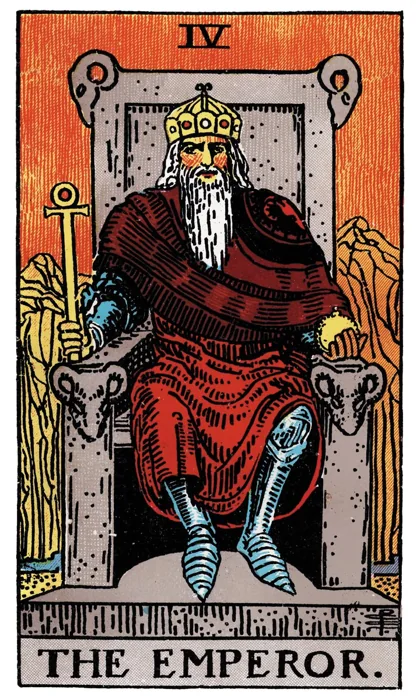
The armour remains visible beneath formal clothing. It invites a reading of reliable protection, while also raising the possibility that vigilance has become difficult to put down.
Crown and carved throne make authority unmistakable. They cannot tell us how well it is exercised; that question belongs to the decisions made from the seat.
The person everyone expects to cope
Internally, the Emperor can feel like gathering yourself and deciding to deal with what has been left vague. Making an appointment can give a postponed task a definite place in the week. Sorting its paperwork may be the next step, while another situation needs a clearly stated boundary. Relief comes from having a position you can act from, even if the whole situation remains difficult.
This state can be especially valuable after inconsistency. If other people's moods or unreliable promises have shaped your days, a dependable routine may restore a sense of room around you. The structure does not solve everything, but it means that at least some parts of life no longer need to be improvised under pressure.
As a person, the Emperor often makes others feel they can depend on him. He is direct about his responsibilities and gives people a clear sense of where they stand. It can be harder for him to ask for help or admit that a problem is beyond his experience. The competence through which he supports others may also keep them from seeing where he needs support.
Being the strong one has costs when it leaves no acceptable way to need help. You may continue issuing instructions because admitting fatigue would feel like abandoning your post. Irritation can become the only emotion you permit yourself to show: it sounds decisive, while fear, grief, or loneliness would expose more.
Maturity includes the ability to distinguish steadiness from invulnerability. You can keep a commitment while acknowledging that it is difficult. You can ask for support before the arrangement collapses. A person who knows their capacity is often more dependable than one who must continually pretend to have no limit.
Authority has to answer for its effects
The Emperor asks what gives an authority the right to be followed. A title establishes a role; it does not settle whether the person uses the role well. Experience deserves attention, but experience can also harden into certainty that no longer notices changed conditions. Trust develops through the relationship between decisions, explanations, and consequences.
There is a difference between power over an outcome and responsibility for the people affected by it. You may have the right to choose a deadline or a rule, while others carry much of its practical cost. Authority becomes more credible when those effects are visible to the person deciding, and when feedback can alter the arrangement.
A boundary also creates a space inside it. The point of a door is partly that you can close it; it is also that a life can unfold on either side. If a boundary becomes so rigid that no negotiation, care, or new information can pass through, protection may have become confinement.
The deeper task is to build something that does not require your constant domination to remain coherent. A family, team, or project matures when other people can exercise judgement within it. The Emperor's strongest achievement may be an arrangement stable enough that he no longer needs to occupy the centre of every decision.
Make the responsibility visible
At work, the Emperor often draws attention to responsibility that has never been clearly assigned. A team can contribute enthusiastically while remaining unsure who makes the final decision or how to tell when the work is complete. Agree on who owns each part of the work and where difficulties should be raised. People can then follow a proposal through to a decision without repeatedly guessing the process.
He favours plans that survive contact with ordinary constraints. A timetable should include the work nobody enjoys mentioning: review, maintenance, interruptions, handovers, and the possibility that a person will be unavailable. A plan is useful because it helps people coordinate, rather than because its neatness makes uncertainty temporarily disappear.
As a manager, this card asks whether your standards are clear and consistent. Moving expectations create anxiety even when each new request sounds individually reasonable. When the goal changes, explain what prompted the change and which requirements are now essential. People should not have to become expert readers of your mood in order to do good work.
Creative work benefits from a modest Emperor presence: a deadline, a defined scope, a place to keep materials, a decision about which version will be finished. Too much structure can flatten discovery; too little can leave every possibility permanently open. The useful frame gives the work enough resistance to take shape.
The shadow is control disguised as quality. You keep authority over small decisions and correct them before anyone has a chance to act independently. Later, you may wonder why nobody takes initiative. People learn to wait because independent action is repeatedly corrected. Delegation requires giving someone both a task and a real area in which their judgement is allowed to matter.
If you are dealing with an authority figure, attend to specific behaviour. Do they keep agreements, explain changes, and make room for relevant questions? A forceful manner can accompany excellent leadership or poor leadership. The tone alone is less informative than what happens when someone reasonably disagrees.
Stability is maintained
In material matters, the Emperor is concerned with foundations: recurring commitments, clear records, upkeep, and knowing what resources are already spoken for. This is often unglamorous work, but it reduces the number of surprises that must be handled as emergencies. An arrangement you understand is easier to revise than one you avoid looking at.
Before a major commitment, examine the obligations you would take on and who would be responsible for meeting them. Consider how the arrangement would hold up if circumstances changed. A tarot reading cannot establish whether a purchase or investment will succeed, nor assess a legal agreement. The Emperor can prompt you to read the terms carefully and seek the information needed to understand their practical consequences.
At home, stability includes maintenance as well as rules. A household needs functioning systems, but it also needs a fair account of who keeps them functioning. If one person has the final say while someone else carries the daily work, authority and responsibility have become separated. That separation often produces conflict disguised as disagreement about small details.
Material security can become a moving target. You build a reserve, then need a larger reserve before allowing any ease. You improve the home, then discover another defect that must be fixed before you can enjoy it. The Emperor benefits from defining enough, so protection does not expand until it consumes the life it was meant to secure.
Safety that leaves room for another person
In a relationship, the Emperor can represent the reassurance of a partner who follows through. An agreement still matters to them when keeping it becomes inconvenient. Their affection is evident in the practical commitments they continue to meet. This consistency can be especially valuable when past experiences have made it difficult to trust what people say they will do.
Love expressed through responsibility still needs to be recognisable to the person receiving it. Paying attention to logistics may be generous, but it does not automatically replace tenderness, curiosity, or conversation. A partner can appreciate everything you do and still feel that they rarely meet you outside the role of provider or organiser.
The card raises the question of who defines the terms. Clear expectations are helpful when they are shared. One person's preferences presented as the natural order of things can leave the other constantly negotiating for ordinary freedom. A relationship needs room for difference without treating every difference as disloyalty.
Protection becomes controlling when another person's independence is framed as a danger you alone can manage. Deciding whom they may see, what they may wear, or which choices they can make is not made caring by a protective explanation. The relevant distinction is whether your support increases their capacity to live or reduces it.
With family, the Emperor may bring inherited ideas about duty, fathers, authority, or the person who kept the household together. You can value what a figure provided while recognising what their style made difficult. Gratitude does not require repeating every rule, and criticism does not erase every act of care.
For a developing relationship, this card asks what consistency actually looks like between you. It need not mean rushing toward a formal milestone. It may begin with making clear plans, speaking honestly about availability, and allowing actions over time to establish what the connection can bear.
You cannot remain on duty indefinitely
The Emperor can suggest that steadiness has become continuous readiness. Keeping track of everything leaves you anticipating the next problem even when none is present. Disengaging can feel like leaving the gate unguarded. This may be a symbolic invitation to examine the workload and expectations around you, rather than another instruction to become more resilient.
A dependable routine can support rest as well as output. A stopping time, a handover, or an agreement about who handles interruptions may make more difference than telling yourself to unwind. If the system relies on your constant availability, the system itself needs attention. Exhaustion is not evidence that the responsibility has been taken seriously enough.
The card cannot explain symptoms or assess health. Its practical contribution is to ask whether bodily needs have a legitimate place in your arrangements. If every request from work is treated as binding while sleep, food, and recovery remain negotiable, your hierarchy of obligations may need revision.
Choose a boundary you can actually keep
As advice, the Emperor asks for a decision you can maintain in practice. Explain what you can offer and where your responsibility ends. Be clear about what you will do if the boundary is crossed, keeping the response within your control. An understandable consequence gives the agreement a firmer basis than a threat that depends on making another person change.
Put important agreements somewhere they can be revisited. Memory is selective, particularly when people are tired or disappointed. A written scope, schedule, or division of work can reduce unnecessary conflict by giving everyone the same reference point. Keep it proportionate; an ordinary agreement need not become a bureaucracy.
His shadow is rigidity in the service of pride. You continue defending a decision because changing it would look weak, even after its original reason has disappeared. Acknowledging a mistake may briefly unsettle your image while improving the actual situation. The people affected are often more interested in the improvement.
The corrective is neither abandoning standards nor making every decision collectively. It is matching authority to responsibility and keeping both open to relevant information. Some moments require a firm answer. A firm answer is stronger when it can explain its purpose without relying entirely on the fact that you gave it.
When authority fails to support the people relying on it
Reversed, the Emperor can describe an excess of control: rules multiplying, disagreement becoming dangerous, or a leader treating every question as a personal challenge. The arrangement may look organised from the outside while people inside it spend their energy avoiding blame. Order maintained through fear can conceal how little trust remains.
The opposite pattern is absent authority. A difficult decision keeps being postponed as responsibility passes from one person to another. Everyone waits for someone else to make the call. A person may hold the title without performing the work of the role. The result is instability beneath a reassuring organisational chart or family story.
Internally, the reversal can concern your relationship with your own authority. You know what you need to decide but keep seeking permission from someone unlikely ever to grant it. Taking responsibility may involve making a reasonable choice before you feel fully entitled to do so, then accepting that other people may not approve.
There is also rebellion that remains organised around the thing it opposes. You reject every suggestion of routine or commitment because it resembles an earlier controlling environment. The resistance is understandable, yet it can leave you without structures you would freely choose. A self-authored rule may support freedom differently from an imposed one.
Sometimes this reversal is the welcome softening of an overdefended position. A leader shares power, a parent listens differently, or you allow yourself to be helped. Authority does not disappear merely because it becomes less armoured. It may become more responsive, and therefore more capable of meeting the situation as it is.
What does the structure need to answer?
These pairings explore how authority behaves under different pressures. Read them against the position in the spread and the actual arrangement you are considering.

With The Empress
With the Empress, a dependable structure needs warmth and material care. A plan can make growth possible, while attention to real needs keeps the plan humane. Look for a division of responsibility that allows both firmness and tenderness to belong to everyone.
With The Hierophant
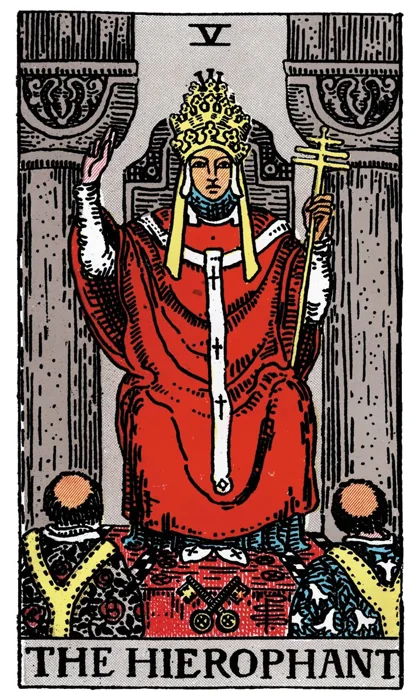
With the Hierophant, personal authority is reinforced by an institution or tradition. This can provide continuity and clear standards. It can also make an arrangement difficult to question because the person deciding presents their preference as something larger than themselves.

With The Chariot
With the Chariot, organisation becomes directed effort. A clear objective and disciplined coordination may help a difficult undertaking. Check that determination still responds to conditions; increasing force is not always the best answer when the route itself needs reconsideration.

With Justice
With Justice, someone in authority must be able to explain a decision and accept scrutiny. Examine the evidence behind it and whether the standards apply equally to everyone affected. The pairing can prompt a closer look at accountability, though it cannot predict the outcome of a legal case.
With The Tower
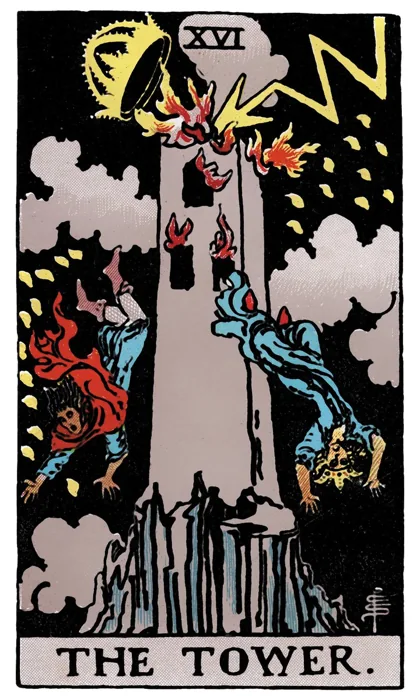
With the Tower, an established arrangement may be under visible strain. Examine the fault rather than treating every warning as a threat to stability. The pairing can support deliberate repair or revision before preserving appearances becomes more important than addressing the problem.
With Four of Pentacles
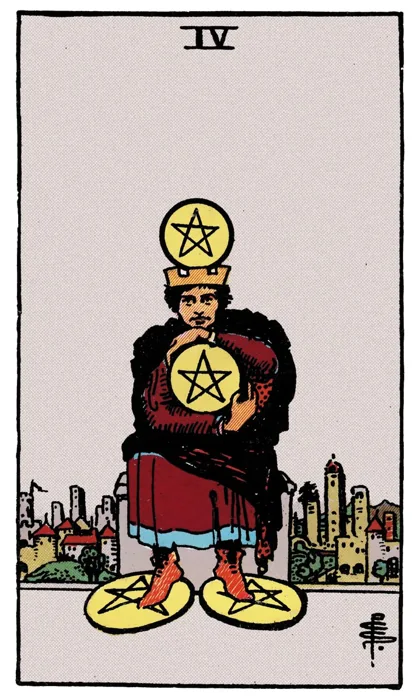
With the Four of Pentacles, security may be turning into a tight grip. Resources, roles, or decisions are guarded so closely that adaptation becomes difficult. Identify what truly needs protection and what could be shared without endangering the foundation.

With King of Swords
With the King of Swords, clear judgement and formal authority become prominent. This can help establish a consistent standard. The danger is an arrangement that is impeccably reasoned but inattentive to the people who must live with its effects.
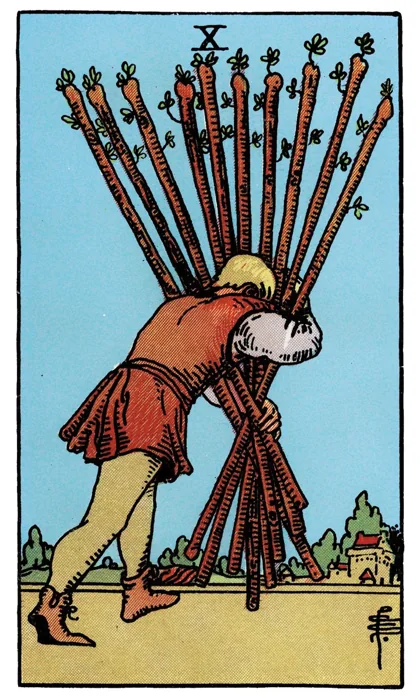
With Ten of Wands
With the Ten of Wands, responsibility has accumulated around one person. Some of it may be necessary; some may remain there because delegation feels risky. A sustainable handover requires clear expectations and enough trust for someone else to work differently.
The builder and the keeper of the keys
The builder is an Emperor figure because an idea must answer to weight, sequence, materials, and use. A beautiful plan does not excuse a weak foundation. The achievement is something other people can inhabit without needing to understand every decision that keeps it standing.
The keeper of the keys offers a more ambivalent image. Access has to be managed, and someone must take that duty seriously. Yet holding the keys can become a source of identity: every request confirms that you are necessary. Good stewardship eventually asks which doors need a keeper and which could simply be left open.
The parental archetype belongs here in its broadest sense: the person who provides a dependable frame while another person develops. Its success is measured partly by increasing independence. A protector who cannot tolerate the protected person's growth may have begun to confuse love with remaining indispensable.
Make one arrangement dependable
Choose an area in which ambiguity repeatedly creates friction. Write down the decision needed, the person responsible, the limits of their authority, and when the arrangement will be reviewed. Keep the answer short enough that everyone affected can understand it without an interpretation.
Then check the human cost. Who performs the work, who benefits, and who has a route to raise a problem? Adjust the arrangement where those answers do not match your intention. The Emperor's practical achievement is something people can rely on — including when they need it to change.
Artwork & interpretation
Waite describes the ankh-shaped sceptre, orb, ram-headed throne, and the figure’s association with executive power and realisation. This guide reads those images through contemporary questions of dependability, boundaries, leadership, and accountable authority. A. E. Waite, The Pictorial Key to the Tarot: The Emperor.
The symbolic associations and examples offer ways to read a situation. They do not establish another person’s thoughts or fix an outcome.
A structure earns trust by supporting life within it. Its mere survival is not proof that it still works.
Use the cards in a spread →