Swords · King
King of Swords
The responsibility that comes with being believed
The King of Swords makes decisions that affect other people. Clear standards help him explain a difficult situation and justify the authority he exercises. That authority needs to remain open to challenge. When his interpretation becomes final by default, the people living with its consequences lose the chance to contribute information he may have missed.
- Reasoned authority
- Clear standards
- Accountability
- Strategic judgement
16 min read
In this guide
Someone has to make the call
A room has enough opinions and still lacks a decision. The King of Swords brings attention to the relevant facts and the standard that should guide whoever is responsible for choosing. This card brings structure to thought when indefinite discussion has become its own difficulty. Its authority is useful because a reasoned decision allows people to act, plan, and know what they can expect.
Upright, the King can describe sound judgement, professional expertise, strategic thinking, clear communication, or a role in which impartiality matters. He is concerned with principles that can be applied beyond a single mood or favourite person. The aim is not to eliminate human complexity, but to make decisions that can survive being explained to the people who must live with them.
As a court card, he can represent a person, a responsibility, or a quality you need to develop. He is not restricted to a gender, age, or profession. You may embody the role when moderating a discussion, assessing a proposal, setting a fair rule, or deciding between competing obligations. What matters is that your judgement influences more than your immediate preference.
The King differs from the Queen's personal discernment by placing greater emphasis on shared standards and responsibility for a wider system. The distinction is interpretive, not a hierarchy of intelligence or worth. One may clarify the boundary around a life; the other may establish the process through which several lives can cooperate without depending on one person's changing disposition.
The card can favour seeking relevant expertise, but it does not tell you that any confident authority is correct. Ask what qualifies the person for this question, what information they are using, and whether they acknowledge the limits of their knowledge. Expertise becomes more credible when it can distinguish a firm conclusion from a provisional one.
Its practical invitation is to make the basis of a decision visible. State the issue, identify the evidence, explain the criteria, and accept responsibility for the outcome. You need not satisfy every preference. You do need to avoid hiding a personal preference inside the language of an objective necessity when alternatives genuinely exist.
Authority faces the viewer
The King sits facing forward on a tall carved throne, sword raised in one hand. His blue robe falls across the seated body, with warmer colours at the edges. Clouds occupy parts of the sky and birds appear in the distance. The frontal pose differs from the Queen's profile: this figure presents authority directly to whoever approaches.
The King holds his sword ready without striking. It gives authority a visible form: a judgement could be put into effect. Consider where that authority comes from in your situation. Someone may have power through expertise or an appointed role, and still need to justify a particular decision. Having the right to enforce a standard does not settle whether the standard is fair.
The throne's height and carved details create a sense of continuity beyond the current decision. Institutions, precedents, and accumulated knowledge can support judgement in this way. They can also make it harder to notice when an inherited rule no longer fits the circumstances. Stability deserves attention without becoming an exemption from review.
The King's direct gaze can be read as an invitation to speak plainly. Yet it also raises the question of who feels able to answer. A person in authority may imagine that everyone is free to object because no objection has been explicitly forbidden. Good judgement notices how the setting, dependence, and consequences affect what people can safely say.

The frontal posture makes the role visible. Ask who can speak in this setting, who bears the consequences, and whether the person deciding has created a real opportunity to hear information that might challenge them.
The held blade suggests judgement that can be acted upon. A useful standard needs a clear purpose, relevant evidence, and an appropriate limit; the power to enforce it does not by itself make it just.
Thinking clearly when the choice will affect someone
The inner King seeks a position that can be defended beyond the emotional weather of the moment. You want enough understanding of the problem to compare alternatives and reach a decision that will not change with every reaction. This can be a stabilising capacity, especially when others are anxious or the consequences are significant. Someone's composure can make a difficult matter easier to examine.
As a temperament, the King may be articulate, principled, reserved, and attentive to inconsistencies. They value competence and often show care through reliable judgement rather than overt reassurance. A useful answer, a well-designed process, or a problem prevented may be their way of saying that your wellbeing matters. That care is easier to receive when it does not assume practical help is the only kind anyone needs.
The private difficulty may be uncertainty about how to exist without being the person who knows. If others rely on your judgement, admitting confusion can feel like surrendering the role that makes you valuable. Yet expertise does not require universal competence. Naming the boundary of your knowledge may be one of the most responsible uses of authority available.
You may also be trying to think your way out of a feeling that deserves acknowledgement. Analysis can clarify causes and choices, but it cannot always perform the work of grief, disappointment, or longing. You can understand why something happened and still be affected by it. The King's maturity includes knowing which kind of attention the present experience requires.
At his strongest, this card describes internal authority that does not depend on constant agreement. Criticism of a decision no longer has to feel like an attack on your right to exist. You can hear it and use it when reviewing the result. Your self-respect rests partly on the quality of your process, including your willingness to correct it when it produces a poor outcome.
A principle must survive its application
The King asks what makes authority legitimate. Confidence, intelligence, and a formal title can all influence whether a person is believed, but none guarantees a fair decision. Legitimacy grows through relevant knowledge, transparent reasoning, appropriate limits, and accountability. The person affected should not have to rely entirely on the decision-maker's private assurance that they meant well.
Impartiality does not always mean ignoring differences. Applying the same rule to people in materially different circumstances can produce unequal effects. A serious standard asks which differences are relevant and why. The aim is neither automatic exception nor mechanical sameness, but a reasoned account of what fairness requires in the actual case.
The card also explores abstraction. A category helps us organise experience, but a person is never exhausted by the category used to make a decision about them. Efficient systems can forget this, especially when their language makes the human consequences sound distant. The King is responsible for keeping the model connected to what happens outside the model.
His deeper discipline is the right to appeal. A decision can be firm without being beyond correction. If no evidence could change your view and no affected person can challenge the process, authority has become self-protective. Good judgement builds a way to learn from its consequences rather than requiring everyone else to absorb them silently.
Build a process that does not depend on reading your mood
At work, the King supports strategy, governance, evaluation, and decisions requiring clear ownership. Define the objective, the relevant constraints, and the criteria by which alternatives will be assessed. A visible process reduces the need for people to guess what the most senior person secretly prefers. It also makes disagreement more useful because participants can question the grounds rather than speculate about motives.
For leadership, consistency is a form of care. People need to know what is expected before their performance is evaluated. Keep those standards consistent, while distinguishing a lack of skill from a problem with conduct. People may still dislike a decision, but they are better able to respond when its basis can be understood and applied.
The King can represent a specialist whose advice is valuable because it is grounded in relevant experience. Choose expertise suited to the question. Someone excellent in one domain may still be guessing in another. Ask what is known, what remains uncertain, and which assumptions would materially change the recommendation. A good adviser can tolerate those questions.
In project work, strategy means choosing what not to pursue as well as what to do. Establish priorities that correspond to actual capacity, then make trade-offs explicit. If every goal remains equally important, the conflict has merely been transferred to the people doing the work. Authority includes accepting responsibility for limits rather than demanding that others overcome them through effort alone.
For creative work, the King can help organise a large structure: the argument of a book, the logic of a world, the purpose of each section. Use that clarity to support the material, not to flatten everything into a demonstration of your thesis. Art may contain ambiguity that is intentional and productive. A strong structure can hold it without forcing every element to deliver the same conclusion.
The shadow is expertise used to close discussion. Jargon, formal procedure, or selective evidence can make a preference appear unchallengeable. If you hold authority, invite relevant objections before the decision becomes costly to reverse. If you are subject to it, ask for the rationale and available review process through an appropriate channel. Clear questions can reveal where the actual discretion lies.
Do not chair every conversation
In relationships, the King can bring reliability, directness, intellectual companionship, and a strong sense of responsibility. Someone may show affection by remembering the practical problem, giving a considered answer, or making an agreement that remains dependable under pressure. This can feel deeply safe when it is offered alongside respect for the other person's separate judgement.
The difficulty arises when one partner becomes the permanent interpreter of reality. Their definition of reasonableness determines which feelings receive attention. They may also assume the right to end the discussion whenever they consider it settled. Even accurate observations can become controlling within that arrangement. A relationship needs more than a competent chair; it needs both people to have standing as participants in defining their shared life.
For conflict, agree on the issue before arguing the solution. Separate observable events, individual interpretations, and requests. This can make a difficult exchange less confusing, provided the structure is mutually useful. Do not use procedural neatness to dismiss the person who needs time, speaks less fluently, or cannot organise their feelings into a polished case on demand.
When asking about feelings, the King cannot tell you that someone is emotionally unavailable or secretly devoted. Reserved expression has several possible meanings. Look for how the person responds to needs, honours commitments, and allows your influence in decisions. Composure is attractive when it creates room for both people; it is isolating when it turns one person's account into the only admissible one.
In family or caregiving roles, authority may be real and necessary. Its use still benefits from explanation, proportion, and attention to the dependent person's voice. A limit can be firm while acknowledging disappointment. Being responsible for a decision does not require pretending that the person affected has no meaningful perspective on it.
The more mature relational King can say that he has an opinion without turning it into a ruling. He asks whether advice is wanted, recognising that the other person knows their own experience. He can stay with them even when there is no efficient solution to offer. This expands rather than diminishes his competence. He learns how to be trusted without always being in charge.
Understand the terms and the authority behind them
In money or contractual matters, the King favours careful documentation, clear responsibilities, and relevant professional advice. Know which decision you are making and which facts affect it. The card itself cannot determine whether an agreement is lawful, affordable, or advantageous. Its value is in encouraging a process that obtains those answers from the appropriate sources.
Shared resources need more than a confident person willing to manage them. The people affected should understand the arrangement and have suitable access to information. Competence can justify taking on an administrative role; it does not automatically justify excluding everyone else from meaningful decisions. A clear system should remain intelligible beyond the person who created it.
At home, structure may be useful: agreed responsibilities, predictable routines, or a way to handle recurring decisions. Keep the purpose visible. A household rule should serve the people living there rather than becoming a test of obedience to its author. Review it when circumstances change, especially if one person's efficiency creates another person's invisible burden.
The shadow is allowing measurable benefits to erase less measurable costs. Choosing the cheapest option may cost more time, just as making a space perfectly orderly may leave it unwelcoming. Even a division that looks fair on paper may overlook differences in what each person can manage. Good judgement includes the relevant human consequences, even when they cannot be expressed as neatly as a price or a timetable.
Keep judgement available by giving it limits
The King may appear when many people depend on your decisions. Every question reaches you, and the role gradually expands until little attention remains for your own life. Consider which decisions genuinely require your involvement and which could be delegated through clearer standards. Sharing authority can improve a system instead of weakening it.
A habit of constant assessment can follow you into rest. You keep assessing the day's efficiency, extending that judgement to how well you use your leisure. Even a feeling has to justify itself before you allow it any room. Some experiences are more nourishing when they are not immediately submitted for review. The mind's capacity to judge is useful; it need not occupy every room.
If a decision is important, create conditions in which you can think about it properly. Gather the relevant material, allow sufficient time, and consult where needed. The card does not require instant certainty. A deliberate process often communicates more competence than a quick answer designed mainly to prevent anyone from noticing that you needed to consider it.
Make your reasoning available
For one consequential decision, state the criteria before defending the outcome. What matters, which facts support the choice, and what uncertainty remains? This helps distinguish a reasoned conclusion from an attractive explanation constructed afterwards. It also gives other people a meaningful place to contribute information that may improve the decision.
Identify the limits of your authority. Which parts are yours to decide, which require agreement, and which belong to someone else? Taking responsibility includes respecting those boundaries. A person can be highly capable and still overstep by solving a problem they were not asked or authorised to solve on another person's behalf.
The shadow is confusing being right with being entitled to govern. Even a sound judgement may concern a choice another person has the right to make differently. Use clarity to inform, negotiate, and decide where the responsibility is yours. Let it stop short of treating everyone else's autonomy as an error in need of correction.
When authority protects itself from the facts
Reversed, the King can describe rigid judgement, selective reasoning, manipulative use of expertise, or a standard applied differently according to who benefits. The language may remain calm and persuasive while the process becomes unfair. Look at what evidence is admitted, who can question the decision, and whether the same principle is used when it becomes inconvenient to the person in charge.
Another expression is abdication. A decision-maker avoids choosing, leaving others to carry incompatible expectations or guess what will later be judged correct. The reversal may call for accepting responsibility more clearly: make the trade-off, explain it, and provide a route for review. Endless neutrality can conceal a real decision to let the current imbalance continue.
It can also indicate overanalysis. You keep refining the model because acting would expose it to consequences. No decision can remove all uncertainty. Identify the information necessary for a reasonable choice, the risks that remain, and how the result will be monitored. A bounded decision with a review point may be more responsible than indefinite postponement.
Where authority has become harsh, repair requires changing the process as well as the tone. A warmer explanation does not fix an arrangement in which nobody else can influence the outcome. Restore access to relevant information, clarify rights and responsibilities, and make correction possible. Trust grows through observable conditions, not simply a new statement of good intent.
The constructive reversed King becomes more teachable. Once his identity is less dependent on the role, he can admit the limits of his expertise. The people affected can then contribute what his account has missed. Authority can then become less theatrical and more dependable. It no longer needs to appear infallible in order to do useful work.
What makes the decision trustworthy?
These pairings explore expertise, fairness, and the reach of authority. They invite examination of real processes and conduct rather than assigning a diagnosis or motive to a person represented by a court card.
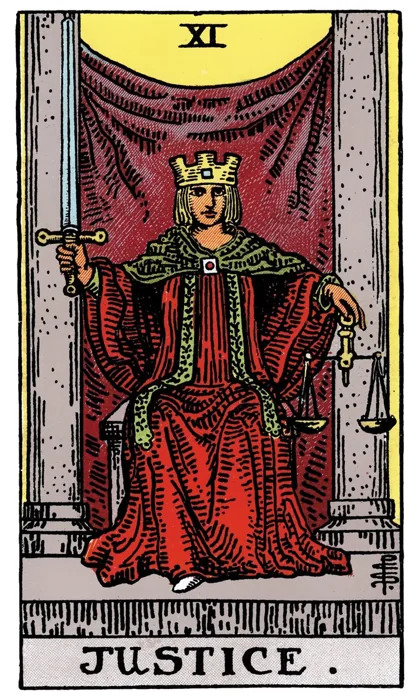
With Justice
With Justice, examine both the decision and the process that produces it. Criteria, evidence, proportionality, and a route to challenge matter. The pairing can support accountability, but it should not be treated as a guarantee that a formal authority or your preferred outcome is automatically fair.
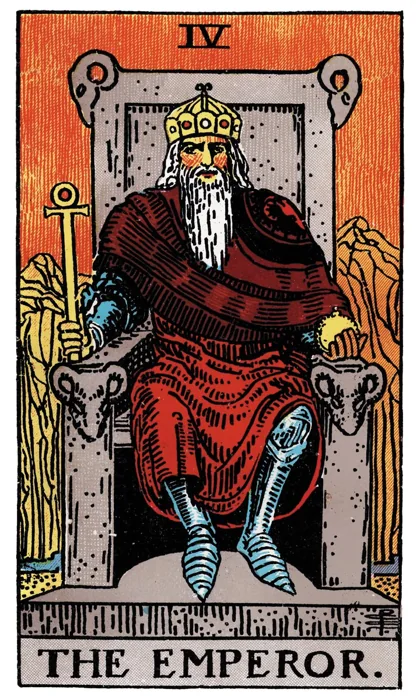
With The Emperor
With the Emperor, intellectual authority meets organisational power. Clear responsibilities can make a system dependable, provided the rules remain answerable to their purpose. Watch for a structure that protects its leaders from criticism while asking everyone else to demonstrate responsibility without having meaningful discretion.

With The Hierophant
With the Hierophant, expertise may operate through an institution or tradition. Learn the relevant procedure and distinguish established knowledge from unquestioned custom. A respected framework can support good judgement while still containing assumptions that deserve examination under the present circumstances.
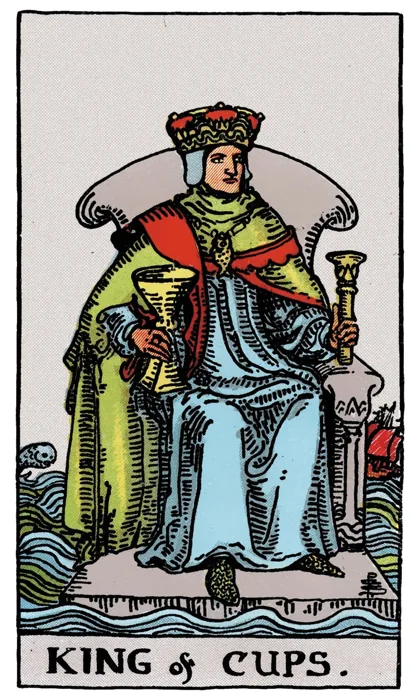
With King of Cups
With the King of Cups, considered judgement benefits from emotional steadiness and awareness of human consequences. You can acknowledge distress without surrendering the decision to it. Equally, a calm process should not make people prove their feelings irrelevant before their practical needs can be heard.
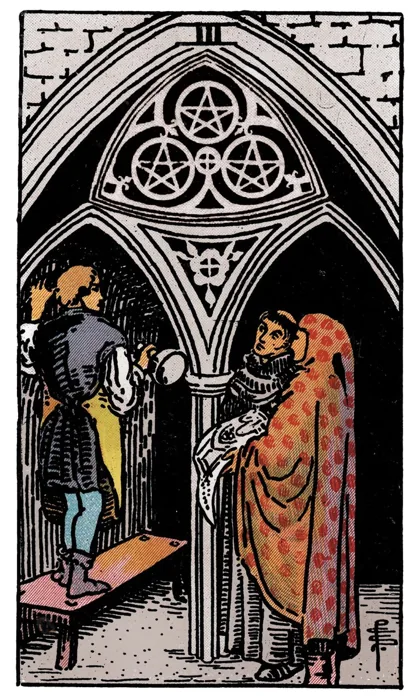
With Three of Pentacles
With the Three of Pentacles, a strong decision needs the knowledge of the people doing the work. Invite expertise from different roles before finalising the plan. Leadership becomes more useful when it coordinates those contributions rather than treating consultation as a courtesy after the real choice has been made.
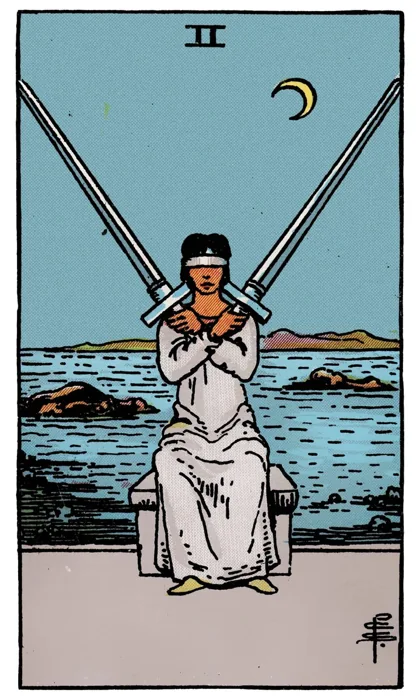
With Two of Swords
With the Two of Swords, the missing piece may be a decision criterion rather than another opinion. Identify what would make one option preferable and what information remains unavailable. If uncertainty cannot be eliminated, consider a limited choice with a review point rather than waiting for perfect certainty.

With The Devil
With the Devil, examine whether authority or expertise is being used to create dependence. Can people obtain information, disagree, and leave the arrangement without improper pressure? Ground the concern in observable conditions. The cards invite scrutiny; they do not prove that a particular person is manipulating you.

With King of Wands
With the King of Wands, a larger vision needs a coherent strategy and clear accountability. Let ambition define a worthwhile direction while analysis tests its feasibility and consequences. Neither inspiration nor logic should become a reason to exclude the people whose effort and lives will make the plan real.
Authority that remains open to correction
A judge listens to competing accounts under rules intended to keep personal preference from deciding the case. The role is powerful because the decision has consequences. Its integrity depends partly on whether evidence can be tested and error can be challenged, rather than on the judge's private conviction of being a fair person.
An architect draws a structure that other people will inhabit. Elegant reasoning on paper must answer to materials, use, and the lives moving through the finished space. The King's strategic mind becomes responsible when it remains interested in that lived result, including inconveniences the original plan did not anticipate.
A teacher explains the standard and then listens when a student identifies an ambiguity. The correction does not destroy the teacher's authority. It demonstrates what the authority is for: making understanding possible, rather than preserving a performance in which the teacher must always have been right first.
Give one decision a clear basis and a review point
Choose a manageable decision that affects more than your immediate mood. Write the aim, two or three relevant criteria, and the facts you are using. Identify one person or source that could reveal a blind spot. Make the decision within the authority you actually have, and communicate the part others need to understand.
Set a proportionate point for review. What outcome would show that the decision is working, and what would justify changing it? The King of Swords becomes trustworthy through this combination of clarity and accountability. You can make a firm choice today without requiring tomorrow's evidence to flatter it.
Artwork & interpretation
The historical image associates the seated sword-bearer with judgement and authority. This original essay examines standards, expertise, and accountability without treating rank, gender, or professional status as evidence of moral correctness. A. E. Waite, The Pictorial Key to the Tarot: King of Swords.
The symbolic associations and examples offer ways to read a situation. They do not establish another person’s thoughts or fix an outcome.
A decision becomes more trustworthy when the person making it can explain its grounds and hear a challenge.
Use the cards in a spread →