Pentacles · Three
Three of Pentacles
Good work becomes possible between people
The Three of Pentacles brings people with different knowledge into a shared piece of work. A plan becomes more useful when the person making it can speak with the person carrying it out. Good collaboration needs clear expectations about the finished result. It also needs an agreement about how each contribution will be recognised.
- Craft
- Shared expertise
- Constructive feedback
- Recognition
16 min read
In this guide
The person with the tools belongs in the conversation
A plan meets the person who knows how to make it. When a client explains what they need, a colleague may notice a constraint that changes how it can be made. The work improves because both perspectives can influence it. The Three of Pentacles is about this productive meeting of knowledge. It does not merely celebrate being in a group. It asks what the group makes possible that would be harder to achieve separately.
Upright, the card can describe skilled work, collaboration, apprenticeship, constructive assessment, and recognition of competence. Something is being built or refined through attention to standards. The result matters, and so do the people whose effort produces it. A useful interpretation looks at roles, communication, resources, and whether expertise reaches the decisions it ought to influence.
The Three can appear early in a project, when an idea needs a workable plan, or later, when feedback can improve what already exists. In both cases, the task is to make the work visible enough to discuss. A sketch, sample, draft, or demonstration gives people something more precise to respond to than a general promise of quality.
Recognition is part of the card, but it need not mean applause. Being consulted, trusted with responsibility, credited accurately, or paid for skilled work can all be meaningful forms of recognition. Notice whether praise is accompanied by conditions that respect the contribution. Appreciation becomes thin when it substitutes for resources or leaves the maker without a voice in decisions affecting the work.
The card does not assume that collaboration is automatically pleasant. Different expertise can produce disagreement because people see different risks. That can be useful when the disagreement remains connected to the task and participants have a fair way to resolve it. Harmony that requires suppressing the most relevant objection may produce a smooth meeting and a poor result.
Its invitation is to build a working relationship around the thing being made. A clear purpose helps identify whose knowledge is needed. Together, agree how you will judge whether the result fulfils that purpose. You do not have to make everyone interchangeable. The strength lies in contributions that remain distinct enough to add something the others could not supply alone.
Three people beneath a carved arch
Inside a stone building, a craftsperson stands on a low platform with tools, facing two other figures. One of the standing figures holds a plan or drawing. Above them, three pentacles are worked into the architectural decoration. The scene places practical labour, consultation, and a larger structure in the same frame.
The raised platform is functional: it gives the worker access to the task. It also brings the craftsperson into a visible position in the conversation. A contemporary reading can see respect for embodied knowledge here. The person who encounters the materials directly may know something the plan cannot reveal from a distance.
The drawing gives the discussion a shared reference. Instead of relying entirely on private images of what the result should be, participants can point to something. This matters in everyday collaboration. A clear example, brief, or draft can expose differences in understanding before they become expensive disagreements about a finished product.
The arch suggests that individual acts contribute to something larger than a single gesture. A building must hold together across many decisions and kinds of work. Read the pentacles integrated into its decoration as an image of skill made visible in the result. Quality is not simply announced; it is present in how the parts meet.

The worker is part of the conversation, not merely a pair of hands carrying out a completed idea. Ask whether practical expertise can influence decisions before the consequences become difficult to change.
A drawing gives the participants something to point to. In your own work, a brief, sample, or clear standard can reveal differing assumptions early enough for the group to improve them together.
Let your competence be seen before it is perfect
The inner Three often concerns the wish to be taken seriously for what you can do. Practice has taught you to notice details and make judgements that someone seeing only the finished surface may never recognise. Recognition can feel particularly meaningful when another person understands the actual difficulty of the work instead of offering a vague compliment detached from it.
As a temporary way of being, the card may describe conscientiousness, teachability, and pride in craft. You want to make something sound, useful, or well-finished. That pride need not be vanity. Caring about quality can be a form of respect for the people who will encounter the result and for the time you have spent learning how to produce it.
Showing unfinished work can feel exposing when you take pride in being competent. A comment on the draft may sound like a judgement about whether you deserve to be doing the job. Yet this is the stage at which feedback can become part of making the work. Invite it while changes are still possible, with a clear explanation of which questions would help you proceed.
You may also be learning to receive help without diminishing your contribution. Another person's skill does not make your own less real. A good collaboration can increase the quality of the whole while making each person's strengths more visible. The question is whether the relationship supports mutual respect or uses assistance to establish a permanent hierarchy of worth.
The stronger personal expression includes knowing what you know and where you need another perspective. You can explain why a detail matters while remaining willing to hear about a constraint you missed. Confidence and teachability become compatible because your value no longer depends on being the only person in the room with something useful to offer.
Quality is partly a social achievement
The Three challenges the fantasy of the entirely solitary maker. Even work done alone often depends on inherited techniques, tools made by others, teachers, readers, or the conditions someone else maintains. Recognising these contributions does not erase individual effort. It gives a more accurate account of how skill enters the world and why access to good support matters.
It also asks what counts as knowledge. Formal expertise, practical experience, and the user's understanding of a need may each reveal a different part of the problem. A hierarchy that hears only one of them can make preventable mistakes while remaining very confident. Good collaboration brings relevant knowledge into contact without pretending all claims are equally informed about every question.
The card's ethical subject is credit. Who is named, who is paid, who is consulted, and who becomes invisible once the result is admired? Shared work requires an account of contribution that does not automatically favour the most fluent speaker or the person with the highest status. Recognition should follow the work, not merely the position from which it is presented.
Its deeper promise is a form of belonging based on participation. You do not have to resemble everyone else to have a place. What you bring contributes to a result that also depends on others. Learning what they can offer helps you find a place alongside them. This is cooperation with substance: a shared purpose supported by clear, respectful differences.
Agree on what good work means before reviewing it
Work is the Three's most direct setting. Begin with the purpose and the criteria. Who will use the result, what must it do, and which constraints matter? A shared understanding of quality prevents review from becoming a contest between unstated preferences. It also helps distinguish a necessary revision from an optional change in taste.
Bring relevant people into the process early enough to influence it. The person who builds, teaches, maintains, or uses the result may identify a problem while it is still inexpensive to address. Consultation after every important choice has been fixed is often only a performance of inclusion. Genuine collaboration allows information to change the plan.
For a learner, the card supports apprenticeship and feedback tied to practice. Make an attempt, compare it with a clear standard, and ask about the specific part you do not yet understand. A good teacher can identify the next useful adjustment rather than overwhelming you with every difference between your current work and expert performance.
For a manager or client, respect craft by providing a usable brief, sufficient resources, and timely decisions. Repeatedly changing the goal while praising flexibility does not create the conditions for quality. If the scope changes, discuss the consequences. The person doing the work should not have to absorb every new requirement invisibly to remain regarded as professional.
In creative work, choose feedback suited to the stage and purpose. An early structural question differs from a final proofread. A reader who is excellent at one may be unhelpful at the other. Tell collaborators what kind of response you need, and assess suggestions by whether they improve the intended work rather than whether they would produce someone else's preferred work.
The shadow is collaboration without ownership. The maker receives incompatible instructions because everyone can comment but nobody takes responsibility for a decision. Establish who is accountable for the final choice and how disagreements will be resolved. Clear authority can support cooperation when it incorporates expertise and accepts responsibility, rather than becoming an excuse to ignore every inconvenient contribution.
A shared life has practical joints
In relationships, the Three can describe building something together: a household, a routine, a project, or a more workable way of handling recurring difficulties. Love is expressed through participation. Each person learns what the shared life requires and contributes enough attention that the other is not left managing the whole arrangement alone.
For a new connection, notice how you cooperate on small things. Can you make a plan, adjust when something changes, and listen to each other's preferences? These ordinary exchanges reveal a kind of compatibility that attraction alone cannot establish. A relationship becomes easier to trust when both people can influence the practical terms under which it develops.
In an established partnership, the card can invite a conversation about roles. Perhaps a division once made sense but no longer fits current work, capacity, or needs. Review it as an arrangement that can be improved, rather than treating every request for change as an accusation that the past was entirely unfair. A shared system should be allowed to learn.
Outside support may be useful when both people want to improve a pattern but cannot see it clearly from inside. The card can prompt consideration of an appropriate facilitator or professional, without guaranteeing that one particular form of help will solve the problem. Good support preserves the participants' agency and helps them make their own workable agreements.
The Three does not establish a third romantic person or infidelity. Its three figures depict participation in a task, and relationship readings should not turn a number into an accusation. If there is a concrete concern about trust, address the evidence and the agreement directly. The card's broader question is who contributes to the relationship and how outside influences are handled.
The shadow is making partnership feel like a perpetual performance review. Practical competence matters, but a person is more than their usefulness. Leave room for affection, play, and being together without a task to optimise. Collaboration supports intimacy best when it creates conditions in which both people can live, not a system in which every moment must earn approval through productivity.
Skilled work needs clear terms
In financial and practical exchanges, the Three asks how value and responsibility are agreed. If you are commissioning work, clarify scope, timing, standards, and what happens when requirements change. If you are providing it, make the contribution understandable and discuss terms before assumptions become obligations. Actual contracts or substantial financial decisions may require appropriate professional advice.
The card can prompt reflection on whether expertise is recognised materially as well as verbally. Exposure, gratitude, or the pleasure of participation may have value in some arrangements, but they should not silently replace an agreed payment or fair share of resources. A clear exchange allows people to choose with a better understanding of what they are giving and receiving.
At home, the Three favours projects that benefit from the right skills. Some tasks can be learned; others need a qualified person. Assess the actual requirements rather than making self-sufficiency a test of worth. Knowing when to ask for expertise is part of practical judgement, especially where errors could create serious consequences.
Shared spaces also need a shared brief. What should the room make possible, whose needs are being considered, and what constraints apply? A beautiful result may still fail if it serves only the person who planned it. Consult the people who use the space in ordinary life; their experience is information about whether the design works.
Stop carrying every kind of expertise yourself
The Three can bring relief when you recognise that a task does not require you to become competent in every related field. Identify the part you can do and the part that would benefit from another person's knowledge. Cooperation may save effort, but its deeper benefit is a better result than solitary overextension could produce.
Feedback also needs timing. Too many opinions at once can fragment attention and make every choice feel provisional. Seek relevant perspectives at a stage when you can use them, with a specific question to guide the response. You are allowed to absorb one round of input before seeking another, and to decline suggestions that do not serve the agreed purpose.
Notice the satisfaction of visible progress. A joint that fits, a paragraph that works, or a task completed well can provide a grounded sense of competence. Let that satisfaction register without immediately moving the standard further away. Craft grows through correction, but it also needs the ability to recognise when something has been done well enough to stand.
Bring the work into a useful conversation
Choose the part of a task that would benefit most from another perspective. Show something concrete and ask a specific question. This makes the exchange easier to use than a general request to tell you whether everything is good. The right question can turn feedback from an abstract judgement into a practical contribution.
Clarify roles before relying on them. Agree who is making the work and who has authority to decide, distinguishing those roles from offering advice or being kept informed. Small collaborations may handle this informally, but the understanding still matters. Ambiguity becomes costly when people assume different levels of authority over the same piece of work and discover the mismatch only after effort has been spent.
The shadow is using standards to establish superiority rather than improve the result. A person may criticise expertly while offering no workable guidance, or demand collaboration while retaining all credit. Look for whether the process leaves people more able to contribute. Good craft and good cooperation should strengthen each other rather than requiring someone to disappear.
The parts are not meeting cleanly
Reversed, the Three can describe poor coordination, unclear standards, unused expertise, or work undermined by conflicting instructions. Before blaming ability, examine the process. Check whether the purpose was clear and the necessary information reached the person who needed it. Then consider whether they had enough time and materials, with authority to make the decisions the task required. Quality problems sometimes begin long before the person making the final object touches it.
Another expression is reluctance to learn. You may resist feedback because it threatens an identity built around already being good at the task. Separate the specific revision from the global judgement you hear inside it. A useful correction can improve the work without deciding your overall talent, intelligence, or right to continue.
The reversal can also show expertise being dismissed. A practical warning is ignored because it comes from someone with less status, or skilled labour is treated as interchangeable because the decision-maker does not understand it. Make the concern concrete where possible: what consequence is likely, what evidence supports it, and what alternative would address the issue?
Sometimes a collaboration is simply a poor fit. The participants want different results, use incompatible standards, or cannot agree on a workable process. More goodwill may not resolve those differences. Renegotiating roles, narrowing the shared task, or ending the arrangement can be more respectful than continuing to call repeated frustration teamwork.
A constructive reversed Three returns to the brief. Expectations become explicit, credit is corrected, feedback is made actionable, and the person doing the work regains a meaningful voice. The repair may be procedural rather than dramatic. A clearer agreement can make a surprising difference to both the result and the atmosphere around producing it.
Which contribution is missing?
These pairings explore learning, teamwork, and the conditions for quality. They do not turn the card into a guarantee of professional success or a claim about the number of people in a romantic situation.

With The Hierophant
With the Hierophant, learning may take place through a teacher, institution, or established method. Seek the knowledge the tradition preserves while remaining able to ask why a practice works. Good instruction develops judgement, rather than requiring permanent dependence on the person who first explained the rule.

With Eight of Pentacles
With the Eight of Pentacles, shared standards meet repeated practice. Feedback becomes useful when it identifies what to try next, and practice becomes more directed when it responds to that information. Choose one specific skill or revision rather than treating improvement as an undefined demand to become better at everything.

With King of Swords
With the King of Swords, clear decision-making can help coordinate different expertise. Establish criteria and responsibility without excluding the people doing the work. A strong process gives relevant objections a hearing before authority turns the plan into something everyone else is merely expected to execute.
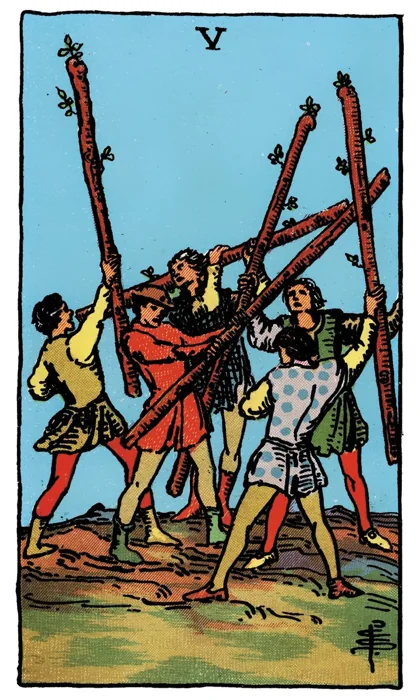
With Five of Wands
With the Five of Wands, disagreement may expose useful differences in perspective. Keep the conflict connected to the shared result and agree how decisions will be made. A vigorous discussion can improve the work, but repeated status contests should not be mistaken for creative collaboration.

With Three of Cups
With the Three of Cups, companionship can make collaboration enjoyable and sustaining. Appreciate the social bond while keeping responsibilities clear enough to protect it. Friendship does not remove the need to discuss expectations, credit, or what happens when someone cannot complete their part.

With Ace of Pentacles
With the Ace of Pentacles, a new practical opportunity may need a team or specialist knowledge to develop. Identify which contribution is missing before making large promises. A small, well-supported beginning can reveal more than a broad plan that assumes one person will supply every skill.

With The Emperor
With the Emperor, structure can protect good work through clear roles, resources, and decisions. Check that the structure serves the task rather than merely the person in charge. Skilled contributors need enough discretion to use their knowledge, especially when conditions differ from what the original plan assumed.

With The World
With the World, the separate contributions may be approaching a coherent whole. Review how the parts meet, complete the remaining handovers, and recognise the people involved. Finishing includes making the result usable beyond the group that built it, not simply declaring the making phase over.
The workshop and the rehearsal room
In a workshop, a learner watches how an experienced hand responds when the material behaves unexpectedly. The lesson is larger than a sequence of instructions. It includes attention, judgement, and the small corrections that make skill durable. The Three values knowledge passed through practice as well as knowledge that can be written in a plan.
In a rehearsal room, performers discover that timing works differently when another person is actually present. A private interpretation meets the shared scene. The result improves through listening and adjustment, provided direction gives the work a purpose without making every participant merely an instrument of someone else's self-expression.
A building carries the work of many people who may never meet its future occupants. Future occupants experience that care through a welcoming place that works well and continues to serve them over time. This is the Three's public dimension: craft can be a contribution to lives beyond the immediate exchange, even when the maker's name is not on the front.
Ask for one specific kind of feedback
Choose an unfinished piece of work or a shared practical task. State its purpose and the part you are uncertain about. Bring it to someone with a relevant perspective and ask one question they can answer from what you show them. Listen for information that changes the work, not merely for approval of you as its maker.
Apply the useful part, explain any decision not to use a suggestion, and acknowledge the contribution. Then notice what the exchange made possible. The Three of Pentacles becomes real when different kinds of knowledge meet in a visible improvement, and the people who supplied that knowledge remain recognised in the result.
Artwork & interpretation
The craftsperson and architectural setting support this original discussion of skill and collaboration. Modern questions of feedback, shared expertise, and credit are interpretive developments rather than promises of a particular professional outcome. A. E. Waite, The Pictorial Key to the Tarot: Three of Pentacles.
The symbolic associations and examples offer ways to read a situation. They do not establish another person’s thoughts or fix an outcome.
People do not need identical skills to work as equals in respect, but their different contributions need to be heard.
Use the cards in a spread →