Major arcana · 21
The World
A life large enough to hold what you have become
The World brings a long experience to completion. Its separate parts begin to make sense together. There is time to appreciate the result and recognise the effort it required before deciding what this completed work allows you to do next.
- Completion
- Integration
- Belonging
- Perspective
16 min read
In this guide
Learning to live with a completed chapter
There is a particular silence after a long undertaking ends. The final examination is over, and there is nothing left to prepare for. Handing over the keys after a move can bring a similar feeling, as can sending finished work out into the world. For months everything pointed towards this moment; now there is no next instruction. The World belongs to that threshold, where achievement becomes an experience you must learn to inhabit.
Its central meaning is completion, but completion has more substance here than simply stopping. Pieces that once seemed unrelated begin to belong to the same story. Skills become usable together. An experience becomes knowledge. You can look back at the person who began and recognise both your continuity with them and the distance you have travelled.
The World can be relevant when a substantial undertaking finishes, such as a course of study or a project ready to hand over. Completion may also bring you into a wider community. Work can reach people beyond its original setting, sometimes through travel or international connections. Consider which possibilities fit your circumstances. The image cannot guarantee a particular event simply because that event would make a satisfying conclusion.
The World need not mean a spectacular public success. Someone who finally leaves an exhausting arrangement may experience a deeper completion than someone collecting another award. An ordinary day can reveal that you no longer organise your life around a former wound. The scale of the achievement cannot always be measured from outside it.
As an outcome, this card invites you to define what a sufficiently complete result would actually look like. Without that definition, every finish line moves. A finished draft seems to require another revision. In a different kind of ending, you may keep waiting for an apology or another person's approval before allowing yourself to move on. The World asks whether the thing is unfinished, or whether you have become reluctant to release your role as the person finishing it.
Finishing also reveals how your project belongs within a larger world. Other people helped make it possible, and someone else may now use the result. Consider what they need from you and which responsibilities can pass to them. As the finished work enters other lives, it develops relationships beyond your own intentions. Part of completion is allowing it that existence outside your control.
A moving figure within a finished circle
A lightly draped figure occupies the centre of an oval wreath. One leg bends behind the other; a white wand is held in each hand. The body appears poised in movement rather than seated on a throne. This is an arresting image for the final Major Arcana card: arrival has not turned the person into a monument.
The wreath gives the figure a boundary without looking like a locked enclosure. Leaves form its living circumference, tied with red ribbons above and below. Read symbolically, the shape offers enough definition for movement to become a dance. Freedom here has a form. A piece of music needs an ending to become something we can hear whole.
Four heads emerge from clouds at the corners: a human figure, an eagle, a bull, and a lion. Their presence draws attention outwards from the dancer. Whatever associations a reader brings to them, the visible arrangement itself suggests several kinds of witness, held around one centre. No single corner possesses the complete view.
The open blue space matters as much as the ornament. The central figure is not crowded by possessions or proofs of achievement. We can read that spaciousness as an invitation to distinguish what experience has made available within you from the objects you once needed to demonstrate it. The image leaves room for a life after the accomplishment.
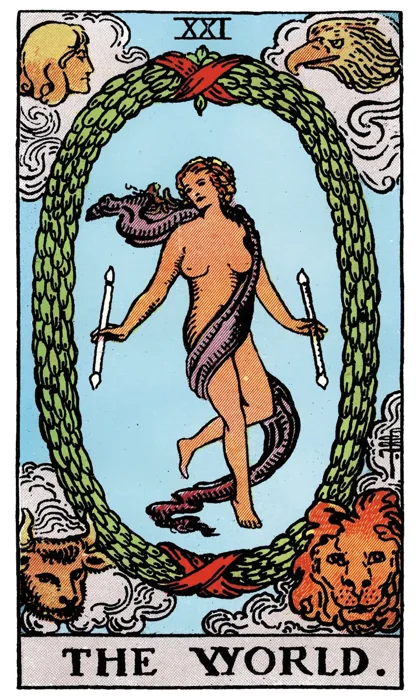
The poised body gives the ending an active quality. A completed apprenticeship can become fluent practice; a resolved transition can become ordinary living. The purpose of arrival is not to hold the same triumphant pose forever.
The tied wreath provides a visible circumference. It suggests the value of naming an endpoint, gathering the work, and recognising the whole. A boundary can protect meaning without preventing another cycle from beginning.
Less need to audition for your own life
Personally, the World can describe a growing ease with being a complicated person. Ambition need not crowd out tenderness, and feeling uncertain does not undo your confidence. You can also need solitude while remaining attached to other people. You can choose which quality a situation needs without declaring the others false. This is integration as a working relationship between parts of yourself.
That ease often arrives quietly. Decisions no longer need to be defended before an imaginary tribunal, and old comparisons become less compelling. An error can be acknowledged on its own terms, without putting your whole life on trial. None of this requires permanent serenity; it means an uncomfortable moment has become a moment, rather than the final verdict on who you are.
The card may also describe the disorientation of reaching a desired destination. You have become the graduate, the parent, the owner, the person who moved away. Yet your feelings have not caught up with the facts. Allow time for the new reality to become familiar. Emotional arrival does not always share a date with administrative completion.
A subtler difficulty is the fear that satisfaction will make you complacent. If striving has supplied identity for years, contentment may feel suspiciously like giving up. The World asks whether you can let something be enough without making enough a permanent ceiling. Appreciation can replenish ambition; it does not have to extinguish it.
As a description of another person, this card may suggest breadth, experience, self-possession, or the ability to move between different settings. These qualities are worth observing rather than idealising. Someone can be accomplished and still have blind spots. Wholeness is the capacity to include correction, not a certificate of being beyond it.
Wholeness has room for an imperfect history
A common fantasy about completion is that it will redeem every difficulty that preceded it. You may expect an achievement to make earlier losses worthwhile. Similar hopes can gather around a new relationship or a finished piece of work, as though either could finally settle the past. The World offers a more demanding kind of wholeness. Some experiences can belong to your history without becoming things you are glad happened.
Integration does not require a tidy moral for every chapter. It may mean recognising what an experience taught, what it damaged, and what you still cannot explain. A life becomes more coherent when those truths can coexist. Forcing the painful part into an uplifting conclusion can keep you further from peace than admitting its unresolved edges.
The card also questions the idea that belonging must be earned by becoming indistinguishable from everyone around you. A mature community can make room for difference while sustaining shared obligations. Equally, personal independence need not mean living without attachments. The dancer has a centre, but there is still a world around that centre.
Completion changes the scale of the question. Earlier you may have asked whether you could survive, learn, choose, or finish. Now the question becomes how to use what you have become capable of doing. Competence creates possibilities and responsibilities. The point of having found your footing is that you can participate more freely.
As the final numbered Major Arcana card, the World invites a retrospective reading. Which earlier lessons can now work together? Courage without judgement may be reckless; judgement without hope may become paralysis. The whole is valuable because its parts can temper one another. No single insight has to carry the entire weight of a life.
Finish the work, then let it have a life
At work, the World can concern bringing separate efforts together into something others can use. Publication or a handover may mark that point, but the everyday test comes afterward. Can someone unfamiliar with the work understand how it functions? Will they be able to maintain it? Answering those questions helps a completed project continue beyond the people who originally built it.
This makes documentation, final decisions, credit, and clear ownership part of completion. A project is not fully handed over if everyone must keep returning to its original creator for permission. Leaving useful records allows the work to endure and allows you to move. The last act of craftsmanship may be making your own constant presence unnecessary.
For a career question, the card can suggest that an existing role has taught you what it can. That does not automatically mean resigning. You might broaden your responsibilities, teach, consolidate expertise, or choose a better rhythm. Ask whether the next development requires a new environment or a different relationship with the one you already have.
Recognition can also reveal an appetite you did not expect. After years of wanting to be taken seriously, you may discover that the work itself matters more than the title. Or you may finally feel ready for a larger audience. Either response deserves examination. Success gives information about your preferences as well as your capabilities.
In creative work, beware of polishing away the point of view that made the piece worth finishing. There is a difference between a necessary revision and an attempt to remove all vulnerability before publication. A finished work can contain limitations and still make a real contribution. Its readers will bring meanings you could not have planned.
When the card appears amid workplace difficulty, consider whether the useful outcome is an orderly ending. An orderly handover means completing the agreed work and making clear who will handle anything that remains before the relationship closes. Staying indefinitely to obtain universal approval can turn a successful contribution into exhaustion. Some professional chapters deserve a good handover more than another attempt to make them permanent.
Two lives that do not have to disappear into one
In relationships, the World can describe a bond that fits into the rest of life. You can bring friends, work, private interests, difficult history, and ordinary moods into the relationship without each becoming a rival to intimacy. The connection has enough room for two people to remain recognisable, and enough commitment for their lives to genuinely affect one another.
This is a useful image of maturity, but it should not be mistaken for a guarantee of lifelong harmony. A relationship continues to require attention after a milestone. Moving in, marrying, or resolving a major disagreement completes one task and opens another. The celebration becomes meaningful through the arrangements that make daily life bearable and generous.
For someone single, the card can invite a fuller relationship with the life already present. This is not an instruction to become perfectly self-sufficient before seeking love. Wanting companionship is compatible with self-respect. The question is whether another person is being invited into your life or asked to supply the life you have postponed living.
Different backgrounds can broaden a relationship while creating practical demands. Connecting lives across languages or places asks both people to adapt. Notice whether one person's surroundings are treated as the default while the other is expected to do most of the adjusting. A shared life requires interest in each other's world, including conversations about travel time and family expectations that may feel less romantic but matter just as much.
When a relationship has ended, the World may describe closure you can establish through your own decisions. You may never receive the perfect explanation or apology. That absence can remain painful without requiring permanent emotional availability to the former relationship. Completion sometimes means accepting the limits of what another person will help you understand.
With friends and family, the card asks how belonging is expressed. Can people grow without being accused of abandoning the group? Can a former role be revised? A healthy sense of home includes recognition of who you have become. Returning should not require you to shrink until you fit an old photograph.
What does enough make possible?
In material matters, the World may prompt you to check whether an obligation is complete. After a move, for example, a payment or document can remain outstanding even when you feel settled. A savings milestone also needs to be confirmed against actual records. Establish which responsibilities are finished and which still require attention, so your sense of completion rests on what has been resolved.
A larger question concerns the purpose of accumulation. If a financial target has been reached, what was it meant to make possible: security, time, freedom of movement, care for others? It is easy to replace each target with a larger one before receiving its benefit. The card invites a conscious relationship with sufficiency rather than an automatic escalation of desire.
At home, completion may involve finally inhabiting a place after the repairs, boxes, and temporary arrangements. A home need not be visually perfect to begin supporting a life. Begin using the room in your daily routine, or invite someone over before the last decorative detail is settled. Otherwise the preparation for living can continue so long that living itself is always scheduled for later.
Where resources are limited, avoid turning this card into pressure to feel abundant. A small piece of order can still matter: one resolved account, one secure arrangement, one shared understanding about costs. Wholeness does not require owning everything. It may begin with a clearer view of what is available and where support is still needed.
Let the body arrive after the effort
After sustained effort, relief may be accompanied by tiredness, flatness, or an unexpected need for solitude. The deadline disappears and the momentum that carried you disappears with it. The World can be a useful prompt to allow a period of settling. Finishing something does not obligate you to feel celebratory on command.
Consider what the undertaking displaced. Meals, movement, friendships, sleep, and unstructured time may need a place again. Restore them gradually instead of turning recovery into another performance with an impressive schedule. A life that feels whole has room for maintenance as well as achievement, and for activities that produce nothing worth displaying.
The card cannot assess health or establish that a difficulty has resolved. If something needs attention, completion in another area does not cancel that need. As a reflective image, it asks whether your daily arrangements support the person you have become, rather than continuing to serve an emergency or deadline that has already passed.
Name the finish line and cross it
Make the ending explicit by writing down what must be true for this chapter to close. Distinguish essential obligations from improvements you could keep making indefinitely. Once the essentials are complete, tell anyone who needs to know and give yourself a way to acknowledge the transition. A quiet afternoon or ordinary meal can mark it well; the gesture only needs to mean something to you.
Acknowledge the people and conditions that helped. This need not diminish your effort. Gratitude places achievement in its real setting and can reveal relationships worth carrying forward. It also prevents the lonely conclusion that every future success must be produced through your individual strength alone, because that is how the last one is being remembered.
The shadow is perfection disguised as completion. You withhold permission to finish until everyone understands, then find another mistake or possible improvement that appears to justify keeping the work open. Another shadow is superiority after arrival. Experience can become a wall against learning if you assume that having completed one journey means you understand every road.
Let satisfaction have a practical consequence. Decline an unnecessary extension, take the promised rest, make space for a new interest, or allow someone else to continue the work. If finishing changes nothing about how you live, ask whether you have truly accepted the ending or merely added another achievement to the burden you carry.
Almost finished, or afraid of what comes afterwards?
Reversed, the World may describe loose ends, an incomplete transition, or a result that has not yet become integrated into daily life. Something important is missing, but the missing part may be small and specific. Identify it before concluding that the whole undertaking has failed. An unsigned agreement and a fundamentally unsuitable project require very different responses.
Sometimes the practical work is complete while the inner permission to stop is absent. You continue revising because publication exposes the work to judgement. You remain available because leaving feels disloyal. The unfinished detail may be serving a protective function. Understanding that function makes it easier to choose a more honest way of meeting the underlying need.
The reversal can also describe achievement without fulfilment. You reached the destination someone else taught you to want, or sacrificed so much of everyday life that the result feels strangely empty. This is uncomfortable information, but useful. You do not have to denounce the achievement in order to reconsider what should organise the next chapter.
Another expression is fragmented belonging. Different parts of life never meet; each setting seems to require a different version of you. Some separation is healthy and practical. The difficulty arises when maintaining it consumes your freedom or leaves you feeling absent everywhere. Ask where a little more honesty or continuity would be possible.
As advice, the reversal asks for a considered closing process. Look at what remains unfinished and whether it still needs to be done. Some parts may have to be left with regret, while others need more development before the work can responsibly end. Use the actual state of the undertaking to make that judgement, allowing time to distinguish a necessary ending from impatience to move on.
What kind of completion is taking shape?
Read these pairings as questions about the situation. A second card can clarify what is being completed, what makes closure difficult, or what becomes possible afterwards; it cannot certify a particular outcome.

With The Fool
With the Fool, an ending creates the conditions for a fresh beginning. Let the knowledge of the previous chapter travel with you without requiring the new one to resemble it. A modest first experiment may be more useful than an immediate declaration of a new identity.

With Judgement
With Judgement, recognition calls for a decision that can complete a long transition. What have you understood, and what action would make that understanding real? The pairing can support an honest conclusion without demanding that everyone involved agree on its meaning.

With Death
With Death, a chapter may need both an ending and a period of integration. Removing an old structure is different from learning to live without it. Allow practical closure and emotional adjustment to proceed at different speeds without treating either as a failure.
With The Hanged Man
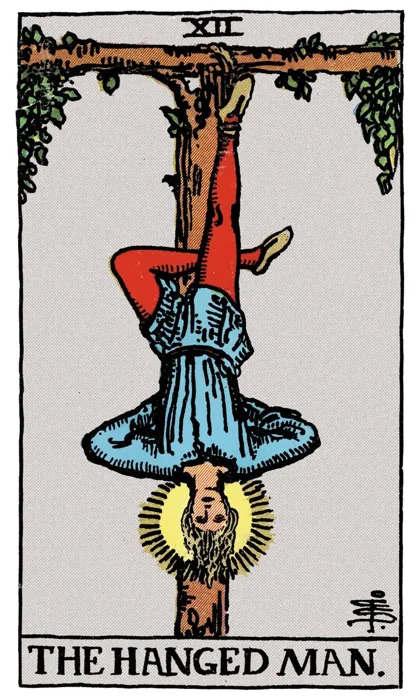
With the Hanged Man, completion may require relinquishing an old definition of success. A pause can reveal which final effort matters and which only prolongs attachment. Consider whether the obstacle is unfinished work or the expectation that finishing should feel a particular way.
With Three of Wands
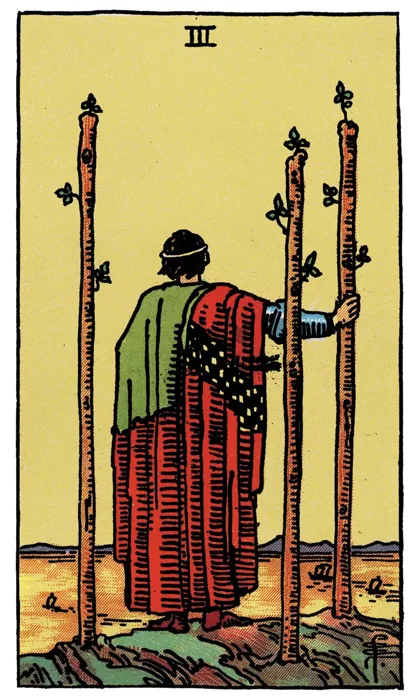
With the Three of Wands, a completed foundation can support wider reach. Before expanding, establish what is stable enough to travel and what still depends on local knowledge or your constant attention. Greater scope becomes useful when the original work can sustain it.
With Ten of Wands
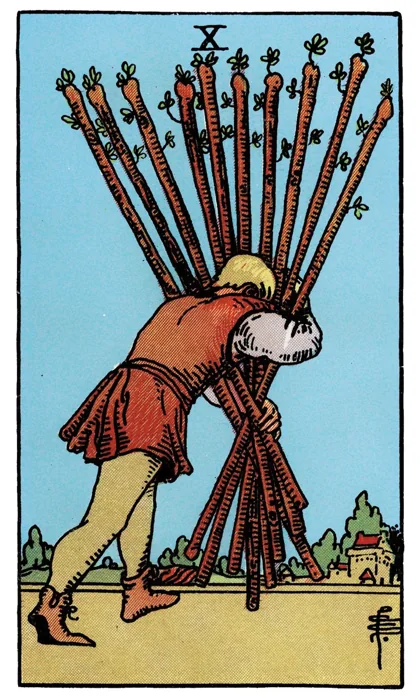
With the Ten of Wands, the final stage may have become unnecessarily heavy. Define what delivery actually requires and distribute the remaining responsibilities. The point of completion is partly to put the burden down; avoid building an ending that generates endless new duties.
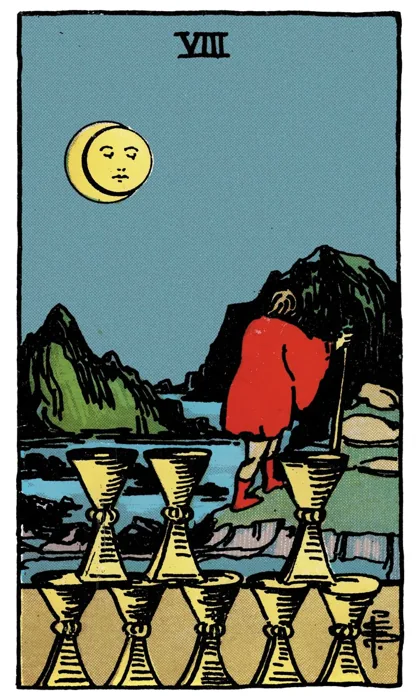
With Eight of Cups
With the Eight of Cups, leaving may follow the recognition that an experience has given what it can. Gratitude and departure can coexist. You do not have to make the past worthless in order to admit that your participation in it is complete.
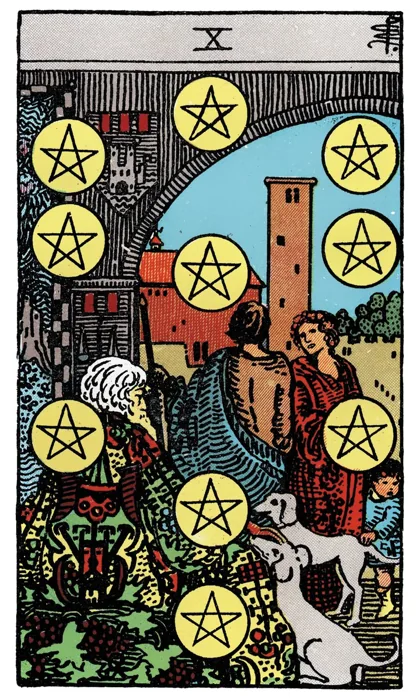
With Ten of Pentacles
With the Ten of Pentacles, consider what an accomplishment contributes beyond its immediate owner. The focus may be continuity, shared resources, or work that others can inherit. A useful legacy includes clear arrangements and room for future people to make their own choices.
Images of a life brought into a fuller whole
The returning traveller offers one useful echo. They arrive with stories and altered habits, but home has also changed during their absence. Return is therefore another act of learning. The journey becomes part of life through ordinary conversations and decisions, not only through a dramatic account of what happened elsewhere.
The dancer offers another. Skill becomes most convincing when the labour of acquiring it no longer occupies the foreground. A movement can be both disciplined and free. As a metaphor for experience, this suggests that lessons have been integrated when you can use them responsively, without reciting every rule that once made them possible.
A completed vessel gives a quieter image. Its maker has shaped and fired it, but its purpose includes what happens afterwards: water carried, food shared, flowers placed on a table. Finishing does not exhaust its meaning. Something made whole can enter relationships its maker could neither own nor fully anticipate.
Give one chapter an actual ending
Choose an undertaking you keep describing as nearly finished. List the essential remaining actions, the improvements that would merely be nice, and the approval you may never receive. Complete or schedule the essentials. Then choose a clear act of closure: send the work, hand over the keys, archive the files, or state your decision.
Afterwards, leave a little space before filling the vacancy. Notice what the completed chapter has given you, what it has cost, and what you want to carry forward. Ask a final question: if I no longer had to prove this particular thing, what would I have room to enjoy, learn, or contribute now?
Artwork & interpretation
Waite connects the final Major Arcana image with completion and a restored world. The discussion here develops an original contemporary reading of integration, belonging, accomplishment, and closure, alongside observations of Pamela Colman Smith’s artwork. A. E. Waite, The Pictorial Key to the Tarot: The World.
The symbolic associations and examples offer ways to read a situation. They do not establish another person’s thoughts or fix an outcome.
You can finish a chapter without making it perfect, and carry its meaning without carrying every part of it.
Use the cards in a spread →