Wands · Three
Three of Wands
What happens when your effort reaches beyond you
The Three of Wands follows the first commitment. Work has begun to reach other people, and their response now affects what happens next. The wider opportunity brings dependence on circumstances you cannot manage entirely from your own position.
- Expansion
- Foresight
- Cooperation
- Expectation
16 min read
In this guide
The ships are already on the water
After sending an application, you have to wait for someone else to read it. Sharing your work creates a similar dependence on a response. An initial conversation may open a possibility, but you cannot carry it forward entirely alone. The Three of Wands belongs to the period after intention becomes outward action, when your effort has entered a wider world and you must begin learning how that world responds.
The Three of Wands often concerns reaching beyond your existing position through work with others. More is underway than in the Two: you have made a commitment and are beginning to see what follows from it. Responses now give you information planning could not provide. New relationships develop around the effort, and their possibilities and demands help determine where it can go.
The card can describe work reaching a broader audience, a collaboration extending beyond familiar contacts, or a practical step towards travel or relocation. It may also indicate a change in perspective: you begin to understand your situation within a larger field. The local problem acquires context, and possibilities previously invisible become easier to recognise.
Expansion may first show itself through an ordinary response. A customer returns, suggesting that the work met a need; a connection outside your usual circle gives it a new place to develop. These relationships may support the next stage more effectively than a large announcement. Look at what the undertaking can now do and who it can reach when you judge whether it is growing.
Waiting is part of this card, but it is active waiting. You follow developments closely enough to prepare for the next stage. Where a follow-up is appropriate, you make it and leave room to respond to what comes back. The distinction matters: hovering over a sent message does not make a response more likely. Nor does abandoning attention entirely honour the commitment you have already made.
As an outcome, the card can suggest that a situation opens into further possibilities rather than reaching a final resolution. Progress creates a new horizon. Consider whether you are willing to take part in the relationships and responsibilities that broader scope brings, instead of wanting only the reassurance that the initial effort has been worthwhile.
Watching the ships from a position on the shore
A figure stands with their back to us on raised ground, looking across a golden expanse of water. Three staffs are planted around them, and one hand rests on the staff to the right. Small ships are visible below. The scene combines a stable vantage point with movement that is already happening beyond the figure's immediate reach.
The grounded staffs suggest support rather than weapons in use. Whatever venture is being observed, the watcher has a position from which to assess it. This gives the card a different quality from an impulsive departure. You may have experience, a working prototype, or established relationships that make further reach plausible.
The ships are small relative to the landscape. Their presence introduces scale and uncertainty: they can be seen, but their details cannot be managed from the cliff. Whether we imagine them departing or returning, they depend on conditions beyond the watcher's body. A venture becomes larger partly by involving other people's judgement and effort.
The turned back places the viewer beside the figure rather than in conversation with them. We are invited to look out, too. It can be useful to ask what your own attention would settle on in this scene: the ships, the distance, the secure ground, or the absence of any immediate action that could hurry the journey.
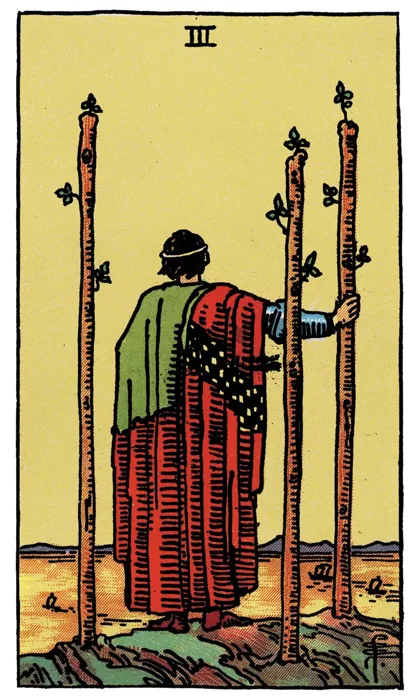
The ships give effort an independent course. Once a proposal, product, or invitation leaves your hands, other people participate in its future. Prepare to learn from their response instead of requiring it to reproduce your original expectation.
The hand and planted staff connect the broad view to a stable position. Expansion is easier to assess when you know what already works. Keep that foundation visible while considering how far the next stage can reasonably reach.
Confidence with an unanswered question inside it
The Three of Wands often feels like expectant confidence. You have done enough to believe something may develop, but you cannot yet see the full result. This can be exhilarating and uncomfortable at the same time. The mind wants to turn a promising beginning into certainty before the situation has had time to answer.
A useful inner shift is from self-preoccupation towards curiosity. Instead of asking only whether you are good enough, you begin asking how the work meets other people, what they need, and what the larger setting makes possible. Your contribution becomes part of an exchange. That wider attention can be less exhausting than continuous evaluation of your own worth.
The card may describe growing independence from immediate approval. You can tolerate a period in which effort has been made but recognition has not arrived. This is not indifference to feedback. It is the ability to let a process take some time without repeatedly declaring the whole undertaking successful or doomed according to the latest small signal.
There is also a temptation to live in anticipated arrival. Imagining the offer or audience you hope for can become so absorbing that the present feels like a waiting room for the next stage. Keep ordinary life in view. The future may deserve preparation, but it should not require every current pleasure and relationship to remain suspended until the expected result appears.
As a personal quality, the Three suggests breadth, practical optimism, and an ability to see connections. Its mature expression includes listening to people closer to the details. A broad perspective is useful when it can receive correction from the ground; otherwise foresight can become confidence in a picture too distant to reveal what is actually happening.
To reach further is to depend on more than yourself
A private intention can remain perfectly obedient to its maker. An outward undertaking cannot. Readers and customers may respond in unexpected ways, while collaborators make changes that improve the idea. Even the timetable now depends on circumstances beyond the maker's control. The Three of Wands concerns the developmental step of allowing a purpose to enter relationships that change it. Reach and control do not expand at the same rate.
This is one reason cooperation belongs so naturally to the card. You may have initiated the venture, but its continuation depends on capacities you do not possess alone. Recognising that dependence can feel like a loss of authority. It can also free you from the impossible task of being the source of every useful decision.
The horizon invites breadth without possession. A place can be interesting without being yours to claim; a market can contain people whose needs differ from your assumptions. Expansion becomes more intelligent when it includes reciprocal understanding. Ask what you bring to a wider setting and what you are prepared to learn from it.
The card also distinguishes hope from prediction. Hope can sustain effort while admitting several possible outcomes. Prediction tries to remove that uncertainty by declaring what must happen. The Three is most useful as a way to practise hope while staying involved. Prepare for the next stage, leaving room for actual responses to change your decision.
Keeping watch after you have acted can require patience of its own. Part of the undertaking is now developing elsewhere, beyond your immediate influence. Stay attentive enough to respond where your contribution is useful. Give others room to carry their part, while maintaining the contact that your existing commitment requires.
Prepare for the response you have invited
At work, the Three of Wands can describe distribution, outreach, partnerships, a launch, or the first signs that an undertaking can extend beyond its original circle. The practical question is whether the next stage is supported. More demand is useful only if you can meet it without quietly undermining the quality or conditions that made the work valuable.
If something has been sent out, decide how to receive the response. Who will answer enquiries? What information will you track? What would count as a promising signal, and when will you review it? These arrangements turn waiting into a process of learning, rather than a succession of emotional reactions to whatever happens to arrive.
A wider audience may reveal that the work solves a different problem than you expected. Stay curious before defending the original description. Sometimes the most useful development comes from noticing how people actually use what you made. Adaptation can preserve the core purpose while changing its form, language, or route to the people who need it.
For career development, the Three may encourage contact beyond your immediate workplace. Sharing a considered piece of work can begin a conversation with someone in an adjacent field. A relevant gathering may offer another opportunity. Give attention to the exchange itself and follow through on anything you offer. Connections become useful through shared knowledge and practical help over time.
In a collaboration, clarify dependencies. One person may be waiting for a decision another does not know they owe. A project can appear stalled when the real problem is an invisible handover. Make the completed work visible and identify who needs to act next, so that the handover can actually happen. Broad ambition becomes workable through these ordinary points of coordination.
The professional shadow is expanding because expansion looks like success. More locations, clients, features, or commitments may dilute the very thing you do well. Before extending the venture, ask what the increase serves and what capacity it requires. A smaller operation with a clear purpose can have a wider meaningful effect than a larger one sustained by permanent strain.
A shared future begins to require participation
In relationships, the Three of Wands can concern plans that have begun to involve other people's lives. An arranged visit requires dates that work for both of you; researching a move brings costs and family circumstances into the conversation. A shared project raises similar questions. You are learning how the connection functions as its hopes become commitments that need practical coordination.
For an established couple, the card can invite a wider shared horizon. You may want to learn, travel, contribute, or build something together. A shared purpose can refresh the relationship when both people have a meaningful voice. It becomes less nourishing if one person supplies the vision while the other is expected to provide all the practical support.
Distance may be relevant, but the card does not establish that someone far away is thinking about you or preparing to return. What matters is the arrangement you can actually observe. Are communication and effort reciprocal? Is there a workable understanding of the next contact? A long-distance connection needs more than the emotional power of anticipation.
If you are waiting for a response, keep the difference between patience and suspended living clear. Allow reasonable time, follow up appropriately, and decide what you will do if no answer comes. Another person's uncertainty does not require you to place your own life on indefinite hold. Hope can remain open without becoming the only available future.
For someone single, this card can suggest extending the settings in which connection is possible. Shared interests, unfamiliar communities, or a more active social life may bring new encounters. The useful emphasis is participation rather than searching the horizon for a promised person. A wider life can be worthwhile even before it produces a romantic result.
Friendships and family relationships may also be changing through distance or new commitments. A connection can grow beyond frequent proximity if both sides develop suitable ways to maintain it. Be specific about what you can offer. Reliability at a realistic scale usually supports a relationship better than expansive promises made during a moment of affection.
Plan for the wait between committing and receiving resources
In material questions, the Three draws attention to waiting after resources have been committed. You may have sent an invoice or be expecting a shipment whose arrival affects the next stage. Check the dates and terms in the actual records. A positive outlook does not make expected money available now, so account for the interval when planning what you can afford to do.
Expansion often brings costs before benefits become reliable. More work can require tools, space, help, or time that must be funded somehow. Examine those demands at a manageable scale. A staged approach can reveal whether greater reach is sustainable before the undertaking becomes dependent on the most optimistic version of its future.
For a move or travel plan, consider the connections between places: transport, communication, practical support, and obligations left behind. The destination is only part of the arrangement. A promising opportunity becomes easier to use when the route towards it has been thought through and the people involved understand what is expected.
The card may also invite a wider search for resources or cooperation. Someone outside the immediate circle may have useful knowledge, but distance does not make an offer inherently better. Compare the terms and the actual value. The expansive feeling of the image is a prompt to investigate possibilities, not evidence that a financial risk will succeed.
Stay available without staying on alert
Once a venture is underway, attention can become tethered to updates. Between checking messages and refreshing the page, you may find yourself rehearsing responses to news that has not arrived. The Three of Wands invites a more deliberate rhythm of observation. Decide when checking is useful and give the rest of the day back to activities that are actually present.
Prepare for success at a sensible scale, but do not live as though it has already arrived. Overcommitting in anticipation can exhaust you before the next stage begins. A little spare capacity may be more valuable than an elaborate system built for demand that has not yet materialised. Readiness should leave room to respond.
Waiting can be emotionally tiring even when the outlook is hopeful. Keep familiar sources of steadiness in place: ordinary contact, manageable routines, and work whose result you can see. The card does not assess health or predict recovery. Its practical value lies in helping you distinguish attentive participation from constant vigilance over something you cannot hurry.
Make the next stage ready to receive what returns
Ask what you have already put into motion and what response it now requires from you. There may be a follow-up to send, a process to prepare, or a relationship to strengthen. Choose the action that supports the undertaking's real next stage, rather than adding another impressive beginning because the waiting feels uncomfortable.
Look outward for information. Ask the people receiving the work how they use it. What you learn from their experience may give you reason to revise your assumptions. This does not mean surrendering your purpose to every opinion. It means distinguishing the purpose from the particular route you first imagined would serve it.
The shadow is remote confidence: believing that a broad view excuses ignorance of details. The person on the shore can forget that someone must navigate the ship. Ask who is carrying the practical demands of your expansion, whether they have what they need, and whether their account of the situation is being heard.
Another shadow is endless anticipation. You become so attached to what may arrive that nothing present feels worth inhabiting. Establish a review point and a fallback plan. These do not betray hope. They give hope enough structure that it can accompany your life without taking possession of it.
When the wider plan meets its missing details
Reversed, the Three of Wands may describe delayed responses, limited reach, poor coordination, or an expansion whose demands were underestimated. Start by locating the actual obstruction. Is the message reaching the right people? Is someone waiting for a decision? Has the environment changed? A specific account of the delay is more useful than treating it as a verdict on the entire venture.
The reversal can reveal an overly narrow expectation of what success should look like. A response has arrived, but it differs from the one you prepared to recognise. Before dismissing it, consider whether it contains useful information or another viable direction. Adaptation may be possible without abandoning the core value of the undertaking.
Sometimes the problem is premature expansion. The original work remains fragile, yet attention has moved towards a larger audience or more ambitious arrangement. Return to the foundation. Strengthening delivery, communication, or existing relationships may create more genuine reach than continuing to extend a structure that cannot yet support itself.
In a relationship, the reversal may indicate mismatched expectations about the future or an arrangement sustained mostly by one person's waiting. Bring the timetable and commitments into conversation. Do not use the card to infer secret intentions. What can be established is whether the current pattern gives both people a workable place to stand.
A constructive reversal can mean choosing depth over breadth. You may bring an undertaking closer to home, serve a smaller group well, or end a distant possibility that no longer fits. The choice can be thoughtful rather than defeated. A horizon remains valuable when it helps you see your options, including the option not to pursue every distant invitation.
What is travelling, and what supports the journey?
These pairings consider what happens after an initiative reaches other people. Cooperation may extend its reach, while waiting for a response introduces uncertainty. The combinations offer questions for the situation, without assuring you that a message or expected return will arrive.

With The Chariot
With the Chariot, outward momentum needs coordination. Clarify the destination and the practical decisions that keep separate efforts moving together. Strong intention can help, but it cannot replace communication with the people whose work makes the larger undertaking possible.
With Wheel of Fortune
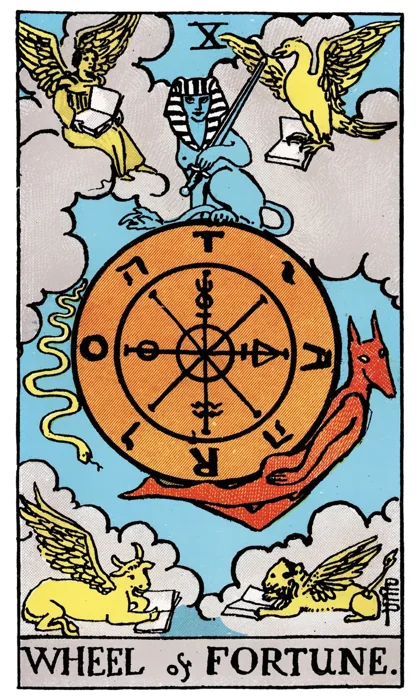
With the Wheel of Fortune, changing conditions may alter the response to an earlier commitment. Keep the plan adaptable and review what is actually happening. A shift in timing can create an opening or a complication without determining the value of the whole project.

With Temperance
With Temperance, wider reach develops through careful adjustment between different people or settings. Allow time to translate expectations and combine methods. Cooperation becomes stronger when differences are worked with deliberately, rather than concealed beneath an enthusiastic statement of shared purpose.
With Two of Wands
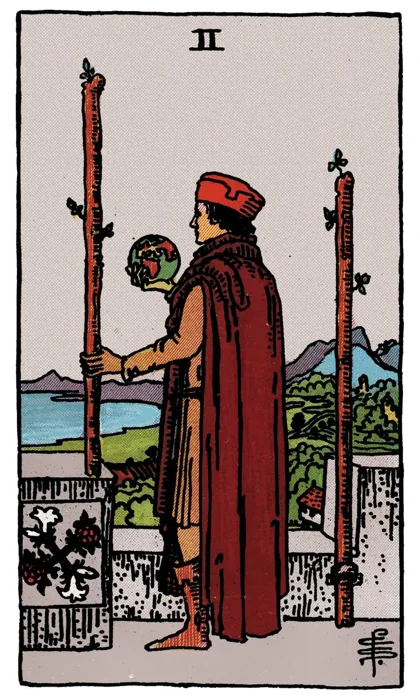
With the Two of Wands, a plan is becoming an outward commitment. Identify what can now be tested through action and response. The next useful information may come from a real recipient, collaborator, or environment rather than another comparison made from a distance.
With Eight of Wands
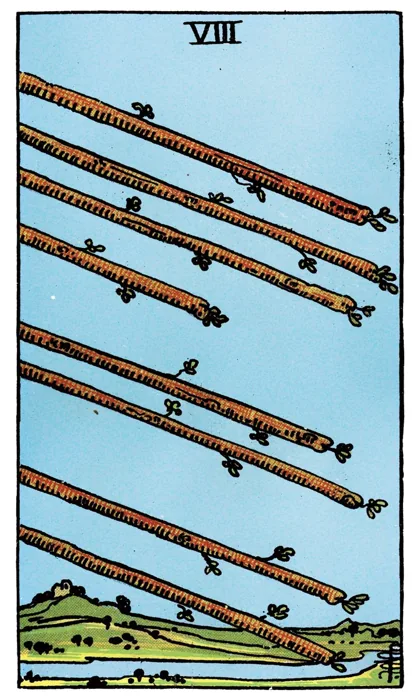
With the Eight of Wands, responses or developments may require prompt coordination. Prepare the essentials without assuming a guaranteed timetable. When information arrives quickly, distinguish what needs action now from what merely feels urgent because several things are moving at once.

With Three of Cups
With the Three of Cups, wider possibilities may grow through community and mutual encouragement. Share the work in settings where genuine exchange is possible. Notice who helps make introductions, sustain morale, or recognise an opportunity, and contribute to those relationships in return.

With Three of Pentacles
With the Three of Pentacles, expansion depends on complementary skills and clear collaboration. Agree on the standard, the handovers, and the roles. A broad vision becomes more credible when the people doing the work can explain how their contributions fit together.
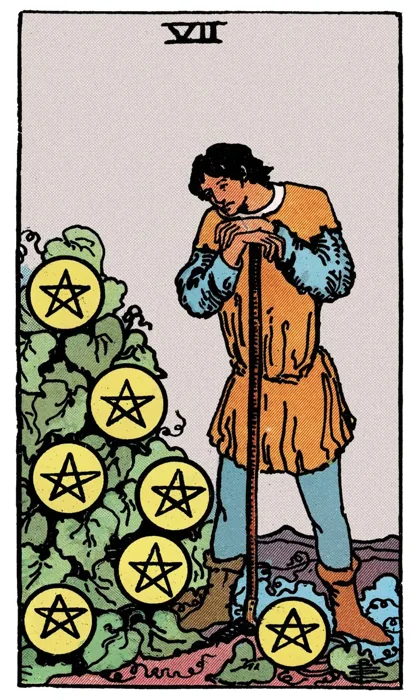
With Seven of Pentacles
With the Seven of Pentacles, effort needs a realistic period of observation before further investment. Decide which signs would justify continuing, adapting, or stopping. Patient assessment is different from remaining committed only because you have already spent time waiting for a return.
The harbour lookout and the work in another language
The harbour lookout gives the card its central rhythm: preparation, departure, observation, response. The watcher remains involved even when direct action belongs to someone else. This is a useful image for any undertaking that has grown beyond one person's hands, where trust must coexist with attention and practical coordination.
A work translated into another language offers a different echo. Something recognisable travels, yet its expression changes through another person's skill and another audience's experience. Wider reach is therefore a form of relationship. The maker may need to release some control in order for the work to become meaningful elsewhere.
The gardener exchanging seeds with a distant neighbour suggests expansion at a modest scale. Neither person knows exactly how the plants will respond to different ground. The exchange contains hope, knowledge, and experiment together. Its value includes what each learns, not only whether every seed produces the expected flower.
Replace one vague wait with a clear arrangement
Choose something you have put into motion and are now waiting on. Write down what has been sent or agreed, who is involved, the response you reasonably expect, and when a follow-up would be appropriate. Identify one preparation that would help if the response is positive and one next step if it does not arrive.
Then return attention to something you can actually do today. The aim is to remain engaged without turning your whole life into a lookout post. Your effort has entered the world; give the world room to answer, while keeping enough of your own life in motion to meet whatever that answer reveals.
Artwork & interpretation
Waite describes a figure watching ships and associates the scene with enterprise and established strength, including commerce and cooperation. This guide considers what follows when effort reaches beyond its maker. It explores the relationships that develop around a commitment and the experience of waiting for others to respond. A. E. Waite, The Pictorial Key to the Tarot: Three of Wands.
The symbolic associations and examples offer ways to read a situation. They do not establish another person’s thoughts or fix an outcome.
You can prepare for a response without controlling what comes back.
Use the cards in a spread →