Major arcana · 14
Temperance
The proportion that lets different things work together
Temperance works through adjustment. You try a mixture and pay attention to the response before changing it again. Timing matters as much as quantity. Its calm develops through this continuing engagement with what you are making.
- Integration
- Proportion
- Adjustment
- Patience
14 min read
In this guide
Keep adjusting while you learn the mixture
A cook tastes a dish and adjusts the seasoning. The recipe gave a starting point; now the ingredients have responded to heat and time in their own way. Keeping the intended flavour requires attention to those changes. Temperance describes this practical responsiveness. You can remain committed to what you are making while altering the instructions that helped you begin.
In a reading, Temperance often concerns adjusting an arrangement as you learn how its parts work together. Cooperation may develop gradually and require patience from those involved. Different needs or resources may be able to work together, provided the relationship between them is considered. The task is often less dramatic than replacing everything and more demanding than leaving everything alone.
Temperance does not necessarily ask for less. A strained arrangement may need more time or a clearer structure. In a relationship, greater warmth or directness could help, depending on what is missing. Proportion depends on the situation. A person who already minimises their needs may require a clearer request, while someone filling every available space may need to leave room for another response.
Temperance can be useful after disruption, when you are working out a new routine. An intense project may need to fit around the rest of life, or separate commitments may have to coexist for the first time. Try an arrangement and observe how it works over several days. Adjusting it as you learn is part of establishing something you can sustain.
There is often a possibility of combination here. People from different fields may find a useful way to combine their skills. Differences in temperament or priorities can also contribute, if those involved understand how to work with them. Combination does not mean erasing the differences. It means understanding them well enough to decide how each can contribute.
Careful adjustment can make an undertaking easier to live with over time. Be alert, though, to discussions of balance that keep postponing a decision. Sometimes the parts can work together with changes; sometimes one of them needs to end. Temperance invites you to keep examining whether the arrangement is supporting the people and purposes it brings together.
Two vessels and two kinds of ground
A winged figure pours liquid between two cups. The hands hold different heights and angles, making the transfer look deliberate rather than casual. The image concerns a relationship between containers, contents, and movement. A useful reading notices the manner of exchange as much as the substance being exchanged.
One foot rests on land and the other in water. The figure is in contact with different conditions at once. This can suggest the work of bringing an idea into ordinary practice, or allowing feeling and practical judgement to inform each other without requiring either to become the whole account.
The white garment gives the central figure a composed outline, while the wings remain vivid and substantial. The image contains energy without scattering it across the scene. Calm here need not mean lack of intensity. It may mean that intensity has found a form capable of holding and directing it.
A path leads toward distant heights and a bright light. The destination is present, but the foreground action is a measured transfer. The picture allows an ambitious horizon to coexist with patient work at close range. The larger aim does not remove the need to attend to the next proportion.

The cups occupy different positions while remaining connected by the flow. The image invites attention to pace, proportion, and what happens when separate elements are brought into relation.
The figure stands across two surfaces. A practical reading asks how different needs can remain acknowledged within one arrangement, rather than requiring one side to disappear.
You do not have to resolve yourself into one mood
Internally, Temperance can feel like a growing capacity to hold different parts of your experience together. You may want company while needing quiet time, or feel ambitious about work you hope to do at a slower pace. Familiar routines matter, although you also want room to change. These needs may require negotiation rather than a verdict about which one represents the real you.
The card may describe recovery from an all-or-nothing pattern. An imperfect day no longer ruins the week, and a disagreement can be addressed without redefining the whole relationship. You may also find it easier to take your practice seriously on days when you can manage only a little. You begin to make adjustments earlier, before the situation requires a dramatic correction.
As a person, Temperance can be patient, diplomatic, observant, and good at helping different temperaments cooperate. They hear the point beneath an awkward expression and can translate between people who use different language for a similar concern. Their contribution often becomes visible through how much less friction everyone else experiences.
The shadow is constant accommodation. You become so skilled at finding a middle position that your own preference is hard to locate. Others experience you as easy to work with while you privately feel diluted or overextended. Harmony has been achieved by removing your needs from the mixture.
Mature integration includes a definite self. You can adapt without agreeing to everything, and you can be considerate while stating that some conditions do not work for you. The ability to adjust becomes more trustworthy when other people know that your eventual agreement contains a real choice.
How different parts of a life can work together
Temperance asks how the separate areas of a life affect one another. The body you rely on for work also needs rest. Time spent in a relationship affects what remains for solitude and friendship, while a creative ambition draws on resources already needed elsewhere. Treating each area as an isolated project can hide the demands placed on the same person.
Integration begins when those connections become visible. A schedule may look reasonable until travel, preparation, and recovery are included. A generous commitment may become less generous when its cost is repeatedly transferred to someone else. The whole arrangement needs attention, rather than a series of individually admirable choices.
There is also a creative possibility in difference. Two ideas may change through contact without either being discarded. An inherited practice may become useful in a new setting after thoughtful adaptation. The result is more than compromise when the relationship produces something that neither element could provide alone.
The card's patience is experimental. You do not already know the perfect proportion, so you observe and revise. This requires tolerance for an answer that remains provisional. A method can be good enough to use now and still need adjustment as people, resources, or aims develop.
The deeper limit is that some things should remain separate. Cooperation does not require accepting harmful conduct, and a fair response is not always halfway between two positions. Integration needs judgement about what belongs in the arrangement and what would undermine its purpose if included.
Make the handover work as well as the task
At work, Temperance draws attention to how one stage connects to the next. A person can complete their task well and still leave a colleague struggling if the handover lacks essential information. Follow the work through those transitions. Check whether feedback arrives while it can still be used and whether people receive what they need to begin their part.
A project may benefit from combining methods rather than choosing one as universally correct. A careful plan can coexist with a small experiment; detailed research can inform a simple presentation. The useful question is which part of the task each method serves and how the results will be brought together.
Collaboration often involves translating between different measures of success. A disagreement about speed may conceal concerns about precision or whether the finished work will be accessible to its audience. These preferences may reveal legitimate needs. Make the trade-offs explicit enough that the group can choose a workable proportion instead of repeatedly arguing as though only one concern deserves to exist.
Creative work benefits from alternating modes. Generating material, selecting it, refining it, and resting from it ask for different kinds of attention. Trying to perform all of them at once can make the work feel impossible. A rhythm that gives each mode some room may produce more than a continuous demand to be inspired and exact simultaneously.
Temperance also concerns how a skill develops through practice. Repeated work with useful feedback gives you something to build on from one session to the next. Some stages will require considerable effort, but a pace that repeatedly leaves you exhausted interrupts that continuity. Find an arrangement that lets learning accumulate as you return to the work.
Mediation can become a way of delaying a decision. A team discusses balance each time a conflict arises, yet the work stays where it was. Agree on the outcome you need and which constraints you must work within, then establish who has authority to decide. A diplomatic conversation earns its place by helping people proceed with a decision they understand.
A shared rhythm with room for two lives
In relationships, Temperance can concern the gradual work of finding a shared rhythm. Two people may differ in how much contact they want or how they recognise affection. Talking about those differences helps them arrange daily life with consideration for each other. Patient repair also happens here, as new agreements become dependable through repeated experience.
Compatibility does not require identical temperaments. One person may think aloud while the other needs time before speaking; one may enjoy frequent contact while the other needs substantial solitude. A useful arrangement makes these differences understandable. It does not ask one person to interpret every mismatch as rejection or the other to abandon their natural pace.
Repair often happens through repeated ordinary behaviour. A conversation establishes the aim, then daily choices show whether it has entered the relationship. Temperance asks for enough patience to notice gradual improvement without using gradualness as an excuse for a pattern that never changes in any observable way.
The card can also support a slower beginning. You allow attraction to develop alongside knowledge of the actual person, rather than forcing an early definition to remove uncertainty. The pace should still be mutually workable. Taking time is different from keeping someone indefinitely available without explaining what you are able to offer.
The shadow is compulsory compromise. You assume that a good partner must always meet the other halfway, even where the issue concerns a clear boundary or behaviour that should stop. Some differences can be negotiated; some require a firm limit. A relationship becomes more balanced when those categories are understood.
Another difficulty is smoothing over every disturbance before it can reveal useful information. You change the subject, soften the request, or reassure too quickly because visible tension feels like failure. A bond can survive a period of discomfort while people tell the truth. Harmony is more substantial when it includes that capacity.
A plan you can live with repeatedly
In material life, Temperance suggests designing an arrangement for the way it will actually be used. A household budget needs some room for changing costs, just as a routine needs to accommodate days when people have less energy. Observe where the plan repeatedly becomes difficult to follow. Making it more forgiving may help it remain useful under ordinary conditions.
Resources can be directed toward several needs without pretending every need is equally urgent. Clarify the purpose of each allocation and the trade-off involved. The card cannot tell you which financial choice will succeed; it can encourage a deliberate relationship between present enjoyment, ongoing obligations, and the future you are trying to support.
At home, small changes may solve a recurring irritation more effectively than a complete overhaul. Move the frequently used object, agree a clearer division of work, or simplify a routine that requires too much coordination. Observe the effect before adding another layer. A workable home often develops through such practical adjustments.
Shared arrangements need review when circumstances change. A contribution that once felt fair may no longer match available time, income, or capacity. Reopening the discussion does not necessarily mean the original agreement was wrong. It may mean the agreement has done its work and now needs to answer a different situation.
Notice the adjustment before the crisis
Temperance can invite earlier attention to small signs that a pace is becoming difficult. You do not need to wait until every commitment feels unbearable before adjusting one. A shorter session, a clearer stopping time, or an ordinary meal taken without another task attached may make the day more workable.
A sustainable rhythm includes both effort and replenishment, but their proportions will differ between people and across time. Avoid turning balance into a rigid requirement to perform every area of life equally well. Sometimes an intense period is chosen; the useful question is whether its cost and endpoint have been acknowledged.
The card cannot prescribe a treatment, assess a condition, or tell you to alter medication. Health decisions need appropriate evidence and professional guidance. Symbolically, Temperance asks whether your routines respond to your actual needs and whether you allow adjustments before strain becomes the only available signal.
Change one proportion and observe
As advice, Temperance favours a specific adjustment over a broad promise to become balanced. Identify what is excessive, insufficient, mistimed, or poorly connected. Change one part at a scale you can observe. The result will tell you more than trying to redesign everything and then being unable to identify which change mattered.
Give the adjustment enough time to show an effect, while deciding in advance what would indicate that it is not helping. Patience becomes clearer when it includes observation. You are neither demanding an immediate transformation nor committing to continue indefinitely out of loyalty to the plan.
The shadow is dilution. In trying to satisfy every preference, you may remove the distinctive quality that made the work or choice worthwhile. Some things need a stronger flavour, a clearer position, or a more definite boundary. Proportion is not the same as blandness.
Another shadow is treating moderation as moral superiority. An intense interest, strong feeling, or ambitious period is not automatically a failure of balance. Ask how the energy is functioning and what it costs. A life can contain vivid commitments while remaining attentive to the person who must sustain them.
The parts are no longer working together
Reversed, Temperance can describe imbalance, poor coordination, impatience, incompatible demands, or an arrangement that has become too diluted to serve its purpose. Begin by identifying the specific relationship that is failing. A general sense that everything is out of balance may conceal one practical conflict with disproportionate effects.
One expression is repeated overcorrection. After working excessively, you may abandon the routine altogether. The same swing can appear in spending, where strict limits follow overspending, or in relationships when giving too much leads to complete withdrawal. A smaller adjustment made earlier may reduce the need for these dramatic swings without requiring perfect consistency.
Another expression is combining things that need different conditions. You try to rest while remaining continuously available, create while judging every first attempt, or have a difficult conversation while one person is rushing to leave. The problem may be the arrangement of attention rather than a lack of will.
The reversal can also indicate impatience with gradual change. Early improvement seems too small to count, so you replace the method before it has had a fair trial. Look for evidence at the scale the process can realistically produce. Equally, do not call an absence of any change a subtle success merely to protect the plan.
A constructive reversal stops an unworkable compromise. You separate tasks, state a non-negotiable need, or admit that two aims cannot both receive the available resources right now. Clearer boundaries can create a more honest balance than a strained effort to keep everything nominally included.
Which parts need a different relationship?
These pairings explore adjustment and integration. They help locate the relevant proportion rather than prescribing one universally balanced way to live.
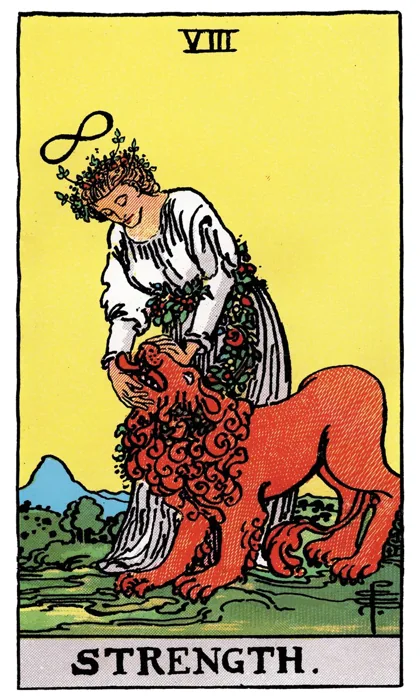
With Strength
With Strength, patient adjustment meets emotional steadiness. A difficult pattern may change through manageable actions and a less punitive response to setbacks. Keep the practical aim visible so that kindness supports learning rather than becoming an excuse to avoid the issue.
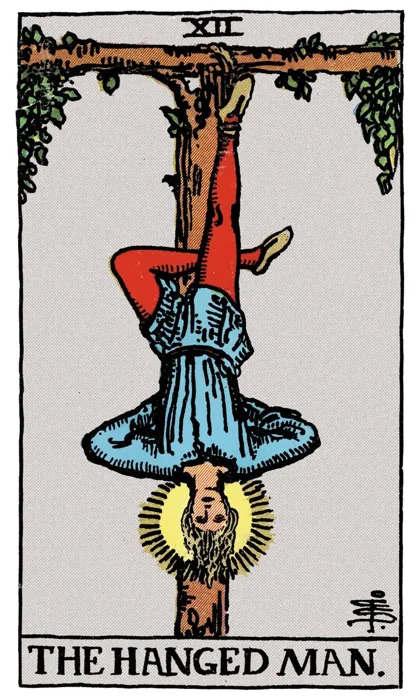
With The Hanged Man
With the Hanged Man, a pause may allow separate parts of an experience to settle into a clearer relationship. Identify what is being learned and when the arrangement needs review. Waiting is useful when it creates room for an actual adjustment.

With Death
With Death, a changed life needs integration. Some habits can provide continuity while others no longer fit. Give attention to the practical routines that help the transition become inhabitable, without demanding that every feeling about the ending resolve at once.

With The Devil
With the Devil, a powerful attachment may need an honest review of its cost and place in your life. Some patterns can be moderated; others need stronger boundaries or outside support. The cards cannot determine which response is appropriate without the actual circumstances.

With The Star
With the Star, renewal can develop through a gentle but real practice. Let hope have an ordinary form that you can repeat. A small improvement becomes more useful when it is noticed and supported, rather than dismissed for lacking drama.

With Two of Cups
With the Two of Cups, cooperation depends on the quality of exchange. Listen for differences in pace, language, and need. Mutual willingness becomes practical when both people can influence the arrangement instead of one continually adapting to the other.
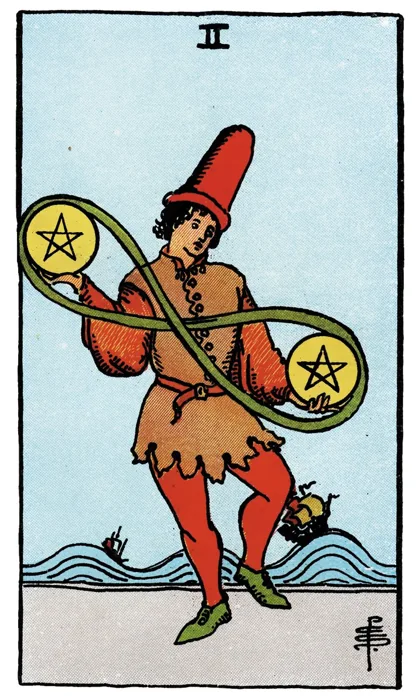
With Two of Pentacles
With the Two of Pentacles, changing demands need a flexible method. Simplify where possible and leave room for ordinary disruption. If the whole arrangement relies on flawless coordination every day, the design may need attention before the effort does.

With King of Wands
With the King of Wands, a strong vision benefits from careful coordination. Ambition can supply direction while Temperance attends to the conditions that sustain it. Make room for feedback from the people carrying the practical work of the plan.
The translator and the musician listening across the room
The translator carries meaning between different languages without assuming that every word has a simple equivalent. They attend to context, tone, and what the listener needs in order to understand. Temperance has this interest in relationships between forms, including what changes during the passage.
The musician in an ensemble listens while playing. Their own part matters, but its force and timing must answer the others. The result depends on responsiveness rather than on every player making the strongest possible sound at once. Restraint can serve expression without making the music timid.
The patient maker develops a material through repeated adjustments. They do not regard every correction as proof that the original intention was wrong. The work becomes itself through this conversation between an aim and the particular conditions of making.
Make one recurring day easier to inhabit
Choose a routine that regularly causes friction and write out how it happens. Include the preparation and the transitions between tasks, especially where someone's needs tend to be overlooked. Find a point where a small change could help. Perhaps a handover needs clarification, or there is simply too little time between one demand and the next.
Change that one part for a defined period and notice what improves or becomes harder. Keep the adjustment if it helps; revise it if the evidence suggests something else. Temperance becomes practical through this willingness to remain attentive after the plan has begun.
Artwork & interpretation
Waite describes the exchange between cups, the figure’s contact with land and water, and a distant path, interpreting the card through spiritual harmonisation. This guide develops an original everyday reading of proportion, integration, and responsive adjustment. A. E. Waite, The Pictorial Key to the Tarot: Temperance.
The symbolic associations and examples offer ways to read a situation. They do not establish another person’s thoughts or fix an outcome.
A workable balance responds to real needs; it does not require every demand to receive an equal share.
Use the cards in a spread →