Wands · Four
Four of Wands
A place where the effort can turn into enjoyment
The Four of Wands celebrates something people have made together. A milestone can give a group reason to gather, or a shared place may finally feel welcoming. There is enough stability for everyone to relax and take part, even while the larger story continues.
- Belonging
- Celebration
- Stability
- Welcome
15 min read
In this guide
There is somewhere to arrive
The preparations are finished, and the first people arrive. You can finally sit down with them and enjoy the room you have made ready. The Four of Wands captures that release. A part of life has become stable enough to be shared, even though the future remains uncertain. You can acknowledge the good in this occasion without waiting for everything else to be settled.
The Four of Wands often concerns feeling welcome somewhere. A home may begin to suit the people living in it, or a group may reach a milestone that gives everyone reason to gather. Hospitality makes that stability available to others. The card draws attention to what it feels like to participate in a place or occasion you have helped prepare.
A celebration can be as small as the first meal after a move. For a while, you sit among the boxes and enjoy having arrived. A team's pause after finishing a task may offer the same relief. There is no need to keep proving the result during that moment; you can join the occasion and let the effort already made be enough.
The Four marks a stable point in a story that will continue. People may have reached an agreement that makes their relationship easier to inhabit. A community may now meet regularly enough for that contact to feel dependable. Recognise what these developments make possible. They still need care, but the need to maintain something does not lessen the achievement of building it.
If your question concerns a difficult situation, the card can direct attention towards the conditions that make cooperation possible. People may need a clearer agreement, a welcoming setting, or a shared acknowledgement of progress. Sometimes a group cannot move forward because it has never paused long enough to recognise what is already holding together.
The image also asks who is included in the celebration. A place can feel warm to those already inside while remaining difficult to enter. A practical welcome helps someone take part. Fair arrangements also need to make room for differences among the people joining in. The atmosphere is only part of the story; the arrangements behind it matter too.
An open frame in front of a lived-in place
Four leafy staffs stand in the foreground, carrying a garland of flowers and fruit. Beyond them, two figures raise bouquets, with other people and buildings further back. The yellow sky gives the scene a bright, open quality. The staffs form a ceremonial frame, inviting the eye towards a place where life is already happening.
The structure is visibly simple. It defines a space without enclosing it in heavy walls. This suggests a useful kind of stability: enough shared form for people to gather, without making the gathering rigid. A household ritual, regular meeting, or clear agreement can serve the same purpose, providing familiarity while leaving room for living variation.
The raised flowers make celebration active. Someone is welcoming, acknowledging, or participating, rather than merely displaying a completed achievement. The card's pleasure has a social dimension. Even a private milestone can become more fully felt when it is recognised by someone who understands what the effort involved.
The buildings behind the gathering suggest continuity beyond the event. There will be ordinary days after this one. Reading the image closely invites us to consider both the special occasion and the durable setting that makes it possible: shelter, access, shared work, and enough trust for people to put down their guard.
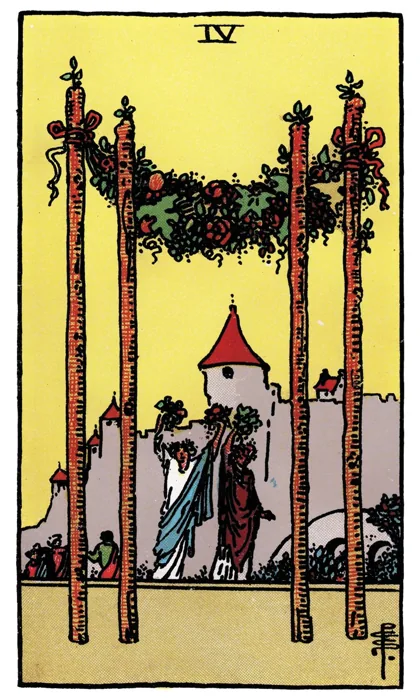
The garland turns a few supports into a recognisable place of welcome. Small shared rituals can make a transition visible without requiring extravagance. What matters is that the people involved understand what they are marking together.
The figures give the celebration life. A beautiful setting is only part of hospitality; people also need permission to enter, contribute, rest, and enjoy themselves. The occasion succeeds when its participants can actually inhabit it.
The relief of not having to earn your place today
Internally, the Four of Wands can feel like settling. You know your way around the kitchen and whom to call when you need something. Expectations have become familiar enough that you no longer have to keep checking them. Familiarity frees attention for pleasure and connection. This is a modest but powerful form of ease: a little less of the day is spent deciding whether you are allowed to be there.
For someone used to instability, ease may initially feel strange. You keep anticipating the next demand or wondering what the welcome will cost. The card can invite you to notice present evidence of reliability without forcing yourself to feel safe on command. Trust often develops through repeated ordinary experiences rather than one dramatic reassurance.
There may be pleasure in recognising your own contribution. Perhaps the room is finally finished through your efforts, or a friendship has deepened because you made time for it. An established routine can also be something you helped create. Let that fact register without immediately identifying the next flaw. Appreciation becomes more available when you stop treating every completed step as merely the minimum required to qualify for further effort.
The card can also bring discomfort around celebration. Perhaps attention embarrasses you, family occasions are complicated, or you do not enjoy the conventional way of marking a milestone. You can choose another form. A meaningful ritual should fit the people living through the transition, rather than requiring them to perform happiness in an unfamiliar language.
As a description of a person, the Four suggests someone who creates welcome and helps others feel included. This gift deserves reciprocity. The person who remembers birthdays, organises gatherings, or keeps a household connected should not become an invisible service. Belonging is healthier when its maintenance is shared and its maker can also be a guest.
Belonging is something people do
A home is partly a place and partly a pattern of response. What happens when you arrive tired, disagree, make a mistake, or change? The Four of Wands asks us to look beneath the attractive image of belonging towards these repeated interactions. A welcome becomes trustworthy through the conditions attached to it.
The card holds an interesting relationship between freedom and structure. Total openness can leave people uncertain about how to participate; excessive rules can make participation feel like an examination. A good shared space offers enough form to orient people and enough generosity to accommodate them. Its structure serves the life within it.
Pausing at a milestone helps you remember it. If each completed task immediately gives way to another, a year can feel like continuous work with little achieved. Marking the occasion gives a particular experience a place in that year. People can recall what happened and their part in it, including why the shared effort mattered to them.
There is a difference between a shared tradition and an obligation to repeat the past. A ritual can carry affection while changing its form as the people involved change. The card's stability is strongest when it can accommodate a new family member, an altered need, or a different way of participating without treating the change as a threat.
The deeper invitation is to make a place where life can be lived, rather than displayed. A home, team, or community does not need to look harmonious at every moment to support belonging. It needs ways to handle ordinary friction without withdrawing the basic recognition that people matter and have a place there.
Recognise the milestone and the people who made it
At work, the Four of Wands can concern a stage the team has completed together. Perhaps something is opening to the public, or a process finally works well enough to rely on. Make the recognition specific. Describe why the result matters and acknowledge the people who made it possible, including those whose necessary work usually attracts little attention.
A milestone can provide a useful pause before the next phase. Review what made the achievement possible, which practices should continue, and what strain should not become normal. Celebration loses credibility when it rewards people for surviving conditions that management intends to repeat indefinitely. Appreciation is stronger when it affects how the next stage is organised.
The card may also concern the working environment. Clear roles, welcoming introductions, reliable routines, and a usable space can transform how people participate. These arrangements are easy to dismiss as secondary to the real work, yet they often determine whether the real work can happen without constant confusion or unnecessary social effort.
For a creative project, a showing, launch, or small gathering can help the work cross from private effort into shared experience. Choose an occasion that fits the work and your capacity. You do not need an extravagant event to make the result legitimate. The important step is allowing it to meet people and have a life beyond preparation.
If you are joining a new team, observe how welcome operates after the first day. Are questions received with patience? Do people explain the unwritten rules? Can disagreement occur without social exclusion? The pleasant atmosphere matters, but its depth becomes visible through ordinary interactions when no one is consciously performing hospitality.
The shadow at work is forced togetherness. A team can call itself a family while expecting unlimited availability or making social participation a condition of acceptance. Healthy belonging respects boundaries. People should be able to contribute well without offering every private part of themselves in exchange for a place in the group.
Build a home the relationship can actually live in
In love, the Four of Wands can describe a shared milestone, an agreement about living together, a celebration, or the comfort of being welcomed into one another's lives. It is often associated with commitment, but the card does not promise marriage or prescribe one model of partnership. The meaningful question is what stability looks like for the people involved.
A relationship becomes more settled through practical understanding: how time is shared, how disagreements are handled, who does what, and what each person needs to feel at home. The grand declaration may matter, but these repeated arrangements give it substance. Affection becomes easier to enjoy when ordinary life does not continually undermine it.
When preparing for a wedding or family gathering, keep the people being celebrated in view. Expectations can accumulate until the occasion barely resembles anything they would have chosen. Ask which parts carry meaning for them and what they can comfortably manage. Considering the guests' ability to participate also helps the event express the relationship it is intended to honour.
For someone single, the card can bring attention to existing forms of belonging. Friendship, chosen family, neighbourhood, and shared interests can provide real intimacy and continuity. This does not diminish a wish for romance. It simply refuses the idea that a life must remain provisional until one particular kind of relationship arrives.
Family connections may be warm and supportive, but belonging can also come with pressure to remain familiar. Notice whether the welcome includes your present choices or depends on an older version of you. You can value a tradition while negotiating its terms, and you can create new rituals where inherited ones leave too little room.
In a strained relationship, look for one piece of shared ground that can be made real. This might be a fair agreement, a regular conversation, or a small enjoyable activity without unresolved demands attached. A pleasant evening does not erase a serious problem, but a reliable practice of care can support the work of addressing it.
Let comfort be usable rather than impressive
For home and resources, the Four of Wands favours attention to what makes a place workable: security, shared expectations, maintenance, and room for ordinary pleasure. A completed repair or settled household agreement may matter more than a decorative transformation. The best improvement is often the one that makes daily life easier to inhabit.
Celebrations can create financial pressure when affection becomes measured through spending. Agree on a scale that fits the people involved. A gathering should not require hidden resentment or debt in order to look generous. Hospitality can be expressed through thought, clarity, and shared effort as well as through what is purchased.
If you share a home, make practical contributions visible. Money, cleaning, planning, emotional coordination, and maintenance are different kinds of work. Fairness does not always mean identical contributions, but it does require a shared understanding that can be revised. The atmosphere of belonging is easier to sustain when one person is not silently financing it with exhaustion.
For a move or property question, use the card to clarify what home means to you, then examine the actual arrangement. A welcoming feeling does not establish affordability, sound condition, or secure terms. The image can help identify your priorities while the practical decision remains grounded in information about the place itself.
A good occasion leaves room to be a person
The Four can invite rest within company: a meal where you do not have to perform, a familiar room, or a gathering from which you can leave when tired. Notice which settings make your attention soften. Belonging is partly the freedom to participate at a human scale rather than remain constantly entertaining or useful.
Hosting and celebrating take energy. Build recovery and shared labour into the occasion instead of assuming the organiser's pleasure will somehow survive an impossible workload. A host who never sits down is also part of the scene. The event becomes more generous when the people making it possible can enjoy some of it.
If your energy is limited, choose a smaller ritual. One visitor, a quiet meal, or a short walk with someone can still mark a meaningful transition. The card is not a measure of health or a demand for cheerfulness. It asks what form of welcome or recognition is available in the life you actually have.
Make the welcome concrete
Mark something that deserves recognition. Be specific about the achievement or transition, then choose a form that suits the people involved. The aim is to let the experience register. Do not postpone all celebration until the final, perfect result; many worthwhile undertakings need moments of shared appreciation along the way.
If you want a stronger sense of home or community, establish one repeatable practice. A regular meal, a clear way to invite newcomers, or a shared responsibility can do more than a vague wish for closeness. Belonging becomes easier to trust when people know how it is expressed and when they can expect it.
The shadow is protecting the appearance of harmony at the expense of honesty. Someone raises a concern and is told not to spoil the occasion; someone feels excluded and is expected to be grateful for being present. A stable community can hear discomfort without immediately treating it as disloyalty.
Another shadow is mistaking a milestone for a permanent guarantee. After a celebration or the handover of keys, the new arrangement still needs ordinary care. Even a carefully made agreement has to be lived with. Let celebration strengthen your willingness to maintain what matters. Its purpose is not to exempt the relationship or undertaking from further attention.
The celebration may need a different shape
Reversed, the Four of Wands does not have to mean the loss of happiness or a broken home. It may describe a private celebration, a delayed milestone, or a form of belonging that does not fit conventional expectations. Before assuming trouble, ask whether the good thing simply needs to be recognised on its own terms.
The reversal can also expose an unstable foundation beneath an attractive occasion. Practical arrangements remain unclear, contributions are unequal, or people are expected to act harmonious without addressing a conflict. Identify the specific issue rather than declaring the whole relationship false. A repairable imbalance deserves a different response from a persistent refusal to respect someone's needs.
Sometimes you are physically present but do not feel included. The group has shared references you do not know, the invitation carries unspoken conditions, or an old role no longer fits. Consider what would make participation more possible. That may involve a conversation, a different level of involvement, or finding community in another setting.
An event may have grown beyond its purpose. The budget, guest list, and expectations now serve an image rather than the people marking the transition. Reducing the scale can restore meaning. You are allowed to prefer a small, honest occasion to an elaborate performance that leaves everyone involved depleted or resentful.
A constructive reversal can mean building a home outside an inherited model. The arrangement may look unfamiliar while offering real care and stability. Judge it by how people are treated, how responsibilities are shared, and whether the life inside it can grow. Conventional appearance is neither a guarantee of belonging nor a requirement for it.
What gives the gathering its meaning?
These combinations explore the foundations beneath celebration and belonging. They do not predict a wedding, a property purchase, or a particular family outcome.
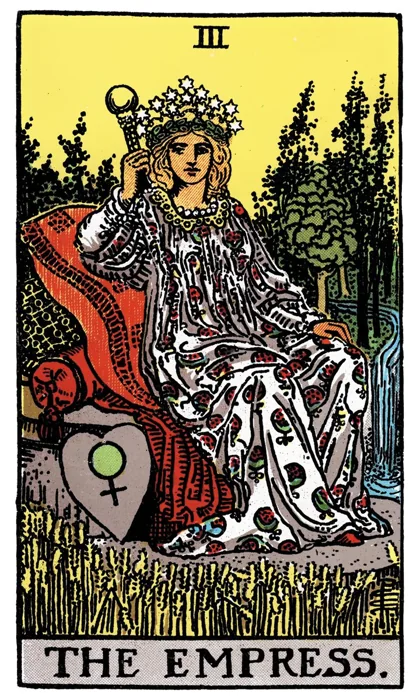
With The Empress
With the Empress, welcome takes a practical, sensory form. Food, comfort, beauty, and thoughtful care can make a place easier to inhabit. Notice the labour behind that ease and ensure the person providing it has room to receive care in return.

With The Hierophant
With the Hierophant, a milestone may be marked through a shared tradition or institution. Consider which parts of the ritual carry genuine meaning and which need adaptation. Belonging should leave room for the actual values and needs of the people participating.
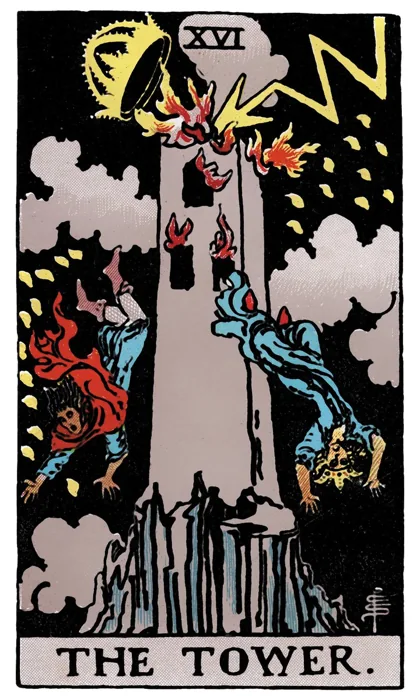
With The Tower
With the Tower, a familiar structure may be changing in ways that affect belonging. Focus on practical support and honest agreements rather than preserving a reassuring appearance. A disrupted arrangement can call for rebuilding, but the cards do not establish what event will occur.

With The Sun
With the Sun, a good moment can be enjoyed openly. Let the achievement or connection register without immediately qualifying it. Shared pleasure becomes more substantial when people can participate freely, including those who prefer a quieter way of joining the celebration.
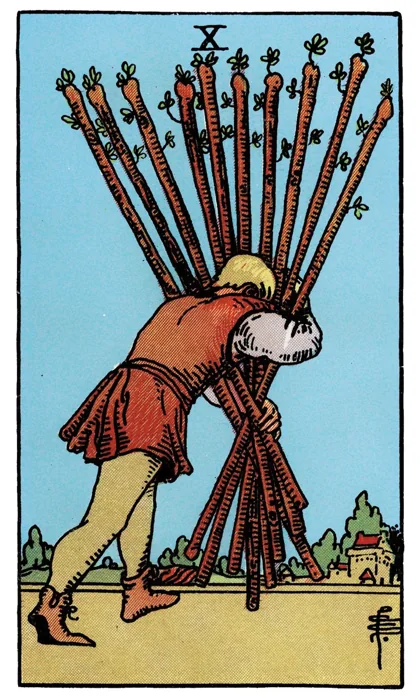
With Ten of Wands
With the Ten of Wands, the work of creating a happy occasion may be falling too heavily on one person. Simplify the plan and distribute responsibilities. A celebration of togetherness becomes more convincing when its preparation is also something people do together.
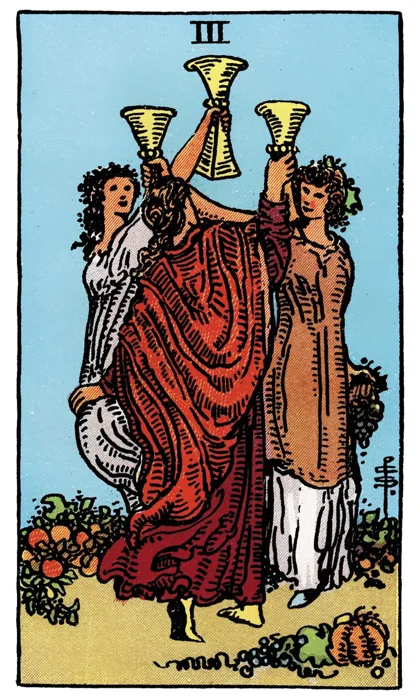
With Three of Cups
With the Three of Cups, friendship and mutual recognition are central. Gather around something that matters to the people involved. The value lies in shared presence and encouragement, rather than the size of the event or its appearance to an outside audience.

With Four of Pentacles
With the Four of Pentacles, the wish for security may make a home or group overly guarded. Consider what needs protecting and where generosity is possible. A stable base can support welcome without requiring that every boundary or practical limit disappear.
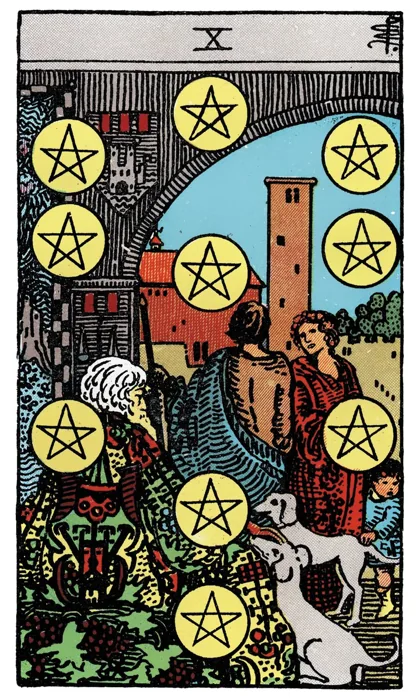
With Ten of Pentacles
With the Ten of Pentacles, belonging connects with family structures, continuity, or shared resources. Make the practical arrangements clear and consider whose needs the tradition serves. A durable home allows future members to participate without being confined to an inherited script.
How a welcome becomes an occasion people can share
The decorated threshold is an image of transition made visible. Ordinary space becomes the place where something is acknowledged: an arrival, an agreement, a season completed. The ritual need not be elaborate. Its power comes from shared attention, giving a change a form that people can recognise and remember.
The feast after work offers another echo. Effort becomes nourishment and conversation, and the people who laboured can see themselves as part of a shared result. This image also asks who cooks, serves, and clears away. The celebration is more complete when its final tasks do not quietly reproduce an unequal arrangement.
The shared table gives a continuing image of belonging. It has enough structure for people to know where to sit, yet its purpose is the life around it. A community can offer that same dependable support while leaving space for another chair. Its value comes from the life it makes possible, without needing to become an object of reverence.
Mark a milestone in a way you would actually enjoy
Choose something you have finished, established, or survived that has not been properly acknowledged. Decide what kind of recognition would feel meaningful: a meal, a message, a small gathering, or time in a place you love. Keep the scale manageable, and include the people whose contribution you want to recognise.
Then look at one setting where you want more belonging. Identify a concrete practice that could make welcome easier: clearer invitations, shared chores, a regular meeting, or permission to participate differently. The Four of Wands becomes practical when a warm idea takes a form that people can reliably use.
Artwork & interpretation
Waite connects the garlanded scene with refuge, domestic harmony, and prosperity, retaining a favourable reading even when reversed. This guide offers original contemporary interpretations of welcome, shared milestones, practical stability, and varied forms of belonging. A. E. Waite, The Pictorial Key to the Tarot: Four of Wands.
The symbolic associations and examples offer ways to read a situation. They do not establish another person’s thoughts or fix an outcome.
A good home makes room for the people living in it, including the versions of them that are still changing.
Use the cards in a spread →