Major arcana · 3
The Empress
A life needs more than permission to grow
The Empress pays attention to the body and the conditions it needs to thrive. Enjoyment matters here, as does responding to weariness. Something has room to grow if the care supporting it can continue.
- Cultivation
- Pleasure
- Abundance
- Care
15 min read
In this guide
Make a place where life can take hold
Someone opens the curtains and makes room at a crowded table. There is a place to sit now, with something good to eat. Nothing spectacular has occurred, yet it becomes easier to be there. The Empress is attentive to this difference. She understands that life responds to its surroundings, and that a welcome can be made from material things.
In a reading, the Empress often concerns the care that sustains growth. Pleasure and generosity have a place in that work, with attention to the body as well as creative life. A beginning is acquiring substance. An idea needs time to become a draft. A relationship develops through time together, while a household needs habits that make sharing a home possible. The card asks what will nourish the thing after the initial excitement has passed.
Her abundance need not mean wealth or an effortless season. It can be the capacity to make a satisfying meal from what is available, or to find room for a garden in a small space. A project that allows experimentation offers another kind of abundance. This should not be used to romanticise deprivation. Resourcefulness is valuable; it does not erase the importance of having enough.
The Empress often feels reassuring because she grants ordinary enjoyment a place beside ambition and responsibility. A life can be productive and still be inhospitable to the person living it. The card may draw attention to pleasures you keep postponing. A meal eaten with attention or time with someone you enjoy can belong in the day alongside its obligations. So can rest and physical affection.
She also introduces a complication. What grows requires resources, and growth can exceed the space prepared for it. Generosity may turn into an obligation that leaves little room for your own life. Even a cherished project can consume too much of it, while the comforts you rely on may become ways of avoiding a decision. The Empress is richest when her welcome includes an honest understanding of what can be cared for well.
The landscape participates
The Empress sits in a landscape full of life. Grain grows in front of her, with trees and flowing water beyond. Cushions and patterned fabric bring that abundance close to her body. Much of the meaning comes from this setting: she appears sustained by a world she belongs to. Prosperity extends throughout the image instead of being confined to an object she possesses.
The grain in the foreground is particularly practical. It can be admired as a texture, but it also represents something that feeds people. Beauty and use share the same field. Read this way, the card does not require a choice between making life lovely and making it workable; it asks how each can support the other.
Her crown, sceptre, and the Venus sign on the shield give her authority without removing her from the landscape. She is at ease, yet the picture is not simply an invitation to be waited on. A cultivated environment raises questions about the labour that supports it, including labour the viewer may initially overlook.
The robe's repeating pomegranates echo the density of the scene. Everywhere there is pattern, material, growth. That richness can feel nourishing or overwhelming, depending on what your life currently needs. The image offers a useful test: is there room to inhabit this abundance, or has fullness begun to crowd out breathing space?
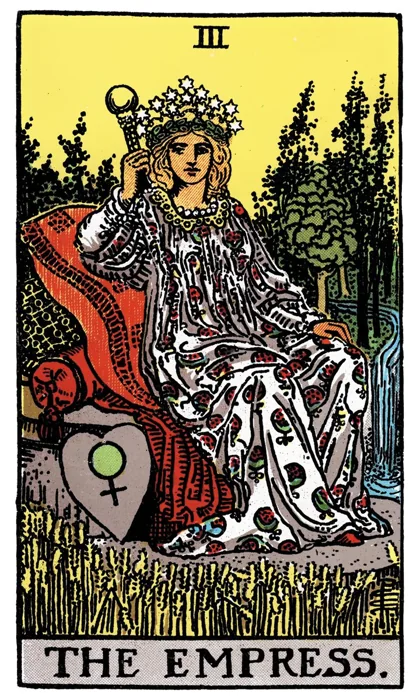
The symbol on the shield rests close to the growing grain. The image lets pleasure and material sustenance occupy the same space, rather than making one an afterthought.
Her surroundings are part of her presence. The card encourages attention to the conditions that shape a life: what shelters it, what feeds it, and what it must share.
Coming back into your own life
As an inner state, the Empress can feel like appetite returning. You become interested in cooking, making something with your hands, dressing in a way that pleases you, or spending time where there is texture and colour. After a period lived largely through obligation or analysis, these interests can be signs of renewed participation in everyday life.
There is permission here to have preferences. You may know how to accommodate everyone else while drawing a blank when asked what you would enjoy. The Empress takes that question seriously. Your answer need not be impressive, useful, or easy to defend. Liking something is already a form of information about your relationship with the world.
As a person, she can be warm, inventive, affectionate, sensuous, and good at making others feel welcome. She notices when someone has not eaten and makes the room comfortable for those arriving. That attention can extend to a fragile idea that needs encouragement before criticism. These qualities belong to people of any gender and do not depend on being a parent.
The more difficult personality pattern is a need to be needed. Care becomes the main route to belonging, so another person's independence feels like a withdrawal of love. Offers acquire invisible conditions. The giver may be sincerely generous while also keeping a private account of how that generosity should be repaid.
Her maturity appears when care and self-respect can coexist. She can be clear about her own needs while offering something freely. Another person can decline without having to reassure her about the relationship. Receiving care matters too. If you can provide comfort but cannot accept it, your role may have become more important than the mutual relationship it was meant to serve.
What growth needs from its surroundings
The Empress asks what would make the life you want possible to live. Your body needs food and sleep, and sustained effort leaves you needing rest and company. A creative project requires time in a place where you can work with few interruptions. Those conditions shape what you are able to make, although the finished result rarely shows how much depended on them.
She also challenges the fantasy of complete self-sufficiency. Much of what allows you to act has been grown, prepared, taught, cleaned, maintained, or offered by someone else. Recognising this does not diminish your agency. It makes gratitude more specific and responsibility more honest: what sustains you, and how is that source sustained in return?
Cultivation has its own discipline. You cannot pull a seedling taller without damaging it, but leaving it entirely unattended is not necessarily kindness. Good care requires observation, adjustment, patience, and sometimes restraint. The relevant question changes as the thing grows. What protected a beginning may eventually prevent it from developing.
The card's deeper generosity includes making room for an outcome that is not a replica of your intention. A child, collaborator, garden, or work of art will answer the conditions you provide in its own way. To nurture something is to enter a relationship with that response. The result belongs partly to a life beyond your plans.
Affection with a daily life
In love, the Empress gives attention to the felt quality of being together. Is there warmth, ease, curiosity, and room to enjoy each other's presence? Grand declarations can coexist with a daily atmosphere in which one person feels neglected or perpetually assessed. The card looks toward the smaller exchanges through which affection becomes believable.
She can describe attraction with a strong bodily dimension: touch, scent, shared food, pleasure in another person's nearness. Desire does not have to prove a larger destiny in order to matter. It does need mutual consent and an interest in the actual person, whose wishes may differ from the role imagined for them.
In established relationships, care often takes practical form. Someone remembers a difficult day, makes space for rest, or takes responsibility without waiting to be instructed. Yet care is not fully measured by the effort spent giving it. A partner may need conversation where you offer solutions, or company where you offer a gift. Warmth becomes more useful when it listens.
Nurturing can gradually turn into managing the other person. Someone who anticipates every household need may also correct how every task is done, until they carry almost all the responsibility. Their partner has fewer chances to contribute and may begin to withdraw. Resentment grows as the exhausted carer wonders why they receive so little help, while the other person doubts that any help they offer will be accepted.
The Empress is often linked symbolically with fertility and motherhood, but drawing her does not establish pregnancy or promise a child. Those associations can also concern making a home, mentoring, creative work, or a wish to care for something beyond yourself. Let the actual question and the person's circumstances determine which meaning belongs in the conversation.
For someone single, the card need not become an instruction to perfect yourself until a partner arrives. It can ask what kind of relationship you are building with your present life. Friendship, pleasure, hospitality, and a home that feels like yours have value now. They are more than rehearsal for being chosen.
The part after the idea
At work, the Empress concerns development: turning something promising into something substantial enough to survive use. This may involve editing, testing, teaching, improving a service, or giving people the resources to perform well. The first idea matters, but so does the patient attention that makes it more than an attractive beginning.
Creative work benefits from her tolerance for messy growth. A draft can contain awkward sections, unresolved passages, and more material than the final form will need. If everything must look accomplished immediately, there is little room to discover a direction you could not have planned. Protect the making long enough for it to offer surprises.
Encouragement should remain particular. Telling someone they are wonderful can be pleasant; noticing what is alive in their work gives them something to develop. The Empress at her best can identify a promising line, a useful instinct, or an unexpected strength without requiring the whole piece to justify the praise.
Leadership brings questions about the working environment. Are the tools adequate? Are deadlines realistic? Does the person doing invisible coordination have time and recognition for it? A team can be told it is valued while operating under conditions that steadily exhaust it. Care becomes credible when it affects those conditions.
The excess is perpetual incubation. Collecting inspiration and adjusting the workspace keep you occupied. They can also reassure you that the project is developing while you postpone showing it to an audience. Cultivation includes harvest. Something may be ready to leave the protective environment even if it could still be improved.
Enough, and the temptation of more
In material life, the Empress asks what resources actually make your days better. A comfortable chair used every evening may matter more than an impressive object you rarely enjoy. Good food, reliable tools, and a little room in the schedule can offer a more tangible sense of abundance than accumulating things whose main function is to announce success.
Pleasure belongs in this conversation without needing either apology or unlimited permission. A purchase can be genuinely enjoyable and still exceed what you can comfortably spend. The card encourages a relationship with resources in which enjoyment remains connected to the conditions that sustain it. Future strain is part of the cost of present comfort.
At home, the question may be whether the space supports the lives actually being lived there. A beautiful arrangement that nobody is allowed to disturb can become strangely inhospitable. Equally, endless accommodation of everyone else's habits can leave you without a place that reflects your own needs. A living home has room for use and negotiation.
Notice the work that makes a household appear to run by itself. Meals require planning before anyone shops or cooks, and preparing for visitors starts long before they arrive. Someone remembers the supplies everyone uses. When that effort goes uncounted, one person's exhaustion can remain hidden. Discussing who does it gives the household a chance to share it fairly and keeps generosity from becoming a permanent obligation.
A body is not an obstacle to the plan
The Empress returns attention to physical experience without asking the body to become another improvement project. You might notice what feels comfortable, which environments leave you tense, or whether you regularly postpone basic needs until they become urgent. Sometimes the useful change is ordinary enough to seem beneath the seriousness of the problem.
Pleasure can restore interest and connection, but it can also become the only permitted way to recover from a life that continually depletes you. If every difficult evening requires spending, eating, scrolling, or another form of compensation, consider the conditions producing the need. The issue may be larger than the particular comfort you reach for.
A reading of the Empress cannot tell you whether you are fertile or explain a health condition. It offers no promise of recovery. You can use it as a reminder to attend to bodily needs and seek appropriate care for a concern. That attention remains worth giving on an unproductive day, before suffering becomes obvious, and while other people still have needs of their own.
Include your own needs in the care you give
As advice, the Empress asks for a concrete act of cultivation. Improve the conditions around one thing you want to grow: give the project a regular hour, make the conversation less rushed, put useful materials within reach. Instead of demanding more enthusiasm from yourself, make participation a little more possible.
Give enjoyment a place in an ordinary day. Agreeing that you ought to appreciate life changes little if you keep postponing every opportunity. Choose something small you would actually enjoy and allow time for it. You do not have to produce gratitude on demand; simply notice what it is like to stop treating pleasure as an interruption to more important work.
Her shadow is smothering abundance. Advice can keep arriving after a decision has been made. Food or other gifts may exceed what someone wants, leaving them responsible for beautiful things they have no room to use. A gift can occupy space the recipient did not offer. Before adding more, ask whether the situation needs nourishment, freedom, or a little less of your involvement.
Care also has a limit. You can support someone's effort without assuming ownership of the outcome. When your help repeatedly requires abandoning your own needs, the arrangement deserves revision. Naming a boundary does not cancel the affection that made you want to help in the first place.
When giving and growing lose their balance
Reversed, the Empress can describe depletion beneath an appearance of generosity. You still host the gathering and remember what everyone needs. While offering encouragement, you may privately wish someone would recognise how much this asks of you. The wish is understandable, but others may have come to believe that this is simply what you enjoy doing. A direct account of the workload may be necessary.
She can also indicate difficulty receiving. Kindness makes you uncomfortable because you cannot immediately repay it, or rest feels undeserved unless you have exhausted yourself first. The result is a life in which care flows outward but has no easy route back. Try accepting something modest without turning it into a debt you must clear at once.
Creative blockage may arise from overprotection. The idea is so precious that any imperfect attempt feels like damage. It remains immaculate in imagination and unavailable in the world. A deliberately rough version can help separate the living possibility from the requirement that its first appearance already be beautiful.
Another reversal is neglect disguised as freedom. A relationship, home, or project has been left to look after itself because attending to it would interrupt a more exciting pursuit. Growth is not always automatic. Notice what has survived on old effort and what now needs a renewed, realistic commitment.
The reversal can be a useful subtraction: fewer obligations, less compulsory hospitality, more space for your own appetite. The question is where care has become excessive, absent, or conditional. Adjusting that relationship may do more than adding another supposedly nourishing activity to an already crowded life.
What kind of growth is taking place?
The cards beside the Empress can change how you understand care in a reading. These pairings consider what makes care possible and where its limits lie, without predicting an event.
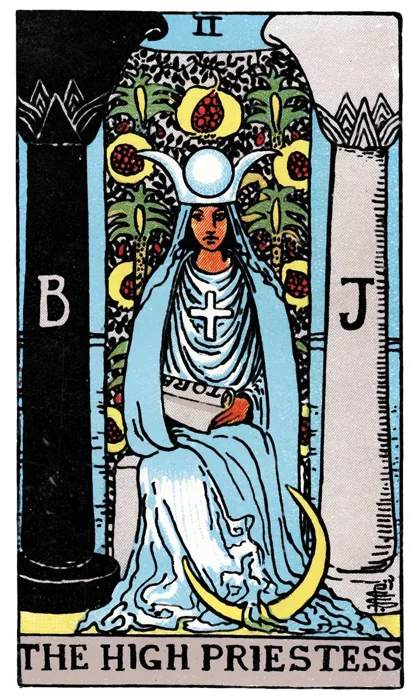
With The High Priestess
With the High Priestess, a private possibility is becoming ready for material attention. An idea may need a workspace; a feeling may need expression through shared time. Preserve some privacy while giving the emerging thing enough substance to develop.

With The Emperor
With the Emperor, care meets structure. Warmth benefits from dependable arrangements, and a good arrangement leaves room for human needs. Notice whether responsibilities are genuinely shared or whether one person supplies affection while the other claims all the authority.
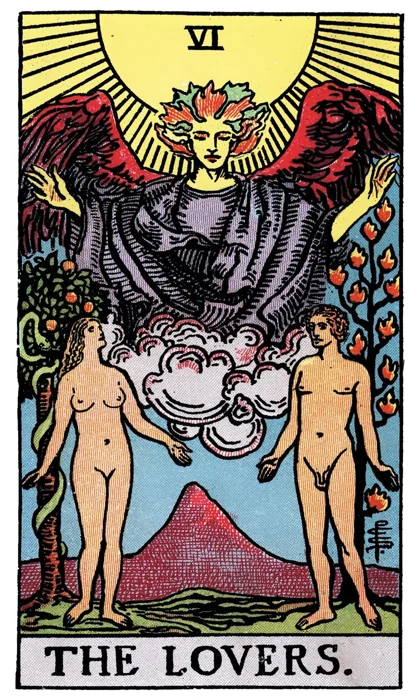
With The Lovers
With the Lovers, attraction asks to become a conscious relationship. Enjoyment and tenderness may be strong, but the pairing also invites attention to mutual choice. A beautiful connection still needs room for two people to want, speak, and decide.
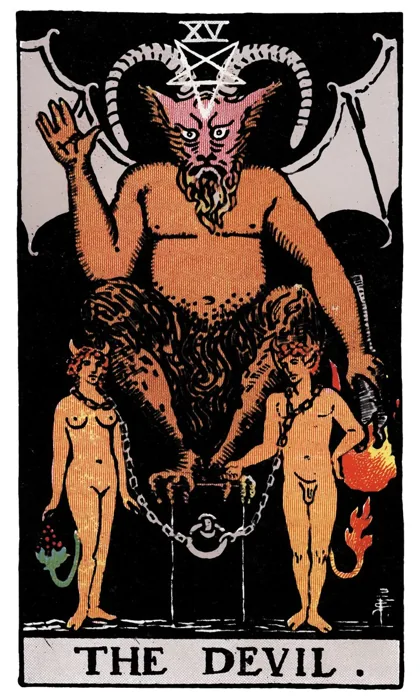
With The Devil
With the Devil, comfort may be tangled with dependency or excess. Something pleasurable can carry a cost that becomes difficult to acknowledge. Look at the actual freedom to decline, change the arrangement, or enjoy something without needing more of it.
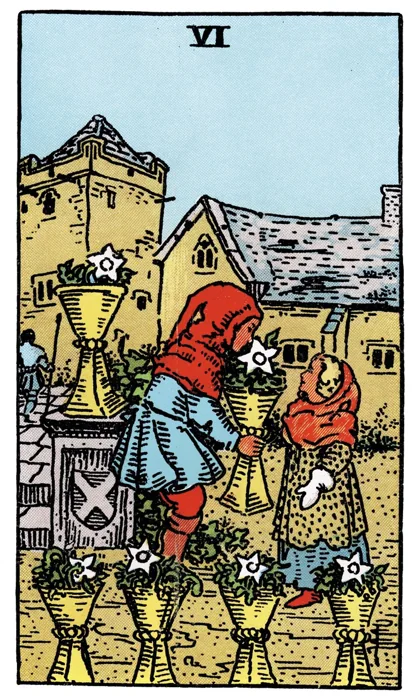
With Six of Cups
With the Six of Cups, care may follow a familiar family pattern. A remembered kindness can be a resource; an inherited expectation can quietly dictate who gives and who receives. Keep what is nourishing without assuming the old roles must remain.
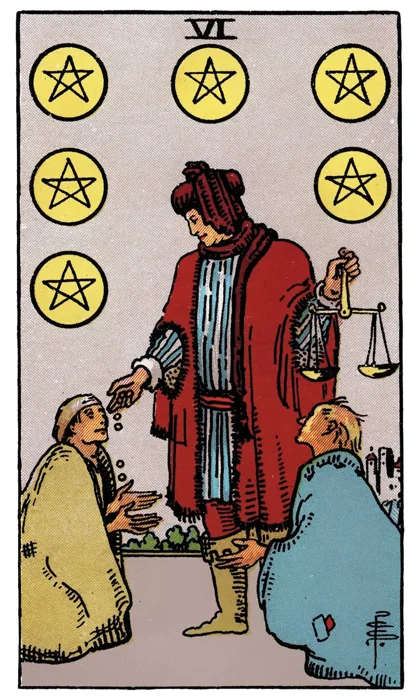
With Six of Pentacles
With the Six of Pentacles, generosity has a visible structure. Who decides what is given, and what response is expected? Help can be valuable while still creating an imbalance. Clear terms allow both gratitude and dignity to have a place.
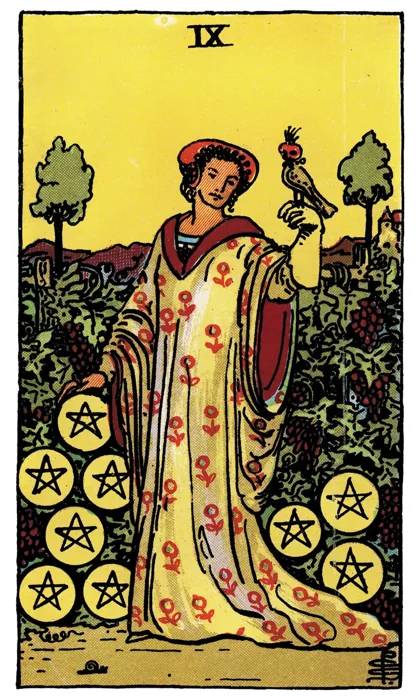
With Nine of Pentacles
With the Nine of Pentacles, pleasure is supported by cultivated independence. You may be learning to inhabit what you have worked for. Consider whether your comfort includes enough freedom and company, rather than requiring constant vigilance to keep everything immaculate.
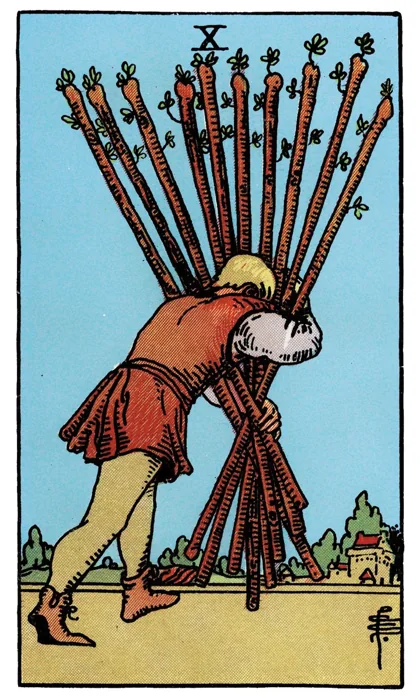
With Ten of Wands
With the Ten of Wands, tending everything has become too much. The task is to identify which responsibilities can be shared, simplified, or released. Exhaustion does not prove that you care more; it may show that the arrangement needs help.
The gardener and the crowded table
The gardener offers a useful image for the Empress because attention must answer a living process. Different plants need different conditions, and the same plant needs different care across time. More water is not always more kindness. Good cultivation includes noticing when the familiar method has stopped helping.
The host brings another aspect: creating a space where people can arrive as themselves. A generous table offers enough without turning enjoyment into a performance of gratitude. At its darker counterpart, guests feel obliged to eat unwanted food and repeatedly praise the host's effort. Expressing a different preference risks upsetting the person who invited them.
The artist belongs here too, particularly in the untidy phase when an idea is being given substance. Materials resist, accidents suggest directions, and the work develops a character of its own. The Empress can enjoy this relationship without reducing creativity to either effortless inspiration or relentless self-discipline.
Improve the conditions around one thing
Choose something you want to flourish and describe what it receives in an ordinary week: time, attention, materials, rest, company, or space. Then name the condition most obviously missing. Be specific enough that a change would be visible. A wish to be more creative is broad; an uninterrupted hour with the materials ready is usable.
Make that change at a scale you can sustain. Include your own needs in the arrangement, and leave room to observe the response. The Empress does not require you to make everything bloom. She asks whether what matters to you has been given a fair chance to live.
Artwork & interpretation
Waite describes the starry crown and Venus shield, with ripe grain and water around the figure. He associates her with embodied life and fruitfulness. This guide draws on those images to consider how people cultivate what they value, including the pleasure of caring for something and the material support that growth requires. A. E. Waite, The Pictorial Key to the Tarot: The Empress.
The symbolic associations and examples offer ways to read a situation. They do not establish another person’s thoughts or fix an outcome.
Care helps another life grow. Possession insists that it grow in the direction you prefer.
Use the cards in a spread →