Major arcana · 2
The High Priestess
What you notice when you leave a question open
The High Priestess takes time with an experience she cannot yet explain. You may have noticed something that matters without knowing what it means. Allow the uncertainty to remain while you learn more.
- Discernment
- Privacy
- Receptivity
- Ambiguity
14 min read
In this guide
There is more here than has been said
Someone answers a question perfectly reasonably, and something in the answer still catches your attention. The timing may seem unusual, or you may have noticed something the person left out. Even a change of tone can stay with you. You cannot yet say what it means. The High Priestess belongs to that interval between noticing and explaining. She takes perception seriously without treating the first interpretation as a verdict.
In a reading, this card can describe incomplete information, a private matter, a period of observation, or knowledge that is difficult to put into words. The situation may need more listening before another intervention. This is particularly relevant when everyone is offering confident opinions and nobody has established what actually happened.
Her quiet is active. She takes time to distinguish what was actually said from what she assumed. A detail that did not fit stays in mind while her impression develops. A patient reader sometimes understands a difficult passage on the third visit because the earlier encounters have changed what can be seen. The High Priestess recognises this kind of knowing.
The High Priestess is often associated with intuition. An impression can draw on experience you have not consciously put into words, though fear and old expectations can influence it too. Look back at what you actually noticed. Consider more than one explanation, including what you hope is true, and ask what further information would help you judge between them.
As a person, she may keep her observations to herself and choose carefully when to share something private. In a situation, she can suggest that you have only part of the story. This alone gives you no reason to assume deception. A decision may still be developing, or someone may need privacy. Leave room for what you do not know without turning the uncertainty into a mystery that consumes your attention.
The curtain is part of the picture
The seated figure occupies the space between a dark pillar and a light one. The letters B and J are visible, but the immediate visual fact is the contrast: two strong alternatives framing a person who belongs wholly to neither. You can read this as the capacity to remain attentive while a question still admits more than one answer.
Behind her hangs a patterned curtain. Its palms and pomegranates offer abundant detail while concealing whatever lies beyond. A screen does two things at once: it withholds a view and creates a surface on which the viewer's imagination can work. Notice how quickly an unseen space becomes filled with your own expectations.
The scroll on her lap is partly covered by her clothing. Knowledge is present, but it is not laid out as a public demonstration. The image suggests reading, holding, and interpreting. It also leaves a practical question open: when does partial disclosure preserve necessary privacy, and when does it give the keeper of information too much power?
The blue of her robes and the crescent near her feet contribute to the picture's stillness. Her crown draws the eye back to a face that reveals little outward movement. You might recognise the expression of someone listening closely or slowly understanding something difficult. Much can happen in a person's thoughts before there is any visible sign of it.
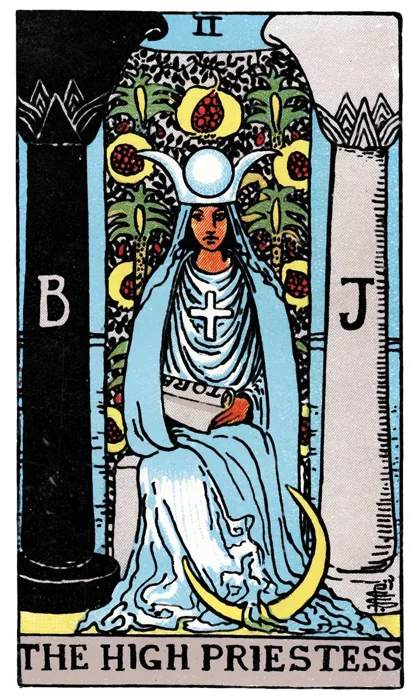
The contrasting pillars frame a figure who remains in the middle. The composition makes room for an understanding that has not yet settled into either side.
The scroll is neither absent nor fully displayed. Its partial visibility invites a distinction between information you lack, information withheld, and meaning that needs time to emerge.
An inner life with a door of its own
The High Priestess can describe a period in which your inner life is more active than your social life suggests. A conversation keeps returning to you. A former ambition no longer feels convincing. You may be carrying a question that becomes less clear when you try to explain it too early to people who immediately offer solutions.
Privacy gives that question time to develop. You can change your mind without announcing each stage of the process. Writing in a journal may help you recognise connections between thoughts that seemed unrelated. A walk or unhurried reading can offer a similar interval. Allow yourself to hear the thought more clearly before requiring it to become a revelation worth sharing.
As a temperament, this card can suggest someone who notices more than they disclose. They may be an attentive listener and an excellent judge of atmosphere. Others sometimes project wisdom onto such a person because the silence leaves room for an idealised image. Being quiet does not make someone all-knowing, and being seen that way can become its own confinement.
A more difficult version appears when you begin to treat your interior interpretation as the only trustworthy account. You read meaning into delays, expressions, and coincidences, while direct explanations seem disappointingly ordinary. If no possible response could change your understanding, the process has stopped being receptive. It has become a closed system.
The mature High Priestess can remain private and still be answerable. She can say that something feels wrong without claiming to know another person's motives. She can revise an impression when new information arrives. There is strength in that modesty: it preserves the sensitivity while removing the demand that sensitivity must always be right.
Living beside what you cannot yet know
Incomplete knowledge is an ordinary part of life. Another person's experience always extends beyond what they tell you, and even your own responses can take time to understand. You cannot know exactly how a choice will feel a year from now. The High Priestess asks you to make room for these limits instead of treating every unanswered question as something you should be able to resolve immediately.
Her deeper challenge is to resist both premature certainty and endless suspension. Some questions benefit from waiting; others become more painful because waiting has replaced a necessary conversation. Discernment includes recognising which kind of uncertainty you are living with. The absence of an answer does not, by itself, tell you to remain still.
There is also a difference between mystery and mystification. A poem can retain depth after careful explanation because there is more to encounter. A manipulative person may insist that ordinary questions prove you are incapable of understanding them. One invites sustained attention; the other uses obscurity to avoid accountability.
This card can be read as a relationship with the unspoken parts of experience: grief before it has a name, an attraction you have not admitted, a conviction that is quietly losing its authority. These do not need immediate public interpretation. They do need an honest place in your own awareness, where ambiguity can remain alive without becoming an excuse.
Intimacy does not abolish privacy
In relationships, the High Priestess often draws attention to the space between what is felt and what is expressed. Two people may sense an attraction without speaking about it. A long partnership may contain a concern that both approach indirectly. The card can make that silence visible, but it cannot tell you what another person secretly feels.
Reserve can be attractive because it allows imagination to participate. The person seems deep, composed, perhaps unusually understanding. Take time to discover whether there is a relationship beneath the atmosphere. Shared affection becomes clearer through actual contact, mutual interest, and choices that include both people. An intriguing absence is not yet evidence of connection.
Privacy deserves respect even in close relationships. A partner does not owe you unrestricted access to every thought, message, or memory. At the same time, privacy cannot settle every disagreement about shared life. Information that materially affects an agreement may need to be discussed, even when the discussion feels exposing.
The card's more difficult pattern is indirectness becoming a test. You hope someone will notice that you are hurt without telling them, or believe that asking for care would make it less meaningful. The longing to be understood is real. Making understanding depend on accurate mind-reading can leave both people increasingly alone.
A small disclosure can help another person understand your silence. You might explain that a subject is difficult to put into words and that you need time to answer. You can keep the details private while giving them a reliable account of where you stand. With that context, they have less reason to invent an explanation for the distance between you.
The value of listening before you enter
At work, this card favours observation, careful research, close reading, and attention to the unofficial life of a situation. A new role has written responsibilities and an unwritten culture. Watch how a decision is made in practice, including whose knowledge is consulted. Notice any difficulties people avoid naming before assuming the written procedure explains the whole situation.
This is useful for interviewing, editing, research, and any work in which the first explanation is likely to be incomplete. Let a person finish. Leave a little space after an answer. Revisit a note that seemed peripheral. Often the important distinction appears when you stop trying to make the material confirm your proposed account.
Creative work sometimes benefits from time out of view. An idea may still be finding its form when someone asks who it is for or how you intend to present it. Answering too early can pull the work towards familiar expectations. Develop enough of it that a reader can respond to what you have made, giving you feedback you can actually use.
There are limits to waiting. A colleague cannot respond to a difficulty you have never raised, and a project cannot be assessed on the basis of insights you keep entirely private. The High Priestess is most helpful when observation eventually improves an action, explanation, or decision. Otherwise contemplation can become a refined form of postponement.
Confidentiality also belongs here. Being trusted with information creates an obligation to handle it carefully. It does not entitle you to use your access as social currency. If you must communicate a concern, choose the appropriate person and the necessary detail, rather than enlarging your importance through hints about what you know.
Read what the attractive story leaves out
In practical matters, the High Priestess asks for attention to information that has not reached the centre of the discussion. There may be terms you have not read, recurring costs you have not counted, or an assumption about shared resources that nobody has actually agreed to. A quiet review can be more useful than another confident forecast.
A strong feeling about an opportunity deserves investigation, not automatic obedience. Write down the particular detail that produced the feeling. Is the timetable unexplained? Are questions answered evasively? Does enthusiasm depend on your not checking something? Specific observations are easier to evaluate than a general conviction that something is meant for you.
At home, the card may concern personal space and the right to withdraw without being treated as hostile. A room, shelf, routine, or period of uninterrupted time can protect an inner life. Shared households function better when these needs are expressed plainly instead of emerging only as irritation when someone unknowingly crosses them.
Shared money introduces a boundary to privacy. Each person may reasonably want some independence, while still needing enough common information to make informed commitments. Secrecy becomes consequential when someone is expected to consent to an arrangement whose relevant facts they cannot see. The question is what must be knowable for the agreement to be fair.
Quiet enough to notice your own pace
The High Priestess can invite a reduction in competing input. Constant commentary, messages, and requests for an immediate opinion leave little room to recognise what you actually think. An interval without consumption can feel strangely empty at first because attention has become accustomed to being given an object every few seconds.
Rest may involve letting an experience unfold at its own pace. Read slowly if you want to, or take a walk without trying to fill every quiet moment. Choose somewhere you feel free from other people's expectations for a while. You may notice how tired you are, or recognise a wish you have kept postponing. The time can be worthwhile even when it brings no particular insight.
The card does not turn bodily feelings into diagnoses or make dreams reliable warnings. If a physical or psychological concern persists, it deserves appropriate attention beyond the cards. Symbolically, the High Priestess asks whether you have allowed your experience to be heard; she cannot determine its medical explanation.
Check what you heard against what you assumed
Her advice is to make a little room before deciding what an experience means. Record the observation separately from the interpretation: they changed the subject is different from they are hiding something from me. This distinction does not dismiss the concern. It gives you a clearer starting point for finding out whether the concern is supported.
Choose where to place your attention. Listening to everyone can be as distracting as listening to nobody. Return to the person, document, conversation, or piece of work that actually bears on the question. The answer may be less dramatic than the surrounding speculation and more useful because of it.
The shadow is withdrawal acquiring an aura of superiority. You may come to expect others to trust an insight you will not explain. Your motives seem too complex to discuss, and you take offence if anyone interprets your silence unfavourably. A meaningful interior life does not require making other people feel shallow. Depth can be generous, precise, and willing to speak.
Another shadow is waiting for an unmistakable inner signal before making an ordinary decision. Some choices remain uncertain even after thoughtful reflection. At that point, choose according to the information and values available, and leave room to revise. A decision can be responsible without arriving with the feeling of destiny.
When silence stops helping
Reversed, the High Priestess may describe difficulty hearing yourself beneath the volume of other people's interpretations. You consult another source, seek another opinion, reread another message, and become less able to recognise your own response. More input has stopped increasing understanding. The next useful step may be to let the existing information settle.
The reversal can also point to distrust of your observations. You notice a recurring inconsistency and immediately explain it away because raising it would be uncomfortable. You do not need to accuse anyone in order to ask a specific question. A concern can be treated seriously before you know whether its eventual explanation will be troubling or ordinary.
At the other extreme, a private interpretation may have become too authoritative. Every ambiguous event confirms it; every clear contradiction is treated as further concealment. This is a moment to seek a grounded perspective and consider what evidence would actually change your view. A belief that cannot be questioned cannot learn from what happens.
Sometimes the reversal is constructive: something private is ready to be expressed. You may be ready to ask the question you withheld or show someone a draft. Naming a feeling can be another way to begin. Disclosure does not have to be total. You can choose one accurate statement and an appropriate listener, allowing the inner material to meet a response without exposing everything at once.
What changes the quality of the silence?
Read these pairings as possible conversations between the images. The neighbouring card can suggest whether quiet is supporting understanding, concealing a difficulty, or preparing a useful act.
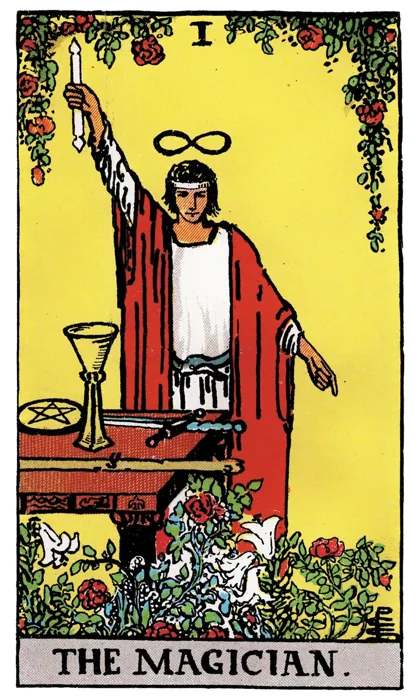
With The Magician
With the Magician, perception seeks a usable form. You may understand something inwardly that now needs an explanation, demonstration, or precise question. The tension is between speaking too soon and holding the insight so privately that it never helps anyone.
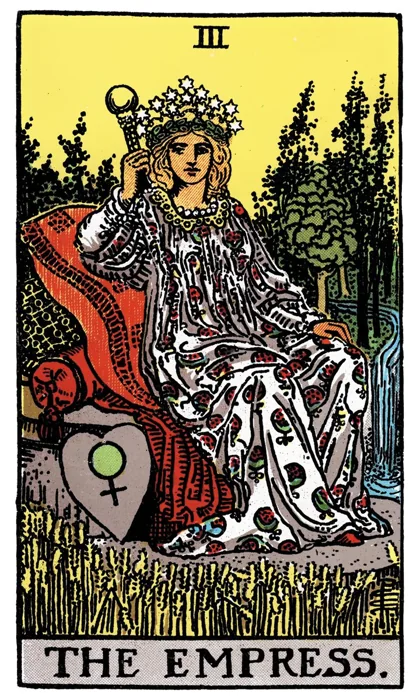
With The Empress
With the Empress, an inner possibility needs conditions in which to grow. A creative idea may require materials, time, and ordinary care. The pairing can also distinguish private feeling from the visible ways care is offered and received.
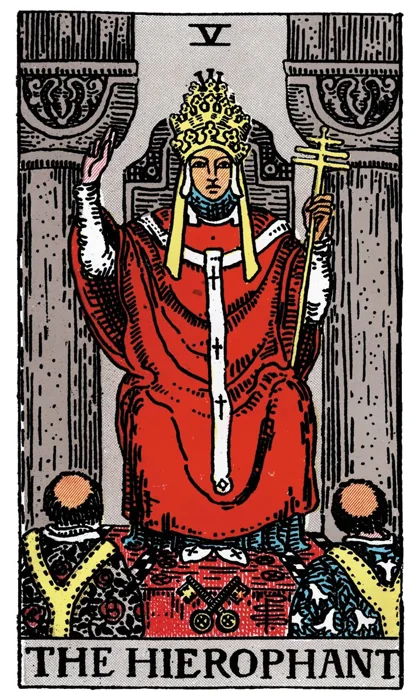
With The Hierophant
With the Hierophant, personal understanding meets an established teaching. You may find language for something previously difficult to articulate, or recognise a difference between your experience and the accepted explanation. Neither private conviction nor institutional authority needs to end the inquiry.
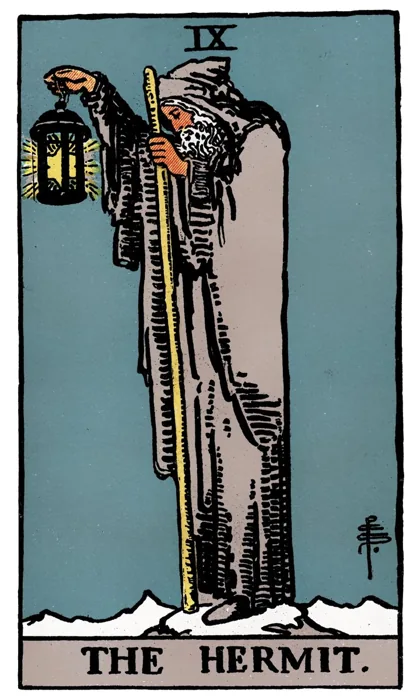
With The Hermit
With the Hermit, solitude becomes especially prominent. This can support study and honest reflection, but notice whether withdrawal is producing greater clarity or simply reducing contact with anything that could challenge your account. A protected interval benefits from a way back.
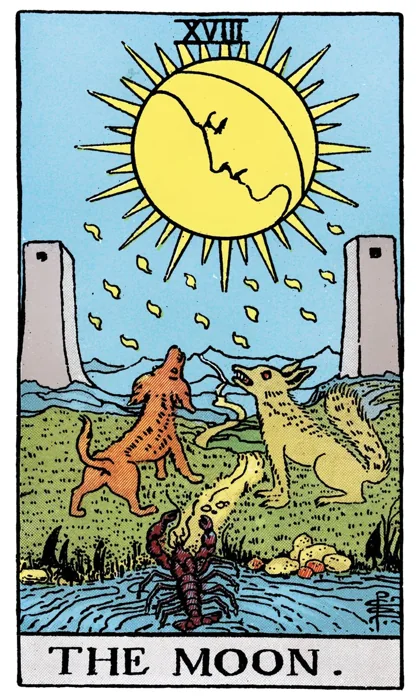
With The Moon
With the Moon, ambiguity may become emotionally charged. Separate an uneasy atmosphere from the facts available. Dreams and associations can reveal what occupies your mind, but they cannot establish what another person has done or what is about to happen.
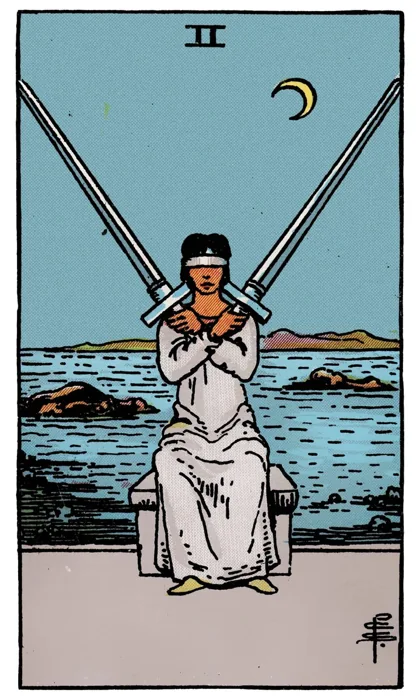
With Two of Swords
With the Two of Swords, withholding judgement may have become a stalemate. Consider whether more information is genuinely needed or whether the available choices are simply uncomfortable. Quiet observation helps only while something is still being learned from it.
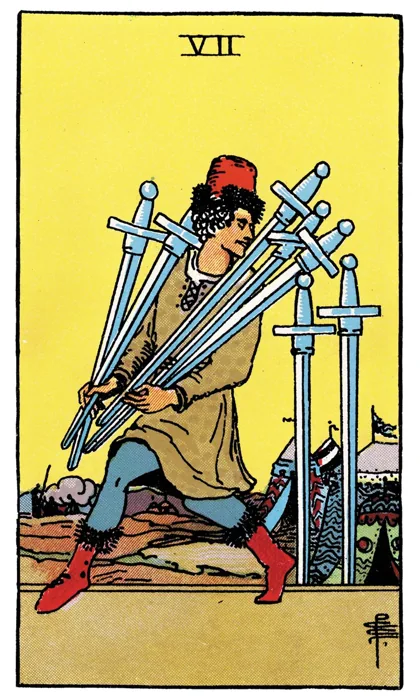
With Seven of Swords
With the Seven of Swords, selective disclosure comes into focus. There may be a sensible need for discretion, or an arrangement in which relevant information is unevenly shared. Ask what needs to be explicit for everyone affected to make an informed choice.
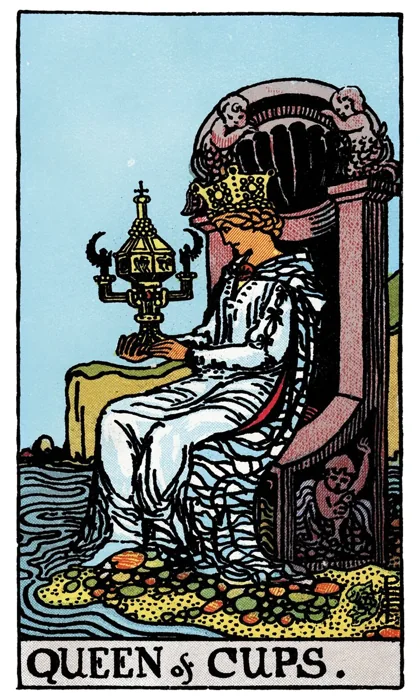
With Queen of Cups
With the Queen of Cups, sensitivity is accompanied by emotional care. This can be a deeply attentive conversation, provided neither person assumes they already know the other’s interior life. Understanding grows through listening and checking, as well as through resonance.
People who give an experience their full attention
The High Priestess can evoke the keeper of a threshold: someone who understands that access and readiness are not the same thing. A demanding book is available to anyone who opens it, yet different parts become intelligible at different moments. Experience changes what a person can bring to the encounter.
She also resembles the attentive reader who resists the temptation to reduce a complicated work to its message. Contradictions, pauses, and unresolved images remain part of the meaning. Applied to people, this quality allows someone to be more than the role they perform or the explanation you have found convenient.
The troubling counterpart is the self-appointed keeper who makes obscurity a source of status. The explanation remains reserved for a supposedly higher level of understanding. Whenever someone asks how to reach it, the question itself is treated as proof that they are unworthy of admission. A useful threshold leads somewhere. It does not exist solely to keep its guardian important.
Give one impression a fair hearing
Choose something you keep noticing but have not understood. Write three short passages: what happened, what you think it might mean, and what remains unknown. Allow more than one explanation in the middle passage. This is a way of preserving the impression without letting it take over the whole account.
Choose a response that fits what you currently know. You may need to revisit a source or ask someone a calm question. If waiting would help, decide when to return to the matter and say that you need time where appropriate. Listening closely can improve your understanding while still leaving some things unknown.
Artwork & interpretation
Waite describes the partly covered scroll, contrasting pillars, patterned veil, and lunar imagery. This guide develops those visible details into a contemporary reading of privacy, attention, and uncertain knowledge; its everyday examples are interpretive possibilities. A. E. Waite, The Pictorial Key to the Tarot: The High Priestess.
The symbolic associations and examples offer ways to read a situation. They do not establish another person’s thoughts or fix an outcome.
Silence can protect something still becoming clear. It can also protect a story from being questioned.
Use the cards in a spread →