Major arcana · 9
The Hermit
Enough distance to hear your own judgement
The Hermit steps away from the conversation to discover what he can actually stand behind. His lamp offers a limited, useful light: enough for careful attention, and sometimes enough to help someone else find a way.
- Solitude
- Discernment
- Study
- Guidance
15 min read
In this guide
Turn down the surrounding voices
A question sounds different after you stop discussing it with everyone. The borrowed phrases become easier to recognise. You may recognise answers you have given mainly to end a conversation. Others have won approval or made it easier to conceal your uncertainty. The Hermit creates an interval in which a more personal judgement can begin to emerge.
The Hermit may reflect a period of solitude devoted to a question that needs sustained attention. Study can serve that purpose, as can a conversation with someone whose understanding has been tested in practice. You may already have plenty of opinions to draw on. Staying with one question for longer gives you time to examine the answer that came most readily and discover where it falls short.
This card often appears meaningful at a point of reassessment. An achievement has lost some of its attraction, a familiar role no longer fits, or a difficult experience has not yet become intelligible. You may need space to distinguish what you have actually learned from the explanation you reached while still trying to get through it.
The Hermit does not make sociability a virtue or solitude a problem. Some lives need considerable quiet to feel inhabitable. Consider what the distance gives you. It may provide rest and time to think independently. If it mainly keeps you from encountering anything that might challenge your current explanation, examine whether it still serves you.
He can also represent a guide. This need not be an impressive public figure or someone who claims exceptional insight. A teacher or practitioner with relevant experience may help. Sometimes the useful contribution is simply helping you formulate the question more accurately. Their value lies partly in knowing the limits of the light they can offer.
The lamp does not light the whole mountain
A hooded figure stands on a pale, uneven height, holding a staff and a lantern. The surrounding space is sparse. There is little to distract attention from the posture, the ground, and the small source of light. The picture has reduced its world to what is necessary for standing and seeing.
A star shines inside the lantern. It is contained, held at arm's length, and visible to the viewer. One useful reading concerns knowledge that has acquired a form in which it can be carried and shared. The figure does not possess daylight; he has something more local, with a practical reach.
The staff matters as much as the lamp. Illumination does not remove the need for support or careful footing. Understanding a situation and being able to move through it are related tasks, but they are not identical. A good insight may still need habits, resources, and time before it changes the way a life is lived.
The face inclines toward the light and the ground rather than addressing an audience. There is no obvious performance of revelation. This allows a reading of patient attention to what can actually be seen. The height gives perspective, but it also creates distance from the lives taking place elsewhere.
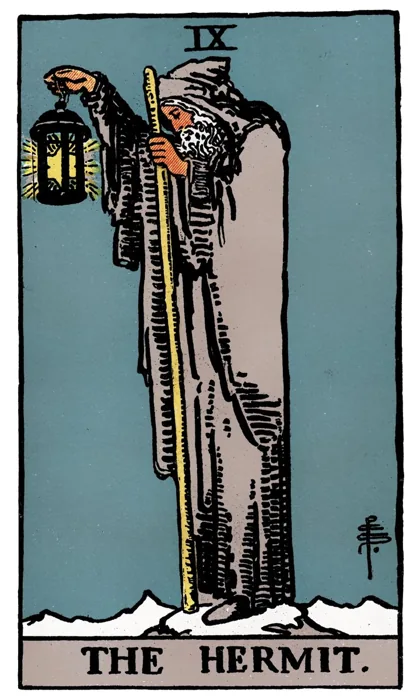
The lamp makes a particular area visible. It suggests useful understanding that can be offered without claiming to illuminate every question or determine another person’s route.
The staff reaches the same ground the figure must negotiate. The image keeps understanding close to the practical conditions that make a difficult passage possible.
A quieter life can be a fuller one
Internally, the Hermit may feel like a reduced appetite for performance. You want fewer conversations in which you must explain yourself, fewer occasions that require a prepared version of your personality, and more time in which attention can follow its own pace. This can be a healthy preference rather than evidence that something is missing.
There can be considerable pleasure in following a difficult problem without interruption. A book or craft offers company of its own, as a long walk sometimes does, without asking you to keep adjusting to someone else's needs. The Hermit makes room for this experience. Time alone can matter deeply to a person even when they have little visible activity to report afterward.
As a person, he may be observant, selective, thoughtful, independent, and less impressed by the usual measures of success. He can notice a false assumption because he is not strongly invested in keeping the conversation comfortable. His reserve may also make others assume either greater wisdom or greater coldness than is actually present.
The shadow appears when discernment hardens into contempt. You begin to regard most people as shallow, predictable, or not worth the effort, while your own habits escape equally close examination. Withdrawal then protects a flattering account of yourself. The absence of friction is mistaken for evidence that your understanding has become superior.
Mature solitude leaves room for surprise. You can prefer a small social world while remaining curious about the people in it. You can decline an invitation without needing to discredit what others enjoy. An independent life becomes more spacious when it no longer has to prove that every different way of living is a mistake.
Knowing what you can honestly claim
The Hermit concerns the passage from information to judgement. Information can be collected quickly; judgement develops through seeing where an idea works, where it fails, and what it leaves out. It often includes qualifications that make the answer sound less impressive while making it more reliable. You learn to distinguish what you know from what you can plausibly say.
Reflection changes the scale of a question. An argument that felt decisive may become one incident in a longer pattern. A disappointment may reveal that the goal mattered mainly because someone else respected it. Distance can help, though it does not automatically produce truth. Your preferred explanation travels into solitude with you.
The card therefore asks for an honest encounter with your own assumptions. What would make you revise the story? Which part have you never seriously questioned? A private understanding becomes more substantial when it can tolerate evidence that complicates it, including evidence that arrives through people whose judgement you do not usually seek.
There is also a question of what understanding is for. You can refine an account indefinitely and still avoid the ordinary act it implies: making a request, ending an arrangement, showing the work, or accepting that someone disagrees. The lamp has a purpose beyond being admired for its light. It helps someone see enough to move.
The deeper generosity of the Hermit is guidance without possession. He can describe a difficult passage and share what helped him, while recognising that another person enters it under different conditions. Wisdom becomes more useful when it offers orientation and leaves room for the traveller's own perception.
Stay with the subject after the easy answer
At work, the Hermit can support an investigation that needs sustained attention. A recurring problem deserves time to trace its cause, especially if quick workarounds have allowed it to continue. Research and careful editing ask for the same willingness to keep looking. Protect enough uninterrupted time to examine the evidence beyond the first explanation that sounds plausible.
Expertise includes becoming less casual about what a subject contains. The beginner may see a simple rule; the experienced practitioner recognises the conditions under which it holds. This can temporarily make you feel less certain. It may also indicate that you are finally seeing distinctions your earlier confidence did not need to consider.
Creative work often benefits from a period of privacy. You can revise a draft or put part of it aside without explaining each decision to an audience. This leaves room for the work to develop in its own way. Eventually, someone else's response may help you see what you have missed. Notice when useful privacy starts becoming a reason to postpone that encounter indefinitely.
The Hermit may describe a mentor whose contribution is a well-placed question. They do not need to take over the project to help you recognise its weak point. Seek someone who can explain the reasoning behind their advice, and who understands enough of your actual aim to avoid simply steering the work toward their own preferences.
An independent role can suit this card, especially where autonomy and depth matter. Yet working alone does not remove the need for exchange. A specialist may need feedback, a clear brief, or another perspective to prevent the private method from drifting away from the problem it was meant to solve.
The shadow is becoming so invested in preparation that participation always feels premature. Finishing a book suggests something else you should study. Another refinement then seems essential, and the work remains private while you reconsider whether it is ready. Decide what level of readiness the next stage actually requires. Learning often continues through use, where the subject can answer back.
Space with a door that can open
In relationships, the Hermit may concern how much time alone each person needs. A bond can develop through attentive conversations without requiring continuous contact between them. Some couples share a close life while also spending substantial time separately. Being able to enjoy that space, free from an expectation to keep the other person entertained or informed, may be part of what makes the relationship workable.
The practical task is to give solitude a context. Saying that you need an evening alone allows the other person to understand what is happening. Simply becoming unavailable can leave them deciding whether you are tired, angry, losing interest, or waiting for them to guess a concern. A modest explanation can protect both privacy and trust.
For someone single, this card need not imply a deficiency to repair. A chosen solitary life can hold friendship, affection, work, and pleasure on terms that suit you. If you want a relationship, the question becomes whether your current arrangements allow anyone enough access to get to know you. Desire and availability may need to meet somewhere.
A difficult pattern is becoming an observer of the relationship while remaining reluctant to participate in it. You notice a pattern and spend time interpreting the other person's motives. In private, you develop a careful explanation of what has gone wrong. Yet the account never becomes a conversation in which they can answer. Insight then creates distance without offering a route toward change.
The Hermit can also describe loneliness inside an apparently stable bond. Practical life continues, but there is little room to be known beyond the roles each person performs. More time together may not solve this by itself. The missing element may be an honest subject, attentive listening, or the willingness to reveal something that has become habitually private.
After a separation or disappointment, a quieter period can help you understand what you want to carry forward. Let reflection include what was good as well as what failed. A complete account may be less satisfying than a simple indictment, but it gives you more useful knowledge about your own participation and needs.
Enough for the life you actually want
In material matters, the Hermit invites a reduction in borrowed standards. You may not need the same amount of space, display, activity, or consumption as the people whose lives are most visible to you. A careful account of what you use and value can make the idea of enough more personal and less constantly negotiable.
A simpler life may reduce strain and give you more room to pay attention. You do not have to make it uncomfortable to show that you take reflection seriously. A pleasant room and tools that work well can support the life you want. Consider what helps you live and think with ease, including useful resources, without turning having fewer possessions into a test of your worth.
At home, this card may highlight the importance of uninterrupted space. A quiet corner, an agreed period without demands, or a place where your work can remain in progress may matter more than a large rearrangement. Shared households need explicit discussion of these conditions, especially where silence is easily interpreted as rejection.
A practical review can also be helpful: read statements, clarify an unfamiliar commitment, or seek qualified guidance on a question beyond your knowledge. The Hermit values careful understanding. He does not imply that solitary judgement is automatically better than relevant expertise, particularly where an error would have substantial consequences.
What happens when the demands become quieter?
The Hermit may suggest a break from continually responding to the world around you. Between messages and social commitments, you can lose track of your own pace. Time with fewer interruptions may reveal that you need rest, or that you have been wanting to explore a new interest. Sometimes the relief comes simply from spending a day without repeatedly moving between demands.
Rest and reflection are different, though they can support each other. An evening spent analysing every difficulty in your life may be solitary without being restorative. You do not have to turn quiet time into a search for insight. An ordinary activity that asks little of you can have a legitimate place beside serious thought.
Chosen solitude and unwanted isolation also feel different, and the distinction may change over time. If withdrawal accompanies persistent distress or makes ordinary care difficult, the card should not turn that struggle into a romantic image of depth. Reaching for appropriate support can be compatible with a strong need for privacy and a small social world.
Narrow the question, deepen the attention
As advice, the Hermit asks you to stop multiplying sources for long enough to work with what you already have. Choose the question that actually matters and give it a bounded period of careful attention. Read the relevant material, review the experience, or speak with one person whose knowledge bears directly on it.
Write an answer you would still find honest without an audience. Notice where you use phrases that sound wise but conceal the particular thing you want, fear, or resent. Precision may make the account less elegant. It can also make the next action easier to recognise.
His shadow is making distance itself the proof of discernment. You refuse to join, commit, or show your work because observing feels safer and more intelligent. There are things you can understand only through participation, including how your ideas behave when other people have a chance to respond.
Another shadow is becoming attached to being the guide. You know how to help someone formulate their difficulty, but struggle to admit when your own life needs the same attention. A role as the thoughtful person should not prevent you from being an ordinary person with an unfinished question.
When the retreat no longer serves its purpose
Reversed, the Hermit can describe too little solitude, too much separation, reflection that has become repetitive, or an insight kept private beyond its useful season. These possibilities point in different directions. Start by asking what the current pattern gives you and what it makes increasingly difficult.
One expression is constant consultation. You have asked so many people what they think that your own response is hard to distinguish from the collection of answers. A period without further advice may help you identify which considerations actually belong to your circumstances. You can receive guidance without putting the decision to a permanent public vote.
Another expression is a retreat that has quietly lost its endpoint. What began as time to recover or think becomes a way to avoid the uncertainty of returning. The first step need not be a dramatic re-entry. A small exchange, an appointment, or sharing one piece of work can restore contact at a scale you can manage.
The reversal can concern thinking that has become circular. You reconsider the evidence without finding anything new, then start again because the conclusion still feels uncertain. Ask what information is missing and whether thinking alone can provide it. You may need to speak with someone or try a limited action before the question can move any further.
Sometimes the reversed Hermit is ready to teach or participate again. Something has been learned, and keeping it entirely private no longer protects its development. You can offer a limited account without pretending it is complete. Returning does not require abandoning the quiet practices that made the understanding possible.
What is the distance making possible?
Read these pairings as different uses of solitude and guidance. The surrounding card may clarify whether a retreat supports learning, recovery, independence, or avoidance.
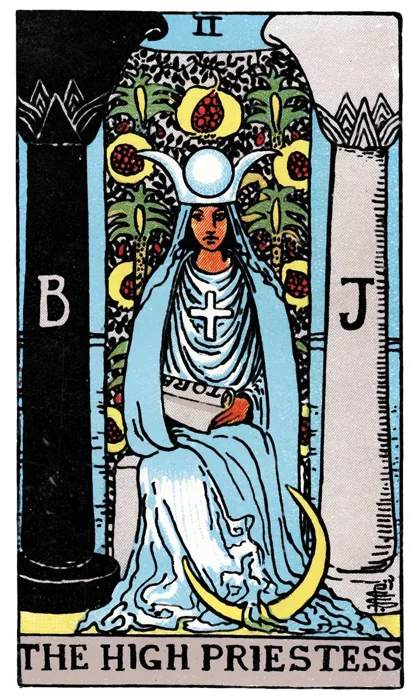
With The High Priestess
With the High Priestess, quiet attention becomes especially prominent. You may need room for something not yet easy to explain. Preserve the observation while remaining open to more than one meaning; privacy need not make the first interpretation beyond question.
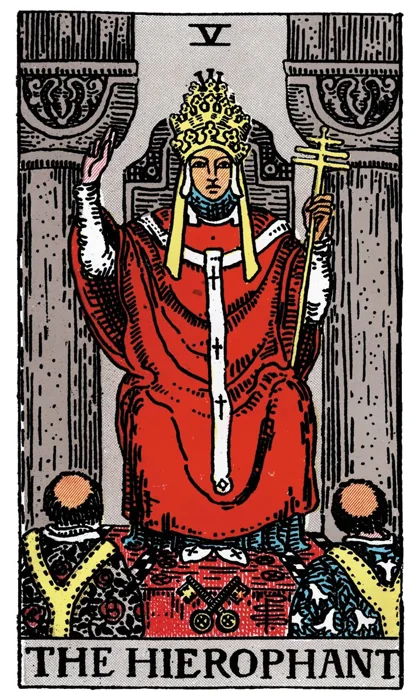
With The Hierophant
With the Hierophant, received teaching meets independent examination. A tradition may offer useful language while leaving parts of your experience unexplained. Study it carefully enough to distinguish its actual limits from the discomfort of being asked to learn something unfamiliar.

With The Chariot
With the Chariot, a driven undertaking needs perspective. A deliberate pause can help you decide whether the route still serves the goal. Reflection becomes useful when it produces a clearer next stage, rather than a permanent exemption from moving.
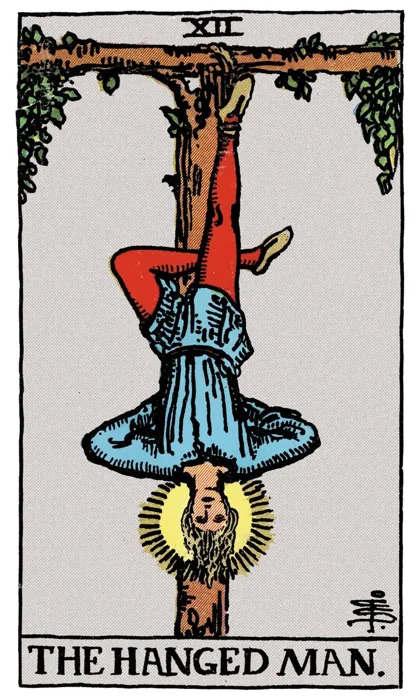
With The Hanged Man
With the Hanged Man, action may be suspended while understanding changes. Some waiting could be necessary, but give attention to what is being learned. A pause can reveal a new perspective; it can also become difficult to distinguish from avoiding an uncomfortable decision.

With The Star
With the Star, a quieter period may restore a sense of possibility after strain. Let hope take a modest form: a renewed interest, a manageable practice, or one honest connection. You do not need a complete future plan for these signs of engagement to matter.
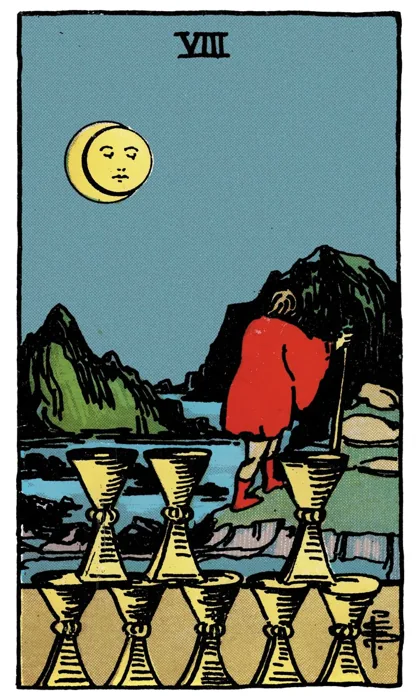
With Eight of Cups
With the Eight of Cups, withdrawal may follow the recognition that something no longer nourishes you. Understand what you are leaving and what you need space to discover. Departure can be meaningful without requiring a claim that the earlier experience had no value.
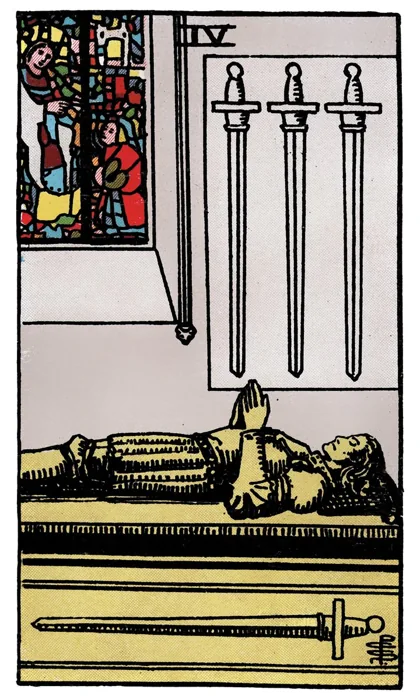
With Four of Swords
With the Four of Swords, rest deserves a place beside reflection. You may need fewer demands before you need another insight. Allow the interval to be restorative rather than using it to perform a more private version of the same relentless work.
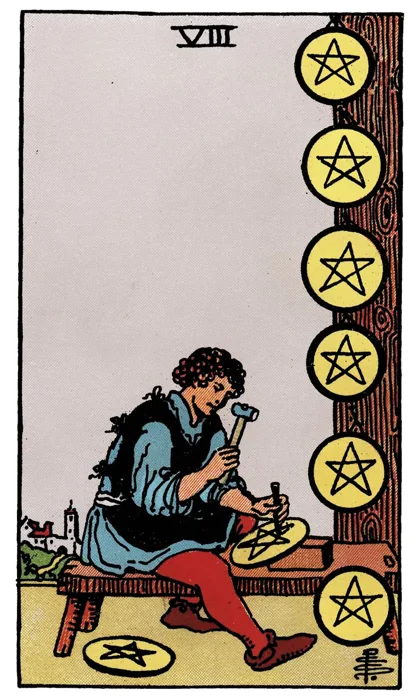
With Eight of Pentacles
With the Eight of Pentacles, solitude supports careful practice. A skill can deepen through ordinary repetition and close attention. Bring in feedback at useful intervals so that the private method continues answering the task, rather than merely becoming increasingly familiar.
Learning to trust the limits of your own knowledge
The reader who returns to a difficult book offers one image for the Hermit. The same passage changes because the person reading it has changed. Understanding is accumulated through encounters, including the times when the material refuses to become immediately useful or clear. Patience allows a relationship with the subject to develop.
The mountain guide brings knowledge with limits. They can recognise terrain, describe a risk, and help someone choose a route, but they cannot walk in the other person's body. Good guidance remains interested in the traveller's condition. It does not turn its own successful passage into a rule everyone must follow.
The quiet witness sees what a crowded situation can overlook. A remark that others passed over stays with them. They may also recall an omission or an inconsistency that the conversation left unexplored. Their gift becomes generous when it can be shared in a form others can use, rather than kept as private evidence that they understood everything first.
Make a quiet interval answer one question
Choose a question that has become crowded with other people's opinions. Give it a defined period of quiet attention and write what you know, what you assume, and what remains unresolved. Use concrete events and preferences rather than general statements about the kind of person you ought to be.
End by deciding what the reflection makes possible: a small action, a conversation, further study, or a genuine period of rest. If nothing new emerges, consider whether the missing element is outside the retreat. The Hermit's lamp is most useful when it helps you see what the next step requires.
Artwork & interpretation
Waite emphasises the star within the raised lantern and reads the figure as a beacon of attainment. This guide develops an original contemporary account of solitude, study, and limited but useful guidance, rather than treating withdrawal itself as wisdom. A. E. Waite, The Pictorial Key to the Tarot: The Hermit.
The symbolic associations and examples offer ways to read a situation. They do not establish another person’s thoughts or fix an outcome.
Solitude can make your judgement clearer. It cannot guarantee that your judgement is complete.
Use the cards in a spread →