Major arcana · 10
Wheel of Fortune
Choosing your response as circumstances change
Wheel of Fortune brings a change in circumstances that effort alone cannot control. An advantage may fade just as an old pattern reappears in unfamiliar conditions. You still have choices about how to respond to the turn.
- Change
- Timing
- Cycles
- Opportunity
15 min read
In this guide
The same effort meets a different world
A proposal that went nowhere six months ago suddenly finds the right person. A reliable arrangement becomes difficult because someone else's circumstances change. You have not become an entirely different person between these moments, yet what is possible around you has shifted. Wheel of Fortune concerns that movement in the conditions of a life.
In a reading, the Wheel can draw attention to a change in timing or circumstances. An opening may have appeared; a familiar pattern may be returning under different conditions. Reconsider the assumptions you made when the situation began. A method that worked then may need adapting, and recognising what has changed is the first part of deciding how to respond.
A favourable turn can feel exhilarating precisely because it releases effort that had seemed ineffective. You can finally use the experience and preparation you have accumulated because the circumstances now allow it. Enjoy the opening without demanding that it prove you were always destined to arrive here. You can make good use of an opportunity while remaining honest about the part you did not create.
An unwelcome turn raises the same distinction more painfully. A setback may result from a mixture of your decisions, other people's choices, and conditions nobody involved can fully control. The card invites an accurate account of that mixture. Blaming yourself for everything obscures possible action as surely as attributing everything to fate.
The Wheel is especially useful when a temporary condition has begun to feel permanent. A difficult period can occupy so much attention that alternatives become hard to imagine; a successful period can make its supporting conditions seem invisible. The image restores a sense of movement. It does not tell you the date, direction, or moral meaning of the next turn.
A turning centre and watchers at the edges
Creatures occupy different places around the central wheel. A serpent descends along one side, while a red figure rises on the other. Above them, a blue sphinx holds a sword. Their positions suggest different stages of movement within a single scene. The stillness at the top belongs to the same image as the ascent and descent below it.
Letters and signs occupy the rings of the wheel. They give the object the density of a system whose whole meaning is not immediately available to the viewer. One practical reading is that an event enters your life through processes larger than your immediate perspective. You see the consequence before you understand every cause.
At the four corners, winged creatures hold open books. Their placement gives the picture a quieter perimeter around its active centre. They can be read as an invitation to observation and study: change does not make attention pointless, even when attention cannot stop the movement. There may be something to learn without a complete explanation to possess.
There is no ordinary human figure visibly turning a handle. Control is not represented in the same direct way as in cards centred on a maker or ruler. The image asks a different question: how do you remain responsive, informed, and recognisably yourself while the position you occupy continues to change?
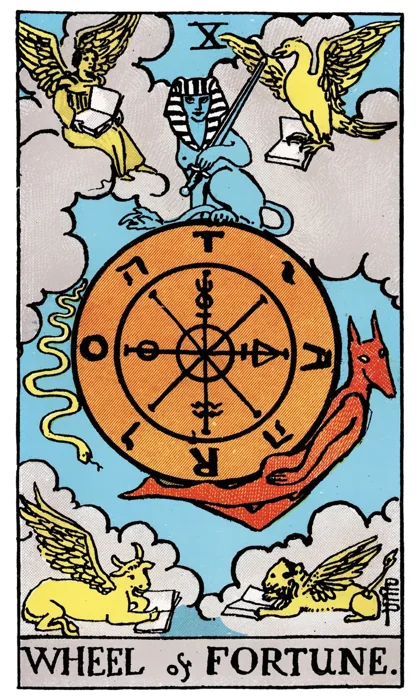
The figures occupy different points around one wheel. The image can loosen the assumption that a present advantage or difficulty must describe a permanent place in life.
The seated sphinx and open books frame the wheel with watchfulness. A changing situation may call for steadier observation, even where it offers no simple means of control.
When your explanation has to catch up
Internally, Wheel of Fortune can feel like surprise arriving before interpretation. Something changes, and the story you have been telling about your life no longer fits as neatly. You may feel relief, excitement, disorientation, or an urge to decide immediately what the event must mean. It is possible to respond before the complete story is available.
A positive turn can disturb identity as much as a setback. If you have organised yourself around struggle, an easier opening may provoke suspicion or the sense that you have not earned it. You may keep making things difficult because difficulty has become familiar evidence that you are taking life seriously. Allow usefulness and pleasure a place in the new conditions.
As a person, this card may describe someone adaptable, alert to opportunity, and able to recover movement after a plan changes. They can see when the moment has become different. Their weakness may be a restless dependence on the next opening, with less interest in the ordinary maintenance that would give an opportunity lasting value.
The opposite pattern is trying to freeze the present. Success brings anxiety about losing position; hardship brings rigid habits intended to prevent further surprise. Both reactions can make change harder to perceive accurately. The need for stability is understandable, but protecting every feature of the current arrangement may also protect its limitations.
A mature relationship with the Wheel allows mixed feelings about a turn. You can welcome a new phase and mourn what it interrupts. You can be disappointed without deciding that the whole future has closed. Emotional adjustment may take longer than the practical change, and that delay does not make your response ungrateful or inadequate.
An outcome is not a moral verdict
The Wheel challenges the habit of treating success as proof of virtue and difficulty as proof of failure. Effort matters, but lives are also shaped by timing, access, other people's decisions, and events no individual arranged. Recognising those conditions makes an account of achievement more honest and an account of suffering less cruel.
You still make decisions within changing circumstances, sometimes with considerable influence over what follows. Estimate that influence as accurately as you can. Assuming you control everything can leave you ashamed of events beyond your reach. Assuming you control nothing can make it harder to notice actions that would help. Examine the particular choices available in this situation.
A familiar pattern can return under different conditions. A conflict may resemble one you have faced before, yet you now have experience that changes how you can respond. Examine the resemblance alongside those differences. If you assume you already know how the story ends, you may overlook choices that were unavailable last time and help the old pattern repeat itself.
There is also a difference between finding meaning in an experience and claiming that the experience was arranged to teach you. You may learn from an event without deciding that it needed to happen or that someone deserved its cost. Meaning can be something you make afterward through your response, relationships, and choices.
The deeper steadiness of the Wheel lies in a relationship with change that neither worships nor denies it. You cultivate what can support you across different conditions: skills, honest connections, workable habits, and the ability to revise a plan. These do not make life predictable. They give you more than one way to meet it.
Recognise the opening, then make it usable
At work, Wheel of Fortune can concern a change in the conditions around a project. New demand may make previously overlooked work relevant; a change in staffing can make a reliable method harder to sustain. Look at what is happening around you when assessing results. Your contribution matters, but the environment also affects how it is received and what it can achieve.
Preparation can make an opening usable. A skill already practised, work already collected, or a relationship maintained without an immediate request may allow you to respond when circumstances shift. This is different from guaranteeing that preparation will be rewarded. It increases what you can do with an opportunity when one becomes available.
An unexpected invitation deserves both interest and examination. The urgency of an opening can make ordinary questions feel like a risk to the chance itself. Clarify the scope, expectations, resources, and practical cost. A worthwhile opportunity should be assessed as an actual undertaking, not only as relief from the fear that nothing will happen.
A setback may call for adaptation rather than a complete judgement on the work. If a budget disappears or a decision-maker changes, the original plan may no longer have a route forward in that setting. Identify what can be carried into another form: the knowledge, material, relationships, or a smaller version that remains possible.
Creative work has its own fluctuations. Interest, reception, and the wider conversation change, sometimes independently of quality. A quiet response does not settle the value of the work; enthusiasm does not remove the need to improve it. Try to maintain a practice that can learn from reception without allowing each turn to dictate your whole identity.
The shadow is chasing every change in the hope that the next one will solve the difficult part of the current undertaking. You change field, method, or audience before the work has had a fair trial. Distinguish a genuine shift in conditions from the discomfort that appears whenever a promising beginning becomes ordinary practice.
The relationship enters a different season
In relationships, the Wheel may describe a change of circumstances that alters the bond: a move, a new schedule, different responsibilities, renewed contact, or a shift in what each person wants. The connection is meeting a new environment. Agreements that once worked may need attention even when affection remains strong.
Chance encounters can feel charged with significance. You meet someone through an unlikely chain of events, or reconnect at a moment when both lives have changed. The coincidence can be part of the pleasure. It cannot establish compatibility or tell you that the relationship must be pursued regardless of what you discover about it.
For an established couple, the card can invite a fresh reading of a recurring difficulty. The same argument may return because the practical arrangement never changed, because a new pressure has exposed an old vulnerability, or because the original explanation was incomplete. Calling it a cycle is a beginning; identifying what sustains it makes the observation useful.
A relationship may also need room for unequal phases. One person is thriving while the other is uncertain; one has more energy, income, or time. Reciprocity need not mean identical contributions in every week. It does require enough openness to discuss the imbalance and enough freedom for the arrangement to change when circumstances do.
The difficult pattern is surrendering responsibility to the story of destiny. A meeting that felt fated may become your reason for staying despite an unresolved problem. When the connection returns, you may take its recurrence as reassurance that better timing will finally change things. Look at what people actually do differently between one turn and the next. Repetition alone does not establish depth or inevitability.
Where a bond is changing or ending, the Wheel can offer perspective without minimising the loss. A meaningful relationship may belong to a phase of life without being reducible to a mistake. You can acknowledge what it gave, what it cost, and what no longer works without forcing all three into a single flattering or condemning account.
Plan for variation, not a perfect forecast
In material matters, the Wheel draws attention to variation over time. A plan may assume steady income while household expenses change from month to month. Look at where a change would create strain and how much flexibility you have. This gives you a practical basis for responding to uncertainty without requiring you to prepare for every imaginable difficulty.
A favourable period can be used to strengthen the arrangements that will support you later. This might mean dealing with deferred maintenance, clarifying recurring costs, or creating more room in the schedule. The useful action depends on your actual resources. The card does not promise a windfall or identify a winning financial risk.
Be wary of interpreting a run of outcomes as a guarantee about the next one. Several successes may encourage overconfidence; several disappointments may make a reversal feel owed to you. Neither feeling establishes what a particular opportunity will do. Evaluate the terms and consequences rather than asking the recent pattern to provide certainty.
At home, changes can arrive through other people's lives: a household member's work, availability, needs, or decision to move. Make the new circumstances explicit before assuming that everyone can continue contributing in the old way. An arrangement adapts more easily when its members can discuss what has actually changed.
Capacity does not arrive in a straight line
The Wheel can be a useful image for the variability of ordinary capacity. Some periods contain more energy, interest, and available attention than others. A workable practice allows for that movement without treating every slower day as evidence that you have lost the ability or every energetic day as the new minimum you must maintain.
Notice patterns where they are supported by your experience: a crowded week, an interrupted routine, or a recurring demand that leaves little time to recover. Recording what actually happens can be more useful than imposing a symbolic cycle on it. The image invites observation; it cannot determine the cause of a physical or psychological change.
If symptoms or changes in capacity concern you, give them appropriate attention beyond the cards. In everyday planning, leave some room for variation where possible. A routine that only works when everything goes smoothly may need adjustment before the next ordinary disruption is treated as a personal failure.
Work with the turn that is actually happening
As advice, Wheel of Fortune asks you to update your understanding of the situation. Which conditions have changed, and which assumptions are still being carried forward automatically? A plan that was reasonable earlier may now need a different pace, partner, method, or scale. Revision can be a sign that you are paying attention.
Separate what you can decide, what you can influence, and what you must respond to. The categories may overlap, but making the distinction can prevent wasted effort. You may not control the timing of an offer, while still controlling whether your materials are ready and whether you understand the terms before accepting it.
The shadow is passive waiting for the next turn to rescue you. Hope becomes an alternative to preparation, and the imagined future makes the present arrangement easier to avoid examining. Choose an action that has value even if the hoped-for opening does not arrive soon. That gives your effort a more dependable purpose.
Another shadow is compulsive pattern-making. You may begin reading each coincidence as a message. A setback then seems like a warning, while encountering the same person again feels like proof that you should pursue them. Patterns can be interesting without deciding your life. Return to observable circumstances and ask what the interpretation helps you understand that could not be explained more simply.
The pattern that keeps asking for a different response
Reversed, the Wheel may bring attention to a difficult period or a disruption that keeps returning. Resisting a change can add to the frustration, though resistance is not the only possible cause. The card gives no evidence of a curse or punishment, and it cannot establish a period of bad luck. Identify the conditions you can observe and how they are affecting you.
One expression is continuing to use an old method after the environment has changed. You increase effort because the result used to follow from it, while overlooking the fact that the relevant people, resources, or requirements are now different. A fresh account of the situation may matter more than further persistence with the same approach.
Another expression is a recurring pattern in which your own response has become predictable. You accept too quickly, delay a necessary conversation, or leave when the initial excitement fades. This is useful to recognise without making it your whole identity. Identify the moment at which a different action could interrupt the sequence.
The reversal can also concern a genuine run of difficult circumstances. Searching for a personal lesson in each event may add an unnecessary burden. Practical support, reduced demands, and attention to the next manageable task can be more helpful than producing an explanation that makes the whole period seem deserved or necessary.
A constructive reversal slows the apparent inevitability of a cycle. You recognise the familiar invitation and decline it, renegotiate an arrangement, or respond with knowledge that was unavailable the last time. The external situation may remain imperfect while your participation becomes more deliberate. That change is significant even without a dramatic reversal of fortune.
What can change, and what can you carry through?
These pairings explore the relationship between changing conditions and deliberate response. They do not establish a timetable or guarantee that a favourable or difficult phase will follow.
With The Magician
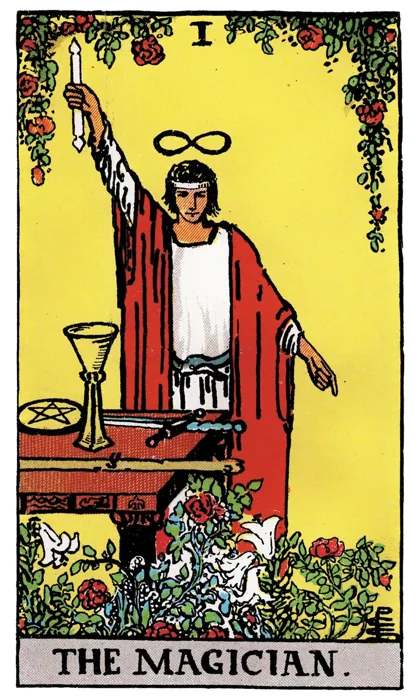
With the Magician, an opening meets usable skill. Preparation may allow you to act quickly when circumstances become favourable. Clarify the actual task before making a large promise; the appearance of an opportunity does not remove the limits of your present capacity.
With The Chariot
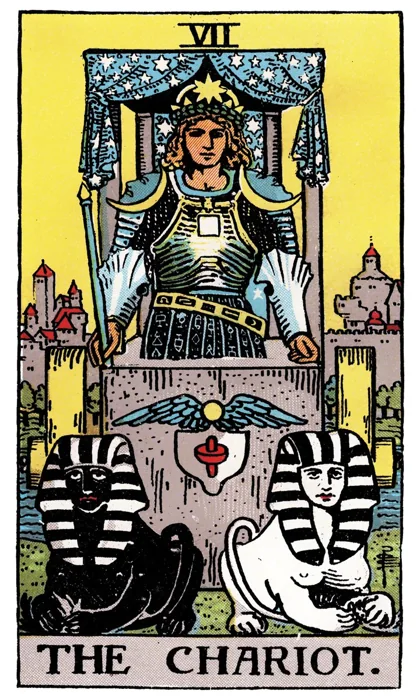
With the Chariot, a chosen direction needs flexibility. The goal may remain meaningful while the route changes. Distinguish determination that helps you adapt from determination that insists the world must restore the conditions under which your original plan made sense.
With Justice
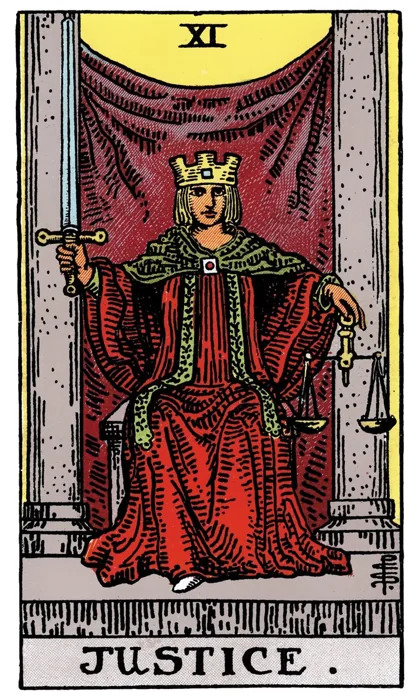
With Justice, a change brings questions of responsibility and consequence. Separate choices people made from circumstances they could not reasonably control. A fair account needs both, especially when a successful outcome tempts people to overlook the conditions that helped produce it.
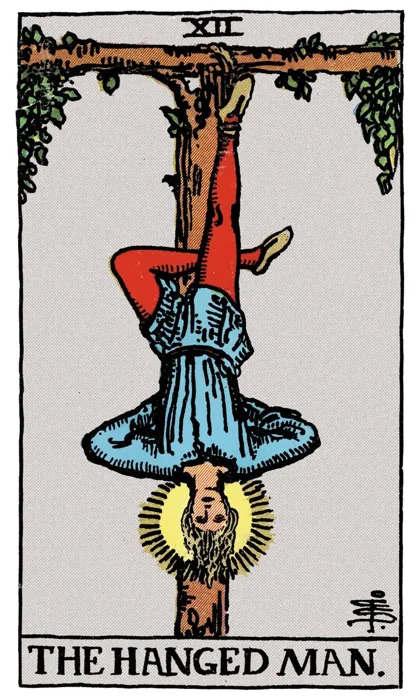
With The Hanged Man
With the Hanged Man, timing may require a pause or a different perspective. Use the interval to identify what can be prepared and what genuinely depends on events outside your control. Waiting becomes clearer when you know what would make action possible.
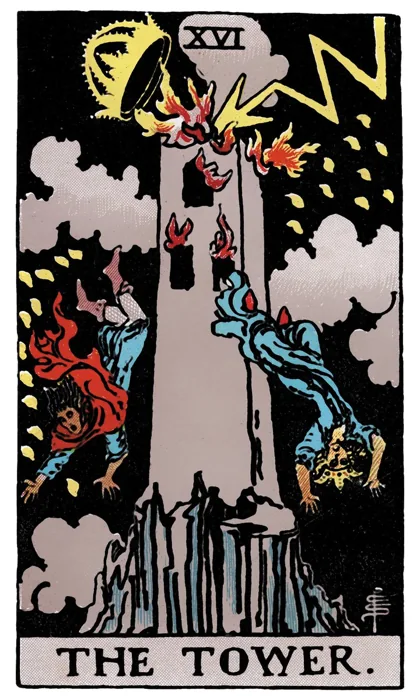
With The Tower
With the Tower, the change may reach the structure of an existing arrangement. Concentrate on what the new facts require rather than preserving the old appearance. The cards cannot predict a disaster; together they invite an honest review of visible instability.
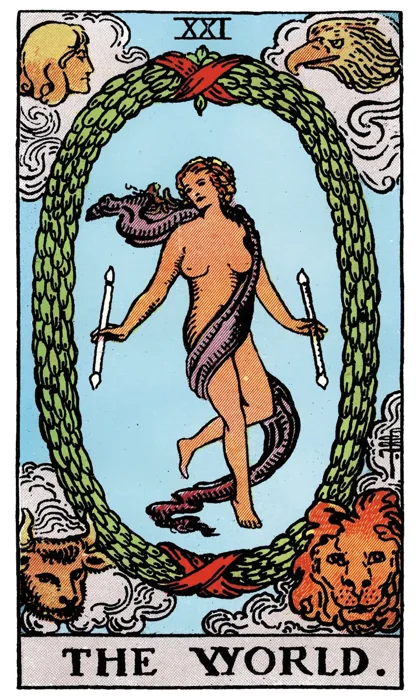
With The World
With the World, a cycle may be reaching a point of completion. Recognise what has actually been achieved before converting the ending immediately into another demand. Consider which skills, relationships, and lessons can travel with you into a different phase.
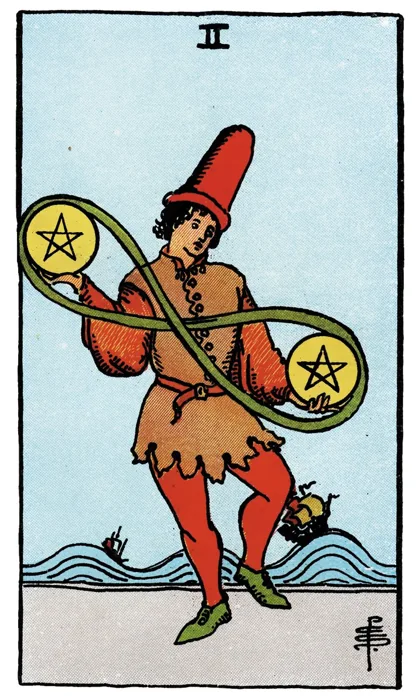
With Two of Pentacles
With the Two of Pentacles, variation needs practical room. A flexible schedule or simpler set of commitments may help you respond to changing demands. An arrangement that requires perfect balance every day is likely to feel more fragile than one with some margin.
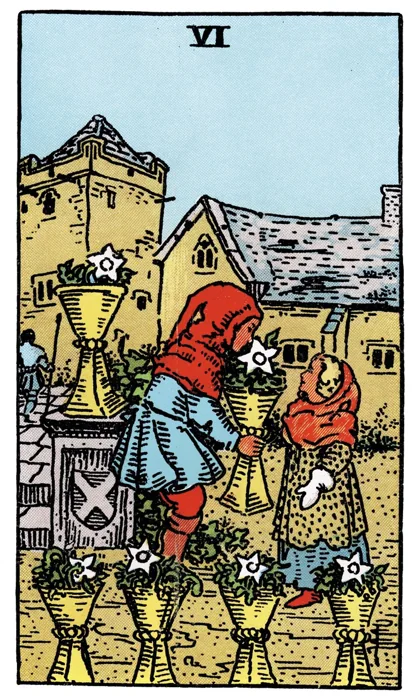
With Six of Cups
With the Six of Cups, something familiar returns under changed conditions. Memory can offer warmth and useful context, but it may also preserve an outdated picture. Meet the person or opportunity as it is now before assuming the earlier story must continue.
Finding your place within a changing situation
The season offers one way to think about the Wheel. Different conditions permit different kinds of work, and a period that looks unproductive may still have a place in a larger process. The metaphor is useful only while it remains a metaphor; it cannot tell you that every personal difficulty follows a predictable natural timetable.
The revolving stage gives another image. A person occupies the foreground for a time, while people and conditions that supported the scene remain less visible. When the stage turns, the arrangement is seen differently. Perspective can reveal both the contingency of a position and the work that made it possible.
The crossroads reached by accident belongs here too. A delay, introduction, or changed plan creates an option you could not have scheduled. What follows depends partly on how you respond. The event can become a turning point through your participation without needing to have been designed for you in advance.
Update one plan to fit the present
Choose a plan that has begun to feel unusually difficult or unexpectedly possible. Write the assumptions it depended on when you made it, then mark which ones still hold. Include changes in time, resources, interest, other people's involvement, and the practical environment.
Use what you have found to revise one part of your plan. If an opportunity is opening, decide what would help you prepare for it. If an earlier route has closed, consider reducing the commitment or finding another way forward. The reading has a practical use when it helps you respond to conditions as they are now.
Artwork & interpretation
Waite describes the wheel and its surrounding creatures in terms of movement and equilibrium, giving the sphinx a place within that account. He also invokes providence. This guide considers how people respond to changing conditions and recurring patterns, with attention to what they can influence. It does not treat events as predetermined. A. E. Waite, The Pictorial Key to the Tarot: Wheel of Fortune.
The symbolic associations and examples offer ways to read a situation. They do not establish another person’s thoughts or fix an outcome.
You can take responsibility for your response without claiming responsibility for everything that happens to you.
Use the cards in a spread →