Major arcana · 11
Justice
Giving a fair account of what happened
Justice examines what happened against the agreements people made. Who now bears the consequences? Answering fairly can be uncomfortable, especially when it means revising an account in which you were entirely right.
- Accountability
- Fairness
- Evidence
- Consequences
14 min read
In this guide
Put the whole account on the table
An argument changes when someone produces the actual agreement. A remembered promise becomes a sentence with a date; a general accusation becomes a sequence of events. Some facts may support your account while others make it harder to maintain unchanged. Justice begins where the story must answer to something beyond the force with which it is told.
In a reading, Justice often concerns a decision and the standard used to reach it. You may be examining whether an agreement is fair or taking responsibility for the consequences of an earlier action. Establish what happened before judging it. A familiar account can acquire authority through repetition, so check which parts rest on relevant information and which remain assumptions.
Justice is not simply the pleasure of being vindicated. It also asks what would count as a fair outcome if your preferred explanation turned out to be incomplete. You may have a legitimate concern and still have contributed to the difficulty. Another person may have behaved poorly without being wrong about every point they raise.
The card can describe a consequential choice that needs to be made deliberately. Before agreeing, examine the obligations you would accept and how other people would be affected. Find out what you still need to know to judge the decision. Clarity at this stage can prevent later resentment about terms that were never properly considered.
Justice can describe a person who expects a decision to have an explanation. Their attention to consistency may help an emotionally charged discussion recover some proportion. They still need to examine this particular case. A familiar rule can overlook an important difference, so the ability to revise its application matters as much as the willingness to apply it evenly.
Justice can help you give responsibility a more accurate place in the account. Some decisions belong to you, while others were made by someone else under circumstances neither of you fully controlled. Looking closely may reveal obligations on several sides. That can be more demanding to address than a story in which one person caused everything.
The scales and the sword have different work
The seated figure holds scales in one hand and an upright sword in the other. The two objects suggest different stages of judgement. Something must be weighed; something must eventually be decided. Endless assessment can avoid responsibility, while a decisive answer reached without examination can merely give prejudice a formal shape.
The figure faces the viewer directly, with eyes uncovered. Unlike familiar images of blindfolded justice, this image permits a reading of attention to the particular case. Fairness needs principles, but it also needs to see who is present, what they could choose, and how the arrangement actually operated.
Pillars and a heavy curtain frame the seat. They give the decision a setting that feels formal and established. This may support trust in a process larger than personal preference. It can also remind you that a formal setting does not by itself establish fairness; the quality of the reasoning still matters.
The blade is held vertically, without an outward swing. Its force is available, but the picture has not turned the decision into an attack. One useful interpretation is that a firm conclusion need not be made cruel in order to be clear. Consequence and humiliation are different things.
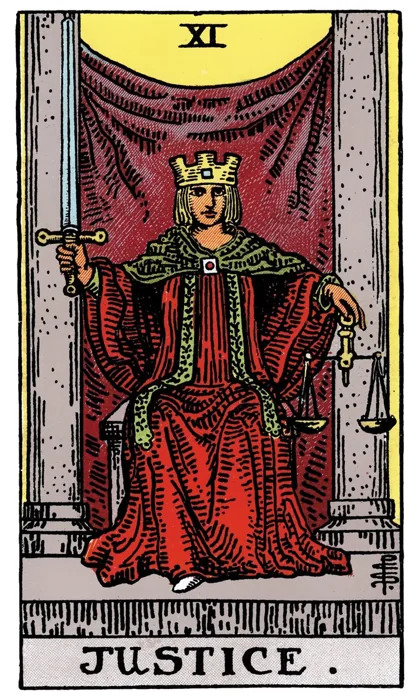
The scales invite comparison, but a fair comparison needs more than equal piles. Circumstances, responsibility, and the actual effect of a choice all belong in the account.
The sword is steady rather than swinging. The image can suggest a conclusion firm enough to act on, whose authority rests on examination rather than the wish to punish.
The discomfort of seeing your own part
Internally, Justice may feel like a moment of sobriety. You recognise that an explanation you have relied on leaves out something you did, accepted, or failed to say. This recognition can sting without requiring a wholesale condemnation of yourself. A precise account of a mistake gives you more room to respond than a vague conviction that you are a bad person.
The card can also describe relief after misplaced blame. Once the actual sequence is visible, you see that you could not have known something, did not agree to a demand, or were carrying responsibility that belonged elsewhere. Fairness toward yourself deserves the same care as fairness toward anyone else.
As a temperament, Justice may be thoughtful, principled, measured, and uncomfortable with arbitrary treatment. This person wants to understand the reasoning behind a decision. They can be an excellent mediator or evaluator, particularly when they can separate liking someone from assessing the particular behaviour under discussion.
The difficult version keeps a private courtroom permanently in session. They keep returning to earlier exchanges as evidence of a larger case. Even a small slight enters the record, making ordinary imperfections difficult to let pass. They may be accurate about individual incidents while missing what a relationship becomes under continuous prosecution.
Mature judgement includes proportion. Some matters need a firm decision; others need clarification, an apology, a practical adjustment, or the recognition that people remember differently. The ability to distinguish these cases is part of fairness. Treating everything as equally serious can make your response less accurate, even when the underlying concern is real.
Fairness is work, not a promise about the universe
Justice is a valuable symbol precisely because fair outcomes are not automatic. People can suffer through no fault of their own, and harmful choices can go unchallenged. The card should not turn those facts into a claim that everyone secretly receives what they deserve. It asks what fairness requires from the people who can act here.
That work begins with a distinction between explanation and excuse. Understanding the conditions around a choice may change how responsibility is assigned. It does not necessarily remove the harm or the need for repair. Equally, acknowledging harm does not require pretending that circumstances had no influence on what was possible.
A fair process may give different people different forms of support because their starting conditions differ. Mechanical sameness can preserve an existing imbalance while appearing neutral. The useful question is what standard you are trying to uphold and whether the method allows people a meaningful chance to meet it.
There is also an ethical demand in knowing more. Once you recognise that an arrangement benefits you at someone else's unacknowledged expense, innocence becomes harder to maintain through inattention. You may not be able to correct everything immediately, but you can decide what to stop denying and what change lies within your reach.
The deeper movement is toward integrity that can survive correction. You do not need to defend every earlier position in order to remain a coherent person. Learning something new gives you a reason to revise your account. Your next action can reflect that changed understanding. An identity that allows repair is more useful than one that depends on never having been wrong.
Make the standard visible before the verdict
At work, Justice asks whether people understood the expectations before their performance was assessed. Discuss what completing the task means and whether the time and resources match that expectation. Someone can only take full responsibility for decisions they have authority to make. Evaluating a result fairly requires looking at those conditions, especially when a standard was made clear only after the work was delivered.
In a review, calling someone reliable or difficult tells them little about what you want them to continue or change. Describe a specific event and explain its effect on the work. If improvement is needed, show what a better outcome would look like. Concrete examples give the person something they can act on without having to defend their whole character.
Justice may draw your attention to the terms of a contract or a formal decision. Read the relevant documents and identify anything you do not understand. When the stakes or complexity warrant it, seek professional guidance about your situation. A tarot reading cannot replace that expertise or predict a legal outcome; it can serve as a prompt to gather information before deciding.
In collaborative work, credit and correction should be distributed with the same care. Notice who did the invisible preparation, who carried the risk, and who had the power to decide. A visible spokesperson may not be the sole author of a success, just as the person closest to a failure may not have created its conditions.
Creative work brings a quieter version of Justice: editorial judgement. You assess what is on the page or in the object, rather than the effort you remember spending. This can be painful when a cherished part does not serve the whole. Specific criticism makes revision possible without requiring contempt for the work or its maker.
The shadow is using process to avoid judgement. More forms, meetings, or criteria can create an appearance of care while the relevant decision remains untouched. A good process helps people arrive at an answer they can explain. It should not become an indefinitely expanding substitute for that answer.
What each person believes was agreed
In relationships, Justice often draws attention to reciprocity, promises, boundaries, and the distribution of practical responsibility. One person may feel that the arrangement is fair while the other is counting work that has never been named. Begin by making the contributions and expectations visible before deciding whose impression is correct.
Unspoken agreements are especially vulnerable. You may assume your understanding of loyalty is shared without having discussed it. Expectations about privacy or a future together can remain similarly unspoken. The other person may be operating from a different understanding. A difficult conversation can reveal a mismatch that neither person deliberately created.
When harm has occurred, an apology matters partly through what follows. Acknowledgement can open the possibility of repair, while repeated behaviour determines whether trust has something to rebuild on. Forgiveness, reconciliation, and continued access to your life are separate decisions. They need not arrive together or be offered on demand.
Justice also asks you to hear a legitimate concern without immediately balancing it against everything the other person has done wrong. Their inconsistency may deserve a separate conversation. It does not automatically cancel the particular point they are making now. Keeping the issue specific can prevent accountability from dissolving into mutual prosecution.
The shadow is keeping score so precisely that generosity disappears. A kind gesture immediately creates a debt, and an inconvenience must be repaid. Even admitting vulnerability may feel unsafe without a counterclaim ready to protect your position. A healthy relationship can tolerate temporary unevenness. What it needs is a shared ability to discuss that unevenness and prevent it becoming one person's permanent position.
If a relationship is ending, this card can focus attention on handling the practical consequences as clearly as possible. The emotional account may remain contested while specific arrangements can still be made. Where formal rights or obligations are involved, use relevant professional advice rather than asking the card to determine what is owed.
Read the terms you are living under
In material life, Justice favours a clear account of commitments, ownership, recurring costs, and shared responsibility. You may be living under an arrangement that began informally and no longer matches the circumstances. Put the relevant facts together before assuming that habit represents a continuing agreement.
There is more than one reasonable way to divide shared expenses. Differences in income may matter, as may how much each person uses a resource or contributes in other ways. Discuss the principle you want to follow before adopting someone's preferred method by default. Everyone should be able to understand why the arrangement is considered fair.
A purchase or financial commitment deserves attention to the actual terms, including limits and consequences that an attractive presentation may leave in the background. The card cannot certify a deal as safe or beneficial. It can remind you that asking a precise question is a legitimate part of informed participation.
At home, include work that is easy to overlook: planning, remembering, cleaning, organising access, and noticing what needs replacement. These tasks often disappear from the account until the person doing them stops. Making the labour visible gives the household a better chance to distribute it deliberately.
Use a standard that includes the circumstances
Justice can prompt a fairer assessment of your own capacity. Your best day's output may be an unrealistic comparison after poor sleep or during an unusually heavy workload. Include those circumstances when judging what happened. They help explain the result and what might improve it, while leaving room to recognise a decision you could have handled differently.
A constant internal trial can consume energy without producing useful change. If you repeatedly review an error, ask whether the review has identified a repair, a lesson, or a different practice. Once those are clear, further punishment may add little. Responsibility becomes more practical when it points toward an action.
The card cannot assess health or determine whether a symptom is deserved, serious, or caused by your behaviour. If something concerns you, seek appropriate care. Its symbolic invitation is to replace moral judgement of your needs with an accurate account of what support and adjustment the situation requires.
Ask what would change your judgement
As advice, Justice asks for the relevant record: what happened, what was agreed, what was known at the time, and what followed. Keep observation separate from interpretation. You can take a concern seriously while leaving your explanation of another person's motive open to revision.
Choose a standard you would still consider reasonable if your position in the situation changed. This will not solve every disagreement, but it can reveal where a principle is functioning mainly as a defence of your preference. A useful rule should be explainable without depending entirely on who benefits from it.
The shadow is righteousness that no longer needs to listen. Once you occupy the role of the wronged or principled person, new information feels like an attack on your moral standing. Let accuracy matter enough to complicate the story. You do not lose every legitimate concern by discovering that one part needs correction.
Another shadow is premature neutrality. Insisting that everyone must be equally responsible can be as inaccurate as blaming only one side. Examine the choices, power, and effects involved. Fairness does not require inventing symmetry where the circumstances do not support it.
The standard is slipping, or the account is incomplete
Reversed, Justice can describe unfair treatment, selective evidence, inconsistent standards, avoided responsibility, or a decision made before the relevant facts were understood. It does not establish which person is right. Begin by locating the specific discrepancy between the stated principle and what actually occurred.
One expression is a double standard. A behaviour is excused in one person and condemned in another because status, affection, or convenience quietly changes the rule. Naming the inconsistency precisely is more useful than a general accusation that everything is unfair. It gives the concern a form that can be examined.
Another expression is excessive self-blame. You assume responsibility for an outcome because accepting uncertainty feels harder than believing you could have prevented it. Reconstruct what you knew and could reasonably do at the time. Hindsight can reveal a lesson without proving that you should already have possessed it.
The reversal may also indicate an apology or decision that avoids the central issue. Careful wording may give the impression that the procedure is complete. Yet those involved still have no clear account of who accepts responsibility for the central problem. Look at the practical change. An account becomes more credible when it affects what happens next, not only how the past is described.
A constructive reversal reopens a judgement that was reached too quickly. You acknowledge missing information, correct the record, or revise an arrangement whose effects were not understood. This can be awkward and still necessary. Fairness is strengthened when a decision has a route to correction.
What needs to be weighed?
These pairings focus on accountability and proportion. They cannot establish guilt, predict a formal ruling, or substitute for evidence about the actual situation.

With The Emperor
With the Emperor, authority needs a clear account of its decisions. Consistent rules can support trust when responsibility and power belong together. Examine whether the people carrying the consequences have a meaningful route to question the arrangement.

With The Lovers
With the Lovers, commitment meets practical consequence. A heartfelt choice still needs informed agreement and fair terms. Clarify what each person is choosing, rather than assuming that affection settles every difference about responsibility or the future.

With Wheel of Fortune
With Wheel of Fortune, distinguish deliberate choices from changing circumstances. A successful result may include unearned advantages; a setback may include conditions no one controlled. An accurate judgement needs room for both effort and contingency.

With Judgement
With Judgement, a larger reassessment needs a precise account of what happened. Recognition becomes useful through responsibility and changed conduct. Avoid turning one mistake into a permanent identity, or treating a fresh start as permission to leave its effects unaddressed.
With Ace of Swords
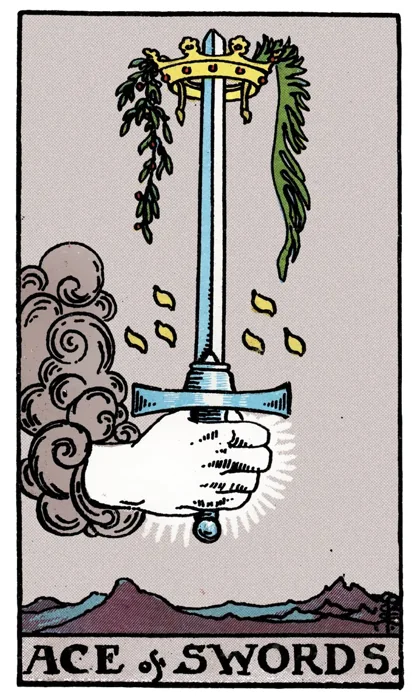
With the Ace of Swords, define the question clearly enough to assess it. A useful distinction can cut through a confused dispute. Make sure clarity comes from the evidence rather than from excluding the inconvenient part of the situation.
With Seven of Swords
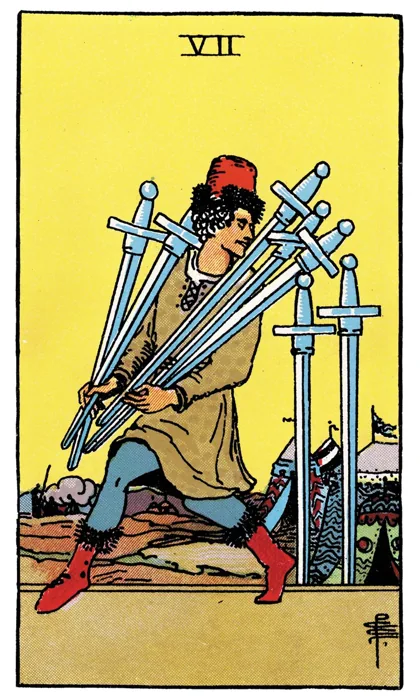
With the Seven of Swords, selective disclosure may affect an agreement. Establish what information each person needed in order to participate freely. Discretion can be legitimate, while an omission that materially changes consent deserves direct examination.
With Six of Pentacles
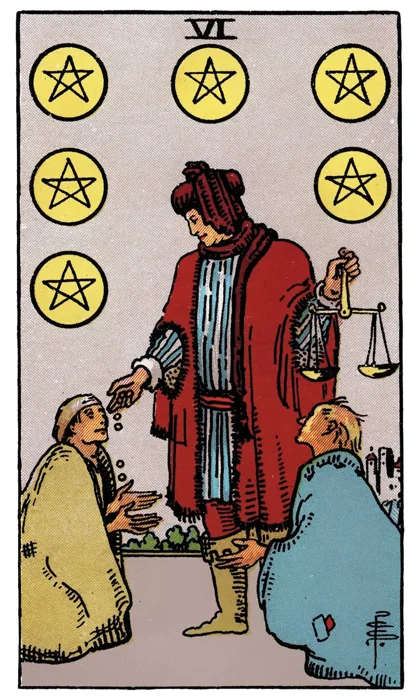
With the Six of Pentacles, fairness concerns the terms of giving and receiving. Help may create an imbalance even when it is welcome. Discuss expectations and decision-making power so that gratitude does not become an indefinite obligation.
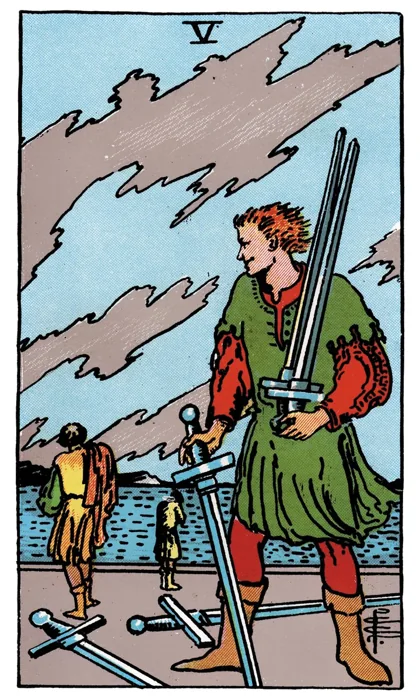
With Five of Swords
With the Five of Swords, the wish to be declared right may be damaging the purpose of the dispute. Identify what repair or decision is actually needed. A victory that deepens the original harm may be a poor measure of justice.
People whose work depends on careful judgement
The witness offers an account of what they saw while distinguishing it from what they inferred. This modest discipline is central to Justice. Its value lies in resisting the temptation to improve a story by adding certainty that experience did not actually provide.
The editor examines the work rather than the author's intention alone. Something can be sincerely meant and still fail in execution. A useful judgement describes the gap clearly enough that revision becomes possible, without confusing criticism of a passage with a verdict on the person who wrote it.
The fair referee applies a shared standard while paying attention to the particular play. Their credibility depends partly on consistency and partly on the ability to recognise an error. Authority becomes more trustworthy when correction is allowed to preserve the standard rather than threaten the role.
Write an account both sides could recognise
Choose one unresolved disagreement and describe the sequence without assigning motives. Add what was explicitly agreed, what each person could reasonably know, and the effect of the actions taken. Mark any point where you are relying on an assumption.
Then identify a modest step towards a fairer arrangement. Clarifying the record may show what needs correction or an apology; a different case may need responsibilities redistributed or relevant guidance. You do not need a complete moral verdict before making one part of the arrangement more accurate and workable.
Artwork & interpretation
Waite distinguishes the moral judgement associated with Justice from the spiritual symbolism of the High Priestess, despite their similar pillars. This guide develops a contemporary reading of evidence, proportion, and accountable decisions without treating outcomes as proof of moral deserving. A. E. Waite, The Pictorial Key to the Tarot: Justice.
The symbolic associations and examples offer ways to read a situation. They do not establish another person’s thoughts or fix an outcome.
Taking responsibility for your part does not require taking responsibility for the whole situation.
Use the cards in a spread →