Major arcana · 6
The Lovers
The choice that makes a relationship real
The Lovers begins with attraction and the experience of recognising something you want. Choosing it brings obligations into view. A possibility becomes a commitment as you make room for it in the life you actually lead.
- Attraction
- Choice
- Reciprocity
- Values
15 min read
In this guide
What changes when you choose a relationship
An encounter can change what you pay attention to. You meet someone, or glimpse a possible future, and find yourself reconsidering plans that previously seemed settled. Wanting it begins to affect the rest of your life. The Lovers asks you to consider what following that attraction would involve and whether you are willing to make the changes it requires.
In a reading, this card can describe romantic connection, a meaningful partnership, a consequential choice, or greater agreement between your values and your conduct. Something matters enough to call for participation. Admiring it from a safe distance will eventually be different from choosing it, just as speaking about a value differs from making room for it in your decisions.
There is often a quality of recognition here: you encounter someone with whom conversation becomes unusually alive, or discover a direction that gives scattered parts of your experience a common purpose. That recognition deserves attention. It does not remove the need to learn more. A powerful first impression begins a relationship with reality; it cannot finish the work of knowing.
The choice need not be between a good option and an obviously bad one. Both possibilities may contain something you sincerely want. You may want intimacy while finding it difficult to give up the freedom of having no one to consider. At work, the security of a familiar role can compete with a wish for greater meaning. Being honest may also put approval you value at risk. The Lovers makes the competing loyalties visible.
The card is most useful when it turns a vague longing into an owned decision. You acknowledge the attraction and examine what acting on it would require. Where another person is involved, their agreement matters too. This gives desire a more adult form. You do not have to become certain about the entire future before making a sincere commitment in the present.
Two people standing beneath an angel
Two naked figures stand beneath a large winged figure and a bright sun. Their exposure can be read as a lack of the ordinary signs through which people protect or advertise themselves: no uniform, possessions, or declared status tells the other what to think. The encounter begins with a vulnerability that presentation cannot entirely manage.
They remain separate. There is open ground between them, with a mountain rising in the distance. The picture allows a reading of connection that does not require fusion. Each person has a body, a perspective, and somewhere to stand; the relationship exists through what happens across that difference.
One figure looks toward the other, while the other looks upward. Their attention is connected without being identical. This small asymmetry complicates an easy fantasy of perfect mutual absorption. Two people may enter the same relationship with different questions, hopes, and ways of understanding what is happening.
A fruiting tree with a serpent appears on one side, a tree with flame-like forms on the other. Together with the unclothed figures, they give the scene an Eden-like setting. Without treating that story as a rule about gender or sexuality, the image can invite questions about desire, knowledge, and the loss of innocence that comes with an actual choice.
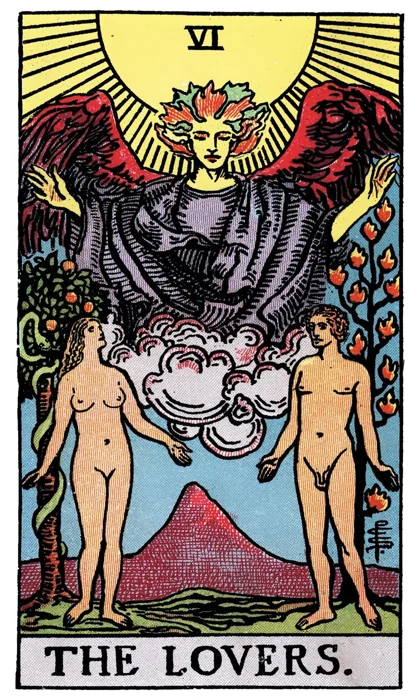
The figures do not merge into a single outline. Their separation makes room for a relationship in which each person remains present, rather than becoming an extension of the other.
The large figure above gives the encounter a wider frame. One possible reading is that a choice asks to be considered in relation to the values you want your life to express.
When wanting becomes difficult to disguise
Internally, the Lovers can feel like a sudden increase in aliveness. You become more attentive to conversation, music, your appearance, or the possibility of being seen differently. A desire you could previously keep abstract has found an object. It begins to disturb arrangements that were manageable while nothing more compelling was in view.
This can be joyful and unsettling in equal measure. You may discover that the sensible account you have given of your life leaves out something important. The card does not insist that every strong desire must be obeyed. It does suggest that pretending the desire is absent will make an honest decision harder.
As a person, the Lovers may describe someone who recognises an affinity between people or ideas. Their responsiveness to that connection can help it develop into a fruitful relationship. They recognise potential in an encounter. Their difficulty may be accepting that warmth and possibility do not oblige them to pursue every bond that could become meaningful.
Indecision sometimes protects an idealised self. While every path remains open, you can imagine being the person who would live each one beautifully. Choosing reveals preference and limitation. You become someone who wanted this enough to let another possibility remain unlived, and that can feel unexpectedly exposing.
You can understand a choice and still feel conflicted about it. Choosing a relationship, for example, does not remove your need for solitude. Taking a job may mean setting aside an ambition you continue to care about. Give those feelings an honest place in the decision. Integrity involves knowing what you are committing to and accepting its costs, even when part of you wishes the choice were easier.
A value becomes visible through what it costs
The Lovers asks how a person becomes the author of a life within relationships they cannot control. Desire is part of the answer, but so are consent, limitation, and responsibility. You can offer a commitment; you cannot make another person meet it in the way you imagined. A chosen bond remains an encounter with someone outside your authorship.
Values become concrete at the point where they compete with something else you want. Honesty is easy to admire until it risks approval. Freedom is easy to praise until another person's freedom disrupts your preference. The card brings these tensions into the foreground without assuming that every conflict has a clean or painless solution.
There is a grief inside many good decisions. Choosing one life closes access to others, at least for a time. That loss need not prove the choice was mistaken. It may simply indicate that you understood the alternatives well enough to recognise what you were relinquishing. Commitment can include that awareness without continually reopening the decision.
The deeper union suggested here is an ability to participate without disappearing. You allow an encounter to change you while retaining the capacity to speak, differ, and choose again. A relationship that matters will affect your identity. Its vitality depends partly on whether the developing person still has a place within it.
Chemistry opens the door; reciprocity keeps it open
In a love reading, the Lovers can bring attention to an important connection and the choices taking shape within it. Existing partners might be finding renewed intimacy or considering their future together. The card gives you a way to explore that experience. It cannot confirm another person's feelings or identify a destined partner; you learn about the relationship through what you share and how you treat each other over time.
Early chemistry can feel unusually convincing. A conversation that lasts for hours makes even your differences interesting, and ordinary time together feels charged. Enjoy getting to know each other while allowing compatibility to emerge more gradually. Disappointment will show you something the first attraction could not. So will practical obligations, especially when meeting one person's needs asks something difficult of the other.
For an established couple, the card can bring attention back to choosing each other within the life you now have. Habit provides continuity, but it can also conceal how much has changed. A promise made years ago may need a fresh conversation about what closeness, loyalty, freedom, and shared responsibility mean today.
Sexual connection belongs here as one possible expression of mutual recognition. Desire is most alive when both people can influence the encounter, including its pace and boundaries. Agreement given to protect the atmosphere or avoid disappointing someone is a different thing from freely offered enthusiasm. Making room for an honest answer strengthens the relationship even when the answer is inconvenient.
The difficult pattern is treating intensity as proof that practical incompatibility will resolve itself. Two people may care deeply while wanting incompatible futures or repeatedly hurting each other through habits they are unwilling to address. The card invites an honest account of the whole connection, including what becomes harder to see when attraction is strong.
A choice between partners should not be assumed merely because the card depicts a charged encounter. When that situation is actually present, the useful focus is clarity and responsibility. Other people need enough truth to make their own decisions. Keeping everyone suspended may preserve your options while quietly transferring the cost of your uncertainty to them.
Choose what you are willing to practise
At work, the Lovers can concern a partnership, a values-based decision, or the relationship between your abilities and the direction you want to pursue. A project may feel compelling because it brings together interests that have lived separately. This is a promising starting point, provided you are also interested in the ordinary work the idea requires.
A vocation is rarely made entirely of the moments that first attracted you. Much of teaching happens in preparation and repetition, away from the moment a learner understands. Writing also involves extensive revision, and running a business brings duties that may feel far removed from the reason you began. Look at the whole practice before deciding whether the appealing identity attached to it is a good guide to the life it would create.
Collaboration brings a different form of chemistry. Someone thinks in ways that sharpen your own thinking, or carries a skill that completes a weakness in the project. Agree how decisions, ownership, credit, and disagreement will be handled while goodwill is strong. A good connection deserves practical terms that help it survive pressure.
The card can also describe a conflict between professional opportunity and personal conviction. An offer may be attractive while asking you to participate in something you find difficult to support. Name the actual conflict rather than treating discomfort as either an infallible warning or an inconvenience to be silenced. You need enough detail to know what you are choosing.
When every option has benefits, use a criterion that belongs to your real life. Which work will you continue doing when the flattering description wears off? Which compromise can you accept without repeatedly resenting the people around you? A decision becomes clearer when you evaluate the daily practice as well as the promise.
Shared plans need shared meanings
Material choices often reveal values more plainly than declarations do. You may say that freedom matters while taking on commitments that leave little room to change direction, or value hospitality while building a home nobody can comfortably use. The Lovers asks whether the arrangement expresses what you actually want to prioritise.
Shared money requires more than a feeling of togetherness. People bring different meanings to saving, spending, debt, generosity, and independence. One person's careful planning may feel restrictive to another; one person's spontaneity may feel unsafe. Understanding those meanings makes a practical agreement easier to reach without turning difference into a character judgement.
A major purchase or move can carry the hope of becoming a particular kind of person or couple. Separate that imagined identity from the commitment itself. Does the location suit your days? Can the costs be carried? Are both people freely choosing the arrangement, or is one agreeing because declining feels like rejecting the relationship?
The card cannot establish whether a financial choice will succeed. Its contribution is to make ownership of the decision clearer. An agreement is stronger when the people involved understand the relevant facts and can explain, in their own words, why they want to enter it.
The cost of living in two directions
Conflicting commitments can consume attention before any visible work begins. What you promised competes with what you want to do. Keeping someone from noticing an avoided obligation can occupy still more of the day. The Lovers can invite an examination of that division. Some fatigue may belong to an arrangement that asks you to keep incompatible stories running.
Greater agreement between your choices and priorities can reduce this strain, though it will not remove every difficult feeling. A necessary conversation may initially make life less comfortable. The useful question is whether it allows you to stop spending energy on concealment, endless rehearsal, or a decision that is never allowed to become a decision.
Pleasure and connection can also renew attention. Time with a person who interests you, or work you actively care about, may restore a sense of participation. Keep room for rest alongside that aliveness. Being absorbed in something meaningful does not make sleep, solitude, and ordinary physical needs unnecessary.
Be clear about what you are committing to
As advice, the Lovers asks you to name what you are choosing in terms that could be lived. Wanting a relationship is broad; agreeing to make time, speak honestly, and negotiate a shared future gives it a shape. Wanting creative work matters; deciding which hours and obligations will change makes the preference consequential.
Include the cost without using it to frighten yourself out of every commitment. A choice does not need to preserve every advantage of the alternatives to be worthwhile. Decide which loss you can carry, which condition you cannot accept, and where further information could materially change your judgement.
The shadow is surrendering judgement to the beauty of the story. You may feel that an encounter is so meaningful that ordinary questions would cheapen it. In practice, a connection with substance can usually bear attention to what it asks of the people involved. Practical clarity gives affection somewhere to live.
Another shadow is confusing agreement with love. You avoid a necessary difference because the momentary harmony feels precious. Yet a relationship that depends on your continuous self-erasure only appears to contain two consenting people. Let a modest, honest disagreement test whether there is room for you as well as for the bond.
The agreement that is missing
Reversed, the Lovers can bring a mismatch into view. Partners may have different priorities or discover that they understood an agreement differently. You might also feel torn between loyalties when making a choice. Separation and betrayal are not conclusions you can draw from the card alone. Ask each person what they want, then compare that with what was actually discussed and what remained an assumption.
One expression is an outward yes that conceals an inward no. You participate while privately hoping the arrangement will dissolve before you have to disappoint anyone. This can make you inconsistent in ways that confuse the people involved. A clear limit may be painful, but it gives everyone more usable information than reluctant compliance.
Another expression is idealisation giving way to knowledge. You see a difference or limitation that early attraction allowed you to overlook. This need not destroy the connection. It asks whether you can become interested in the actual person, and whether the actual relationship still contains enough mutual willingness to continue.
The reversal can also indicate a decision delayed beyond the period in which delay is useful. You have collected information and consulted your feelings, but continue looking for an option that will cost nothing. At some point the choice is between accepting a real trade-off and allowing circumstances to choose through accumulated inaction.
A constructive reversal is the withdrawal of consent from an arrangement that no longer represents you. Acknowledging that a desire has changed may lead you to revise a promise. You can stop presenting an agreement as something you still freely choose. Handle the consequences honestly. The freedom to choose again carries responsibility for how the earlier choice affected other people.
What gives the choice its weight?
These pairings consider how attraction develops into commitment and what happens when values conflict. Reading the cards together can suggest questions to explore with someone; it cannot reveal feelings they have not shared.
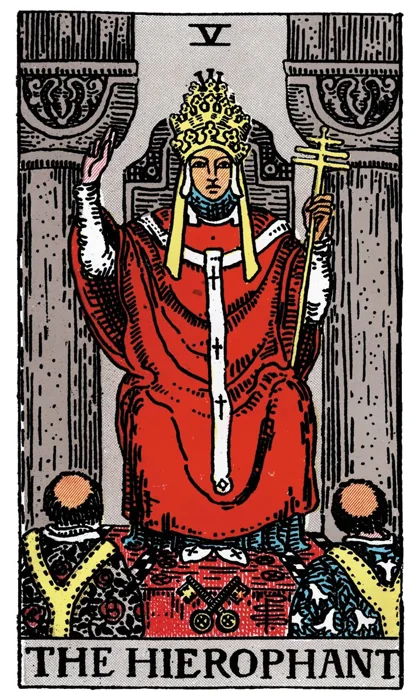
With The Hierophant
With the Hierophant, personal commitment meets an inherited form. A ceremony or shared tradition may support the bond, provided both people understand and choose it. Examine where community expectations help express your values and where they substitute for your own agreement.
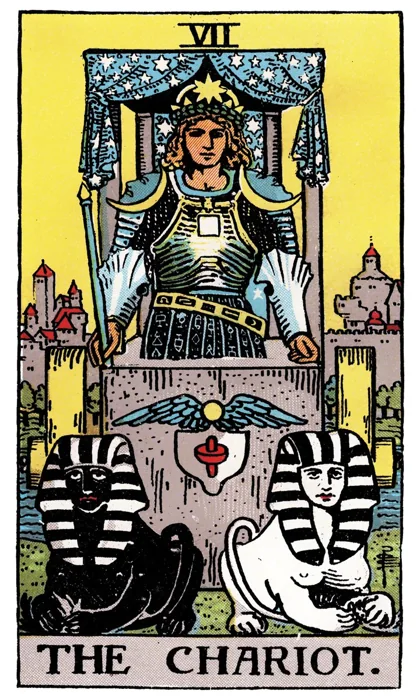
With The Chariot
With the Chariot, a meaningful choice needs direction. Once you know what you want to pursue, coordinate the practical steps that follow. Check that the drive to make progress leaves room for the other people whose participation is part of the plan.
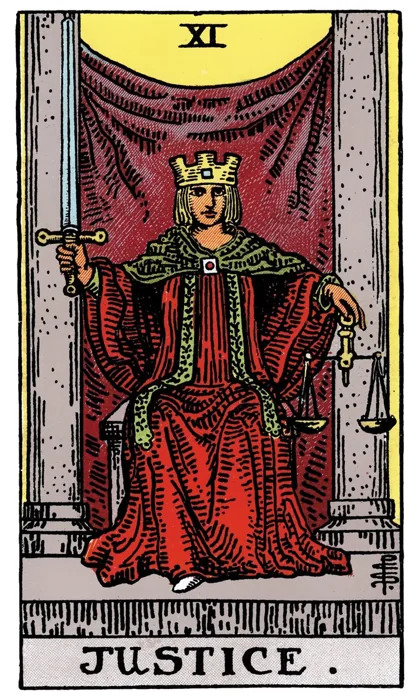
With Justice
With Justice, affection meets accountability. Agreements, fairness, and consequences become important. A sincere intention does not settle whether an arrangement treats everyone fairly; the details of responsibility and the freedom to make an informed choice still need attention.
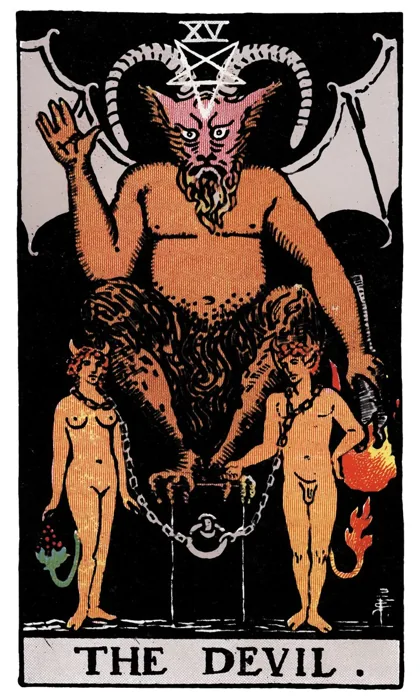
With The Devil
With the Devil, powerful attraction may be entangled with dependency or a costly bargain. Look at the freedom to disagree, decline, or leave. Intensity tells you that the bond has force; it does not establish that its terms support both people.
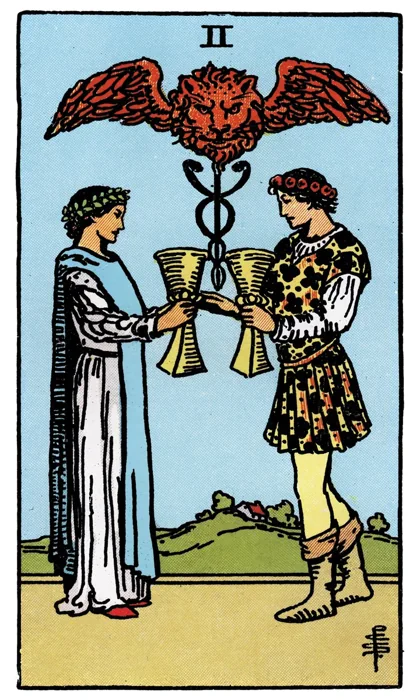
With Two of Cups
With the Two of Cups, consider how each person contributes to the connection. A major commitment depends partly on ordinary exchanges: does the other person ask about your experience, and do you make room for theirs? Look at who initiates contact and how each responds. Feeling that a bond is special does not answer these practical questions.
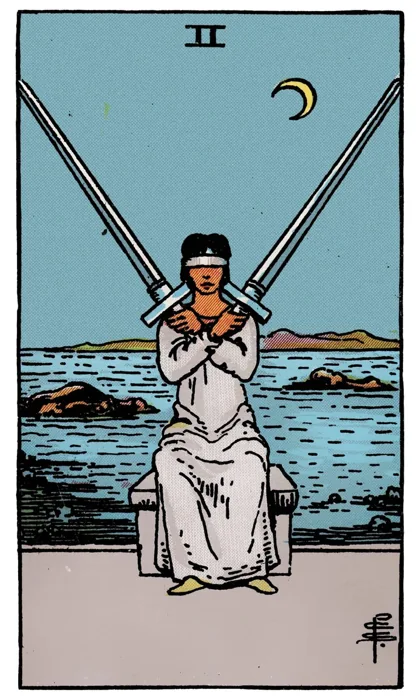
With Two of Swords
With the Two of Swords, a choice may be held in suspension because both answers disturb something valued. Identify the conflict precisely. More reflection helps when it reveals something new; it becomes less useful when it only repeats the wish for a painless option.
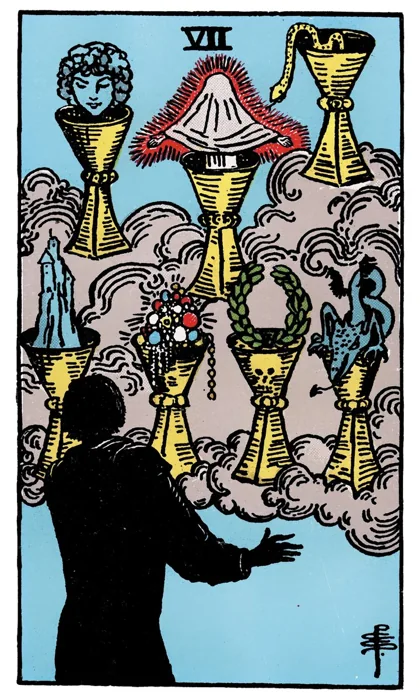
With Seven of Cups
With the Seven of Cups, imagined possibilities can crowd out knowledge of the available choices. Attraction may be directed toward a story more than a person or opportunity. Seek one concrete encounter with the reality before committing to the version in your mind.
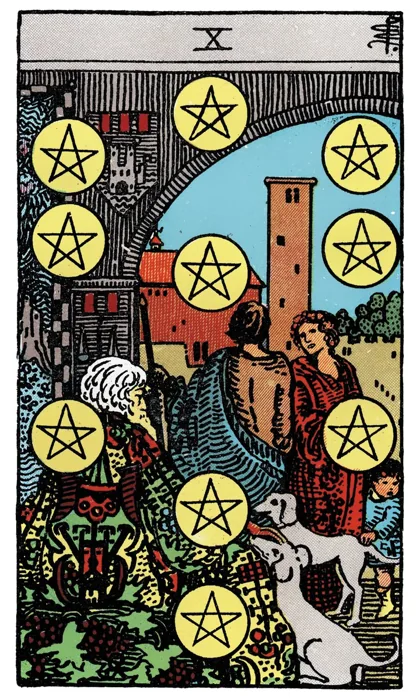
With Ten of Pentacles
With the Ten of Pentacles, a private choice enters a larger network of family, resources, and long-term expectations. Consider what the arrangement asks you to inherit. Continuity can be valuable without giving every existing custom authority over your future.
The companion who changes the road
The companion in a journey offers one image for the Lovers. Meeting them can alter the route and the pace at which you travel. Their presence may also change what you consider worth reaching. A genuine encounter introduces a perspective that cannot be reduced to help or obstruction within your original plan.
The crossroads provides another image, especially where each route expresses a different loyalty. Its difficulty lies in the fact that standing still is also consequential. The person who chooses does not emerge with perfect certainty, but with a clearer relationship to the life they are prepared to inhabit.
The duet captures a quieter aspect. Two voices can create something neither produces alone, provided each remains audible and responsive. If one voice disappears or dictates every phrase, the form changes. Partnership depends on a continuing exchange between individuality and shared attention.
Write the choice without its flattering description
Take one decision that matters and describe an ordinary week after each option. Include time, work, company, limitations, and what you would have to say no to. Leave out the impressive label attached to the choice. You are trying to meet the life it would create.
Then name the value each option serves and the cost each asks you to accept. Choose the next honest act: a conversation, a clear request, a commitment, or the collection of one missing fact. The Lovers becomes practical when the people involved can understand what your yes actually means.
Artwork & interpretation
Waite describes the unveiled figures, trees, sun, and winged presence within an Eden-like image of human love. This guide develops an original contemporary reading of reciprocal choice and commitment, without adopting the source’s gendered theological assumptions. A. E. Waite, The Pictorial Key to the Tarot: The Lovers.
The symbolic associations and examples offer ways to read a situation. They do not establish another person’s thoughts or fix an outcome.
You can choose a relationship wholeheartedly without surrendering the person who is doing the choosing.
Use the cards in a spread →