Swords · Ace
Ace of Swords
The sentence that changes what you can do next
The Ace of Swords makes a distinction clear enough to act on. A problem you could not explain may finally have a name, allowing a difficult conversation to begin. That understanding has consequences. How you use it will affect the people who hear it.
- Clarity
- Discernment
- Truth
- Decision
15 min read
In this guide
The problem has a shape you can finally work with
A situation can remain difficult for a long time partly because it has never been described accurately. What you have called laziness may be overload. An unclear agreement can also look like incompatibility, while fear of the cost of choosing may be mistaken for a lack of options. The Ace of Swords enters when a better distinction changes the available response.
In a reading, the card can describe a clarifying conversation, a new understanding, a decision, an important question, or the beginning of a more rigorous way to think about something. Its value lies in making the situation more workable. The insight need not be dramatic. One precise sentence can reorganise a problem that has previously occupied pages of explanation.
The Ace can also concern speaking plainly after a period of evasion. You identify what you want, what has happened, what you can offer, or what you will no longer agree to. The words may change the relationship because they remove an ambiguity that had been doing practical work for one or more people.
There is force in this clarity. A decision changes which possibilities remain open, and a truth can disturb an arrangement that felt comfortable. Even the definition used to describe a problem can determine the next action. The card therefore includes responsibility for the use of language. Accuracy matters, and so do timing, purpose, and the effect of what you choose to say.
The Ace begins an inquiry with a distinction you can now see more clearly. Examine the assumptions behind that insight before relying on it for a decision. Sudden certainty can be useful energy for this work, although it leaves facts to check. Once you know enough, put the understanding into practice through a question or action that advances the situation.
In an advice position, the card often asks you to separate things that have become tangled: fact and interpretation, preference and obligation, intention and effect, the actual offer and the story around it. Once the strands are distinct, you may discover that each needs a different response. The situation becomes clearer without necessarily becoming simple.
A crowned blade above distant mountains
A hand emerges from a cloud and grips an upright sword. A crown surrounds the blade near its tip, with branches hanging to either side. Below, distant mountains give the image a spare, difficult landscape. There is no person shown using the sword in a particular conflict; the picture presents the instrument and its concentrated possibility.
The blade divides the composition with unusual clarity. It gives a visual form to separation: this from that, a decision from its alternatives, a statement from the uncertainty around it. The image can invite precision while reminding us that cutting changes what is connected. A distinction should reveal something useful rather than merely create opposing camps.
The crown can suggest authority or achievement, but it does not tell us that every person holding a clear opinion has earned either. In this reading, it raises a question about what gives a statement its standing. Evidence, a fair process, relevant knowledge, and an honest account of uncertainty matter more than the confidence with which the sentence is delivered.
The mountains offer little softness. A clearer view may reveal work that still has to be done. An insight can remove confusion without removing consequences, grief, or practical difficulty. The sword gives the beginning a direction; it does not carry the whole journey for the hand that holds it.
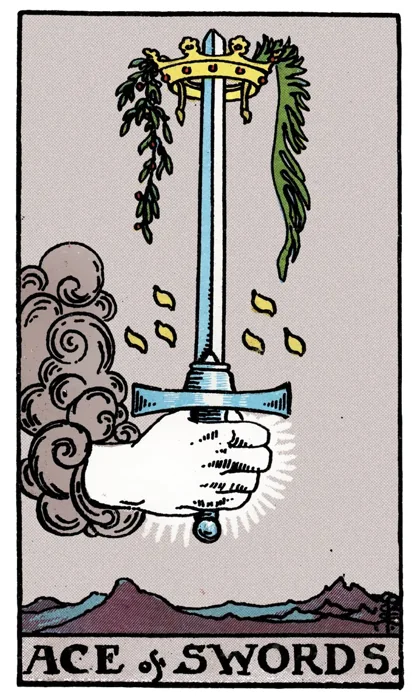
The crown can prompt a question about the basis of certainty. Identify the evidence, experience, or agreement supporting a conclusion, and the part that remains open to revision.
The blade is being held. Before speaking or deciding, consider what you intend the clarity to do: establish a fact, set a boundary, answer a question, or make a practical next step possible.
Relief can arrive with a sharp edge
The Ace can feel like mental space returning. A repeated argument loses its hold because you can finally identify the assumption keeping it alive. You may feel lighter, more decisive, or impatient with explanations that now seem unnecessarily complicated. The relief is useful, though the impatience can make it difficult to remember how long the insight took to become available.
There is often a wish to speak immediately. You want everyone else to see the distinction with the same force that you now feel it. Give the thought enough time to become communicable. Another person may need the evidence, the missing context, or an account of how you reached the conclusion. Your moment of recognition is not automatically theirs.
The card can describe intellectual courage: willingness to question a familiar account, admit that a belief no longer fits, or name something whose ambiguity has been convenient. This may bring social discomfort. A useful thought is not made false by being unwelcome, but an unwelcome thought is not made true by the resistance it receives.
The shadow is identifying so strongly with being clear-sighted that uncertainty becomes humiliating. You defend the first formulation because revising it feels like losing authority. A more dependable account distinguishes knowledge from inference and explains what evidence would change the conclusion. This makes thought stronger rather than less decisive.
As a state of mind, the Ace can also help you separate an experience from the total judgement attached to it. One mistake is not the whole person; one rejection is not every future possibility. Precision can be compassionate because it prevents a difficult fact from expanding until it occupies the entire account of a life.
Language does more than describe the situation
The words used for an experience help determine what can be done with it. Calling something a favour, an agreement, a duty, or a choice gives it a different structure. The Ace asks whether the existing language accurately represents the relationship between people and their actions. A clearer name may make a previously invisible option available.
This power also carries a risk of reducing life to the description that is easiest to defend. You may reduce a person to a category and judge the relationship through it. A complex history then contracts into one decisive sentence. Clarity is useful when it allows more accurate contact. It becomes impoverishing when it removes every detail that would make the judgement less comfortable.
Truth and the wish to win can become closely entangled. You may have a valid point and still use it to humiliate, end a conversation prematurely, or avoid your own responsibility. Before speaking, consider what a successful use of the truth would look like. The answer may be understanding, protection, a changed agreement, or a decision — not simply the other person's defeat.
The card also concerns freedom from an inherited explanation. An apparent rule may turn out to be someone's preference, or an obligation something you never agreed to. Even a familiar description of you may have survived mainly because it suited someone else. The discovery can be liberating while still requiring patient work to change the surrounding arrangement.
A mature relationship with clarity leaves room for revision. The world can answer your best formulation with a fact it does not contain. Listening to that answer is part of the same commitment to truth that produced the original insight. The sword remains useful because the hand can adjust its direction.
Define the task before applying more effort
At work, the Ace can describe a useful insight, a clear brief, an effective question, or a decision that gives a project direction. If effort has been scattered, examine whether people are solving the same problem. A team can work extremely hard while carrying several incompatible definitions of what success would mean.
A clear brief names the intended result, the relevant constraints, and who can decide when the work is complete. It does not need to predict every detail of execution. Its value is providing a common reference so that later disagreements can concern a specific choice rather than a shifting impression of what was wanted.
The card is useful for editing and analysis. Find the central claim and the material that supports it. With those in view, you can decide what to remove without losing the purpose. Cutting is most effective when you know what the work is trying to do. Otherwise, decisiveness can become an aesthetic of severity rather than an improvement in communication.
In a difficult conversation, prepare the particular issue rather than an inventory of every frustration. What happened, what effect did it have, and what needs to be agreed now? A precise account gives the other person a better chance to respond to the actual matter. It also makes evasion easier to recognise.
The professional shadow is a decision announced before the relevant information has been gathered. A clean answer can be attractive because it ends uncertainty, especially in a pressured setting. Ask which facts support it and which assumptions are carrying too much weight. A short pause for one important question may save a great deal of confident work in the wrong direction.
For a new direction, the Ace can provide the sentence around which an undertaking begins: a description of the problem you want to address or the work you want to make, with the conditions you need to begin. Let that sentence guide an initial attempt. Its first useful form does not have to become an unchangeable declaration for the rest of your career.
Say the thing that allows a real answer
In relationships, the Ace can concern an honest conversation, a clear expression of desire, a boundary, or an understanding that changes how the connection is viewed. Ambiguity may have become tiring. A direct question can make room for an answer that is more useful than another round of interpreting hints.
Clarity about your own experience does not establish the other person's inner state. You can say that a pattern leaves you uncertain or that you want a particular kind of relationship. The next part belongs to their response. A conversation becomes more accurate when each person has standing to describe their own experience.
The card can be helpful where affection has become entangled with unspoken expectations. What was actually agreed, what was assumed, and what has changed? Naming the distinction can reduce blame and reveal whether a new agreement is possible. A missed assumption is different from a broken promise, even when both have caused hurt.
A necessary truth may be painful. Consider how to state it clearly without adding injuries that serve no purpose. Precision can limit the damage: this arrangement no longer works for me is a different statement from a judgement that the whole relationship was worthless. Honesty need not expand beyond what you actually know.
The shadow is using bluntness as a proof of integrity. You may say something accurate while choosing a form designed mainly to discharge anger or establish superiority. Ask what the words are intended to accomplish. The wish to be truthful and the wish to hurt can coexist, and distinguishing them gives you more choice.
A constructive Ace can also bring relief through a shared naming of the problem. Once the issue is no longer mysterious, both people may be able to respond differently. The result may be repair, a revised boundary, or a clearer ending. The card supports an honest exchange; it does not prescribe which outcome the exchange must produce.
Make the terms plain enough to understand
In practical matters, the Ace asks for clarity about what is actually being offered, expected, or decided. A warm conversation can leave important terms unstated. Write down the specific questions you need answered and distinguish confirmed details from assumptions or hopes.
A disagreement about resources may partly be a disagreement about language. One person understood a gift, another a loan; one heard a suggestion, another a commitment. Clarifying the original understanding and the present needs can make the next conversation more useful, though the card itself cannot settle the terms or determine anyone's legal position.
At home, a precise description of a problem can make a modest change possible. Too little privacy, unclear responsibility, and an inconvenient layout are different difficulties. Naming the actual issue prevents a general feeling of dissatisfaction from making every part of the environment seem equally wrong.
The Ace does not predict a favourable contract, dispute, or financial result. Its value is the prompt to understand the relevant facts and terms before relying on them. Where a matter requires specialist knowledge, clarity includes recognising which question needs an appropriately qualified answer.
A clear decision can release attention
An unresolved question can occupy attention through constant reconsideration. A clear decision, or a clear account of what is still needed to decide, may reduce that repeated mental work. The benefit comes from having a defined next step rather than requiring yourself to rehearse the whole situation whenever it returns to mind.
The sharpness of a new insight can also create a restless wish to reorganise everything at once. Choose where the understanding has an immediate practical use. One changed conversation or one clarified task may be enough to begin learning what the insight means in daily life.
The card cannot determine the cause of mental strain or promise relief from it. For reflection, ask whether a particular ambiguity can be reduced, a question written down, or a decision given a clear review point. Precision is useful when it reduces unnecessary effort rather than creating another demand to think perfectly.
Separate the fact, the interpretation, and the request
Describe the situation in three parts: what you have observed, what you think it means, and what you want to do or ask next. The separation can reveal where an interpretation has quietly become a fact, or where a real need has been hidden inside an accusation.
Find the smallest statement that is both accurate and useful. Remove exaggerations that make the claim easier to dismiss, and qualifications that obscure what you mean. You can be careful without becoming evasive. The aim is a sentence that another person, including your future self, can actually work with.
The shadow is cutting away complexity merely because it interferes with a satisfying conclusion. Ask what your account leaves out and whether the omitted detail would change the response. A thought can be concise while still acknowledging its limits.
Another shadow is remaining forever in analysis after the useful distinction has already been made. If the next step is clear and proportionate, take it. The Ace's clarity gains value through contact with the situation, where action can confirm, complicate, or revise the understanding.
The thought may be unclear, withheld, or too certain of itself
Reversed, the Ace can describe confusion, an incomplete argument, a difficult truth left unsaid, harsh communication, or a conclusion reached too quickly. Identify which problem is present. More force will not repair missing information, and more information may not resolve a sentence you already know but are afraid to say.
Sometimes the issue is language that sounds precise while concealing the practical meaning. A proposal uses impressive terms but leaves you unable to describe what will happen. Ask for an ordinary example or a plain account. Understanding should become clearer through explanation rather than more dependent on the speaker's authority.
The reversal may also concern a useful insight that has been used as a weapon. You can see a pattern in another person's behaviour and reveal it at the moment it will hurt most. Consider whether the purpose is change, protection, or retaliation. The accuracy of an observation does not settle the ethics of its use.
Another version is excessive doubt about a thought that deserves a fair hearing. You keep adding qualifications until nobody can identify your actual point. State what you know at the scale you know it, and name the uncertainty separately. You do not need complete knowledge of a situation before contributing one accurate observation.
A constructive reversal asks for revision before declaration. Check the premise, define the term, gather the missing fact, or rewrite the sentence. The thought may become less dramatic and more dependable. Clarity often develops through correction, including the willingness to relinquish a formulation that once felt especially satisfying.
What can clarity make possible in this situation?
These pairings explore understanding, language, and decision. They do not prove that one person's account is correct or predict the outcome of a dispute.
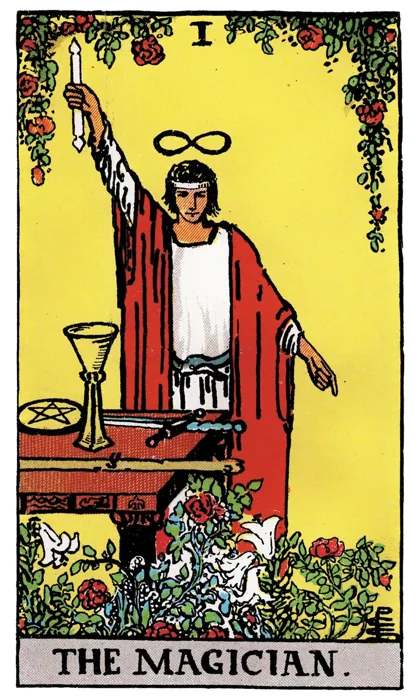
With The Magician
With the Magician, a clear idea has a route into action. Identify the tools and the first demonstrable result. The combination becomes useful when explanation produces an attempt that can be examined, rather than remaining a polished account of what could be done.
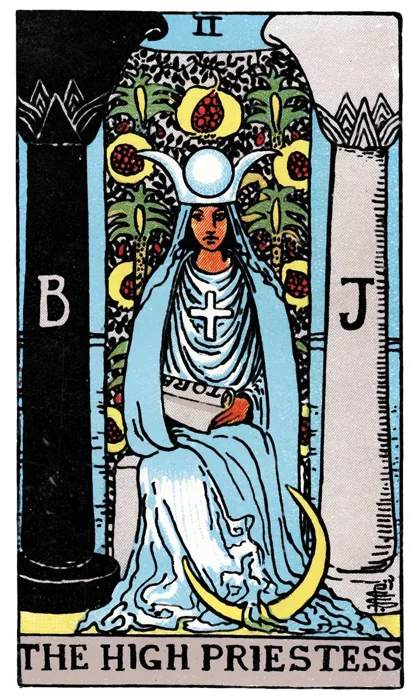
With The High Priestess
With the High Priestess, an unspoken impression may need careful language. Give it a form while distinguishing intuition from confirmed information. The pairing supports an inquiry that respects what you notice without turning every private impression into a public conclusion.
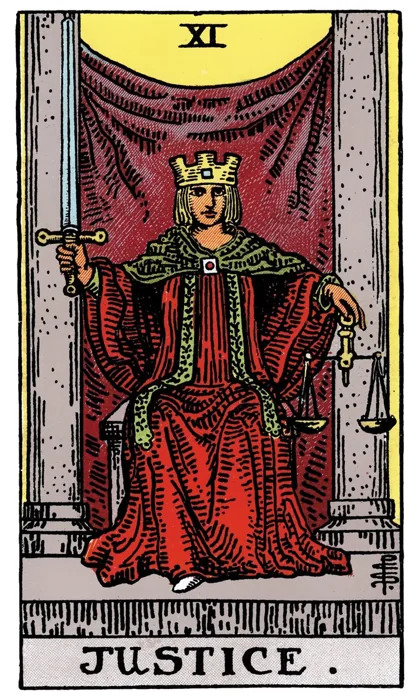
With Justice
With Justice, precision has consequences for fairness and responsibility. Examine the evidence, the relevant agreement, and the standard being applied. Clear reasoning is most useful when the same care is given to facts that support your position and those that complicate it.
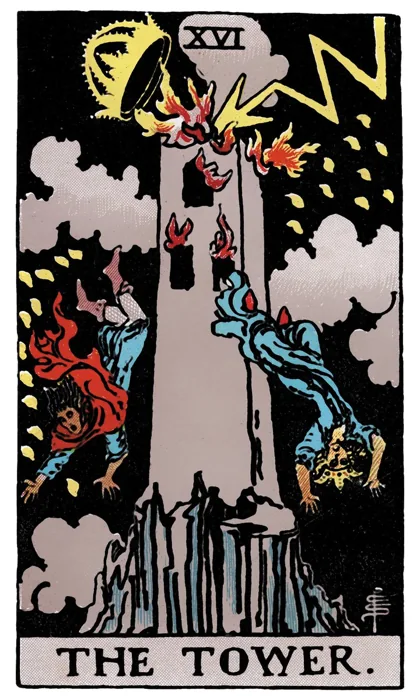
With The Tower
With the Tower, new information may disrupt a familiar account. Separate what has actually been established from the wider conclusions the shock encourages. A more accurate understanding can guide the next step without requiring you to decide the meaning of everything at once.
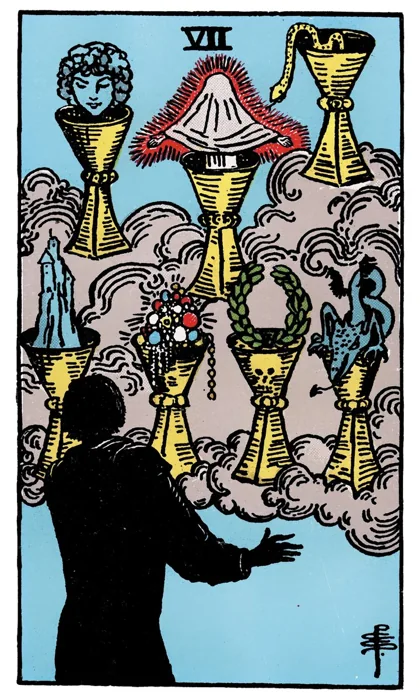
With Seven of Cups
With the Seven of Cups, define what is real inside an attractive field of possibilities. Name the known facts, the desired feeling, and the unanswered question. One useful distinction can turn an imagined future into something that can be tested.
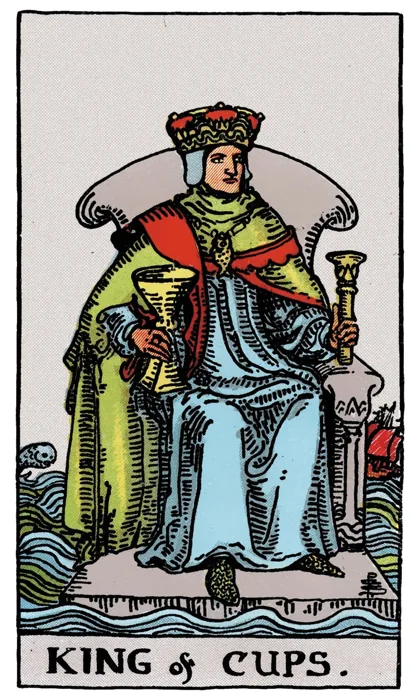
With King of Cups
With the King of Cups, a difficult truth can be spoken with emotional responsibility. Consider both the accuracy of the statement and the purpose of saying it. Care helps the truth become usable without requiring the answer itself to be softened into ambiguity.
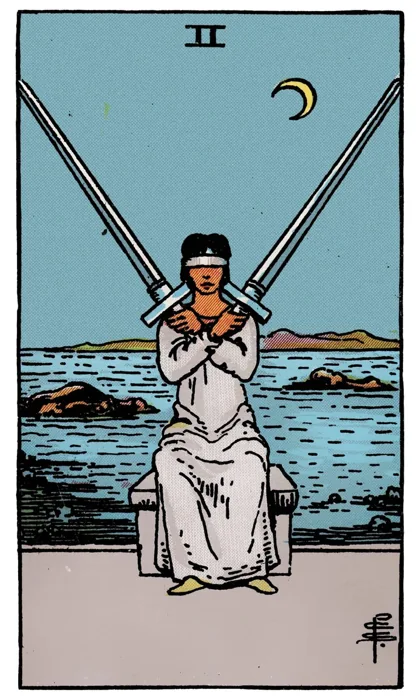
With Two of Swords
With the Two of Swords, identify what would actually help an undecided situation move. The missing element may be a fact, a criterion, or acknowledgement of a cost. Clarity begins when the pause is given a purpose beyond avoiding the discomfort of either choice.
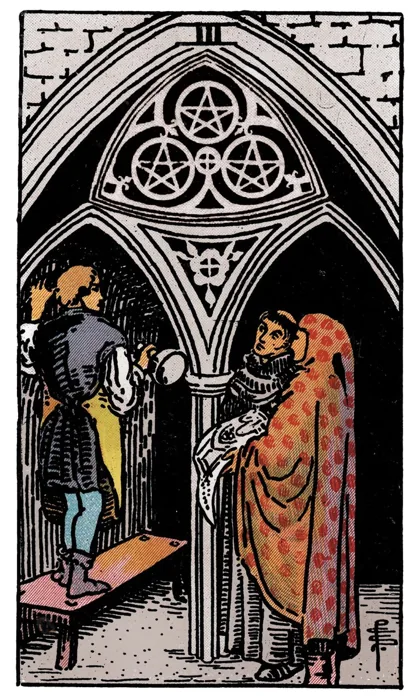
With Three of Pentacles
With the Three of Pentacles, a shared task benefits from a clear brief and respect for different kinds of knowledge. Make the common aim explicit and let practical expertise inform the method. The best idea may become stronger through collaboration rather than through one person's certainty.
A statement that makes further work possible
An editor notices the sentence on which the whole piece depends. Once it is clear, other choices become easier: what belongs, what needs support, and what can be removed. The intervention has force because it serves the work's actual purpose rather than merely displaying the editor's cleverness.
A named boundary changes an ambiguous relationship. What was previously guessed or tested becomes something people can understand and respond to. The statement may not remove disagreement, but it gives the disagreement an honest subject.
The first formulation of an idea can feel complete because it brings relief. Further examination reveals where it holds and where it needs revision. The intellectual courage of the Ace includes both making the claim and remaining willing to improve it when the world supplies an answer.
Write the sentence the situation has been missing
Choose one issue that keeps returning without becoming clearer. Write the observed facts, your interpretation, and the decision or request in separate lines. Then compose one sentence that names the central issue without exaggeration, mind-reading, or a judgement about somebody's entire character.
Decide what the sentence is for: a conversation, a revised plan, a boundary, or a question you need answered. Use it in that limited way and remain open to what follows. The Ace of Swords becomes practical when clarity gives you better contact with the situation, rather than merely a stronger feeling of being right.
Artwork & interpretation
Waite presents the sword and crown as an image of considerable force and triumph. This original practical interpretation develops the blade as discernment, language, and decision, including responsibility for how clarity is used; it does not adopt historical predictive claims as facts. A. E. Waite, The Pictorial Key to the Tarot: Ace of Swords.
The symbolic associations and examples offer ways to read a situation. They do not establish another person’s thoughts or fix an outcome.
A clear thought can open a way forward; certainty becomes dangerous when it stops listening.
Use the cards in a spread →