Swords · Four
Four of Swords
The life that continues while you stop answering it
The Four of Swords allows unfinished matters to wait outside the door for a while. They will still need attention, but recovery needs time of its own. Making that pause can be difficult when you are used to treating every available hour as time you should spend resolving something.
- Rest
- Retreat
- Recovery
- Protected time
17 min read
In this guide
Nothing needs your answer for this hour
The messages are still there. So is the conversation you could rehearse again, the problem with six possible solutions, the feeling that a responsible person would already be doing something. The Four of Swords enters when another effort may be less useful than a period in which effort is allowed to stop. There is an almost unfamiliar relief in discovering that the world can continue without your immediate reply.
In a reading, this card can describe a retreat, a deliberate break, recovery after strain, time away from conflict, or the quiet preparation that precedes a return. Its stillness has a boundary around it. You step out of the demand to decide, explain, defend, or produce so that these activities do not become the only forms your attention knows.
The Four is particularly relevant after the Three of Swords. Something painful has happened, and the next task may be to stop reopening it through continuous interpretation. You do not need a finished philosophy of the experience by evening. Some understanding develops only when the experience is no longer being questioned from every possible angle. A pause can give the facts room to settle.
Containment gives a difficult matter a specific place in your day. You might set a time for the conversation and close the relevant notes until then. Someone else may be able to take responsibility during your break. The issue still matters, but it no longer requires continuous attention. This is particularly useful when treating it as urgent has become a habit that exceeds what the situation actually needs.
Rest has circumstances. Covering a shift or getting dinner ready for children may require someone else's help. Even finding a quiet room can be difficult. The Four becomes practical through those details. Even a modest pause needs protection: fewer requests, a handover, an agreement about interruptions. Telling an exhausted person to relax while leaving every demand in place misses the work this card is asking the surrounding world to do.
There is no promise here that inactivity will solve the problem by itself. The point is to recognise when your capacity to meet it needs care. A useful pause changes the conditions of your return, or clarifies that returning in the old way is no longer appropriate. Sometimes the most consequential discovery made in the quiet is how much of the previous noise was unnecessary.
The swords remain, but no hand is fighting
A golden figure lies at full length with hands joined in prayer. This is an effigy on a tomb, rather than a literal portrait of somebody taking an afternoon nap. The solemn setting gives stillness an authority ordinary rest is often denied. Read symbolically, it creates a room in which there is no expectation that the figure should jump up and prove its usefulness.
Three swords hang vertically on the wall. A fourth lies horizontally along the side of the tomb. The weapons have not vanished, yet none is being wielded. Their presence allows an important distinction: a conflict can remain part of the situation while active engagement with it is suspended. Putting down the argument need not require pretending that it never happened.
At the upper left, a stained glass window brings colour and human figures into the grey enclosure. One figure stands while another kneels. The window can be read as a reminder that support, recognition, or a larger frame of meaning exists beyond the immediate demand. It also lets light into a scene that might otherwise feel entirely sealed.
The image is austere, and that austerity can make the card unsettling. A tomb in a symbolic deck does not establish a death forecast or a medical outcome. What the composition offers this reading is a powerful interruption of ordinary activity: the still figure has empty hands, while the swords remain apart from it, set along the tomb and wall.
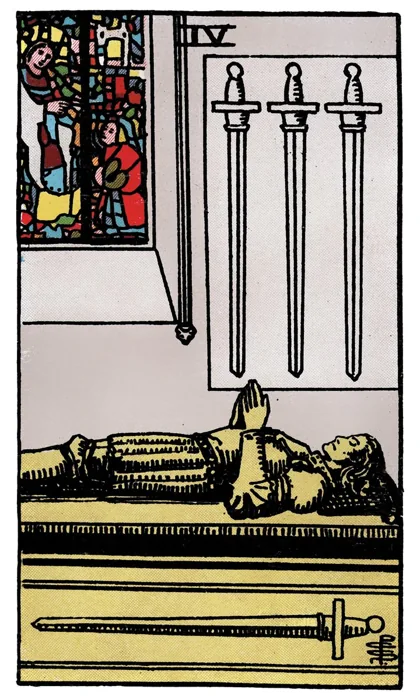
The figure does not grip a weapon or a task. Consider what your own pause would require you to put down, including the less visible work of explaining why you deserve to be unavailable.
The window gives the quiet room a relationship with something beyond itself. Solitude can remain connected to care, meaning, and other people; recovery need not depend on shutting every source of contact out.
When quiet feels strangely difficult
The person described by the Four may be tired of responding. They can still produce a competent answer, perhaps even a cheerful one, but the effort behind it has become disproportionate. Small decisions feel crowded by all the others. The wish to withdraw may be an accurate perception of a limit, rather than evidence of indifference towards the people or work involved.
At first, quiet can feel less comfortable than busyness. Without the next request to organise the hour, you notice the fatigue, irritation, or sadness that activity had kept in the background. This does not automatically mean the pause is going badly. It may mean you have stopped supplying the noise that made those experiences harder to notice.
There can also be pride in being indispensable. Being the person who always answers gives a clear place in the world, even when that place is exhausting. The Four asks what remains of your belonging when you are temporarily less useful. A relationship that can tolerate your absence offers a different kind of reassurance from one that continually proves how much it needs you.
The quieter strength of this card is discretion about your own attention. A debate or provocation can remain unanswered. Feelings, too, can be noticed without requiring an immediate decision. Some things can pass through the day without being recruited into a project. This is a form of steadiness, though it may look unimpressive to an audience accustomed to constant visible motion.
Its difficulty is withdrawal that loses its purpose. The room becomes a place where nothing can challenge an old conclusion, and the promise to return keeps moving further away. Look gently at whether the retreat is restoring contact with life or making contact feel increasingly impossible. The answer may call for company, a smaller return, or a change in what you are being asked to return to.
A person is more than an available pair of hands
The Four questions the idea that value must be continuously demonstrated. A machine is praised for running without interruption; a human life has other requirements. There are hours that cannot be justified by what they produce afterwards. The card gives those hours a serious place, including the ones that contain nothing more impressive than looking out of a window and gradually becoming less braced.
There is humility in stopping. Limited attention means another round of thinking may yield nothing new. Stopping also requires trusting that the world can hold together without your continual vigilance. This can feel like a loss of control. It can also reveal how much control you had been trying to exercise over things that were never fully yours to manage.
A retreat changes the scale of a problem. From inside an argument, every sentence can appear decisive. After some distance, you may discover that the argument concerns a much smaller matter, or that the smaller matter was carrying a larger one. The quiet does not manufacture the answer. It makes more than one scale of interpretation available again.
The card also holds a question about permission. Who is allowed to rest without having their character examined? In a household or team, the answer is not always evenly distributed. A practical reading can therefore extend beyond personal habits to shared arrangements. Rest becomes more credible when it is supported by ordinary cooperation, rather than reserved for the person best able to defend it.
Finally, the Four preserves the possibility of unfinishedness. An unresolved experience can be set down for a while without being abandoned forever. You may return with a different question, or discover that no further question is required. Living does not demand that every difficult chapter be fully interpreted before the next ordinary morning is allowed to begin.
Close the notebook with a place to begin again
At work, the Four can point to leave, a pause between projects, protected concentration, or a necessary reduction in demands. The useful question is which kind of interruption would actually help. An afternoon without meetings is different from time away from work altogether. Calling both rest can leave the deeper need untouched while preserving the appearance that something has been done.
For a project caught in endless revision, the card suggests a cooling period. Leave a brief note about the unresolved question, then stop rearranging the same material. When you return, read it as a whole before touching individual details. Distance may reveal a structural problem that repeated polishing had made harder to see, or show that the work is already sufficiently finished.
A handover is often the practical heart of this card. Name the work that needs attention and the person authorised to make decisions about it. Be equally clear about what can wait. The purpose is to let the person stepping away actually step away. A holiday spent checking whether everybody has survived your absence keeps the same system running from a different location.
If you lead others, watch the example set by your own availability. Announcing that people should rest while rewarding immediate replies gives them conflicting instructions. The Four favours arrangements that make pauses ordinary: realistic coverage, sensible deadlines, and no theatrical surprise when someone is briefly unreachable. The cultural permission matters as much as the calendar entry.
A professional pause can also be a period of reassessment. Once the daily pressure recedes, you may notice that the role no longer fits, or that one recurring demand accounts for much of the strain. Let the observation become specific before making a sweeping decision. A changed responsibility, clearer scope, or different working rhythm may be more relevant than starting an entirely new life.
The shadow is using preparation as a permanent waiting room. You take another course, reorganise the desk, or postpone showing the work until your confidence feels complete. Rest and readiness are related but not identical. If the pause has served its purpose, a limited return with support may teach you more than another attempt to become invulnerable before beginning.
Space is easier to trust when it has words around it
In a relationship, the Four can describe a need for breathing room after an intense conversation or a demanding period together. Affection does not remove the need for solitude. Some people regain the capacity to be present by spending a little time without being asked to interpret, reassure, or respond. Acknowledging that difference can make closeness less crowded.
A useful pause is communicated as clearly as circumstances allow. Explain the space you need and when you expect to return to the discussion, including any contact that would be welcome meanwhile. This gives the other person something firmer than a silence they must decode. You need not provide an elaborate defence of the boundary, but a few plain words can prevent avoidable uncertainty.
Taking space becomes more difficult when it is used as punishment. Disappearing until someone concedes, withholding ordinary warmth to force an apology, or repeatedly refusing any return to the issue changes the meaning of the retreat. The Four invites a distinction between time that makes conversation possible and absence that becomes a way to control its outcome.
For someone supporting a tired friend, care may look unusually quiet. Bring food, take one task, or offer company that does not require entertaining you. Repeatedly asking whether they feel better can become another demand to produce a satisfactory result. Let the help have a modest shape and allow the person receiving it to remain unfinished.
After a separation, the card may suggest a period without continual updates, explanations, or attempts to establish how the other person is doing. This is not a universal rule about contact. It is a question about what the present contact does to your capacity to live your own day. Some distance may make room for feelings that cannot settle while the conversation remains permanently open.
A long quiet spell can also expose loneliness. If withdrawal has become the only available way to avoid conflict, the relationship may need more than another pause. Consider whether there is room for ordinary disagreement, dependable repair, and a return that does not require one person to surrender their perspective. Rest cannot carry the whole burden of an arrangement that keeps exhausting you.
Make the pause possible in ordinary terms
Money enters this card through the conditions that permit rest. Time off may need planning; a reduction in hours may have consequences; a household may need to redistribute tasks. The Four offers no promise that resources will appear because a break is deserved. It asks you to make the need visible enough that practical arrangements can be discussed.
A pause in discretionary spending can sometimes create breathing room, especially when purchases have become another response to an overloaded day. Keep the purpose specific and proportionate. The useful outcome is a little more room to choose, not a new regime in which every small comfort requires a trial and a verdict.
At home, the card may point to one protected place or period. A cleared chair, a closed door, or an agreed quiet hour can matter more than an ambitious redesign. The space should not become another project to perfect before you are allowed to use it. A refuge earns its name by what it permits, not by how well it photographs.
In shared living, notice whose rest generates work for someone else. A fair arrangement may involve turns, explicit requests, and a willingness to accept help done differently from your preference. The Four is most generous when refuge is something a household makes possible for its members, rather than a privilege one person secures by becoming unavailable.
Lower the number of things asking for you
The card can be read as an invitation to reduce input: fewer conversations at once, less repeated checking, a simpler evening. This is an experiment in attention, not a diagnosis or a treatment plan. Notice which demands leave you more scattered and which ordinary activities allow your interest to return without being forced.
Rest does not have to resemble perfect stillness. A familiar walk, undemanding company, or a task with a clear ending may feel more spacious than sitting alone with an expectation to become calm. The relevant quality is relief from continual performance. Choose something you do not have to become good at before it can help.
If a pause leaves the underlying difficulty unchanged, that is information rather than a personal failure to relax correctly. You may need a different arrangement, practical assistance, or appropriate professional support. The Four gives room to notice what is happening; it should not be made responsible for explaining every cause of tiredness or distress.
Give the quiet a boundary, not a performance target
The advice is to stop one unnecessary round of engagement. Decide what can remain unanswered for a defined period, and make that decision real enough to protect. Put the phone elsewhere, hand over the task, or state when you will return to the conversation. A small boundary you can keep is more useful than an imaginary week of perfect peace.
Leave yourself a gentle route back. A note about the next step, a date to review the situation, or a person who can check in may be enough. The return need not be a dramatic declaration of renewed capacity. It can be an ordinary first hour in which you discover what is manageable now.
The shadow is turning rest into another achievement. You may assess how successfully you switched off as though the break had a target to meet. Afterwards, you judge yourself by how much better you think you ought to feel. This recreates the demand inside the refuge. Some pauses are messy, distracted, or disappointing and still deserve to have existed.
Another shadow is expecting silence to settle a matter that needs an actual decision. A pause may improve your ability to speak, but it cannot speak for you. When the time comes, bring back the particular question that remains. You do not have to reopen the entire history in order to take the next necessary step.
The door may need to close, or begin to open
Reversed, the Four can describe a pause that cannot quite happen. You stop working but continue monitoring, lie down while rehearsing tomorrow, or fill every free hour with recovery instructions. The outward activity changes while the demand to remain on duty survives. Look at what would need to feel sufficiently held for you to stop supervising it.
It can also show a return after withdrawal. Interest stirs, an invitation feels possible, or you begin wanting more than the quiet room can offer. This need not mean every difficulty has disappeared. Readiness may arrive as a willingness to try one manageable form of participation, with permission to adjust the pace afterwards.
A third expression is staying away because the return has become frightening. The longer the absence, the larger the imagined first step grows. Reduce the scale: a brief message, a limited visit, one piece of work shared with a trusted person. The aim is contact with current reality, not a performance that proves the whole retreat was worthwhile.
Sometimes the reversed card points to rest that keeps being interrupted by an unchanged system. The request is then less about personal discipline and more about agreements, resources, and expectations. If your only quiet hour depends on somebody else forgetting to need you, the arrangement itself may need attention.
Choose among these readings through the actual situation. Is the missing movement towards a protected pause, towards a supported return, or towards changing the demands that make both difficult? The orientation offers a question about the rhythm of withdrawal and engagement. It does not decide the direction on your behalf.
What the pause is making room for
Read these as conversations between images. The surrounding cards can help identify what needs a pause, what might support it, and what kind of return is being considered.
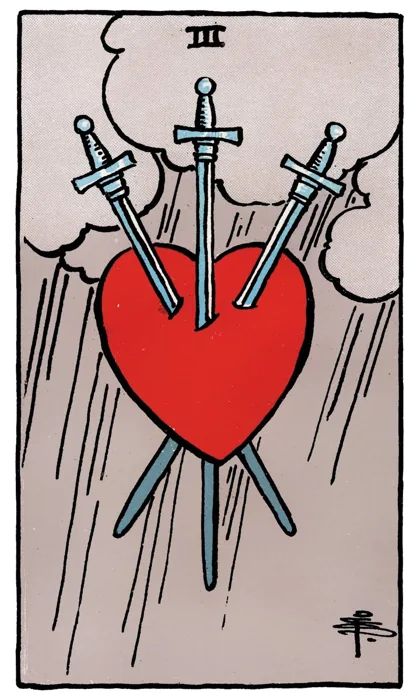
With Three of Swords
With the Three of Swords, pain may need a period without repeated explanation. A difficult conversation can be acknowledged and then set aside for an evening. The pause is not an instruction to suppress feeling; it protects some ordinary life from becoming a continuous hearing about the wound.
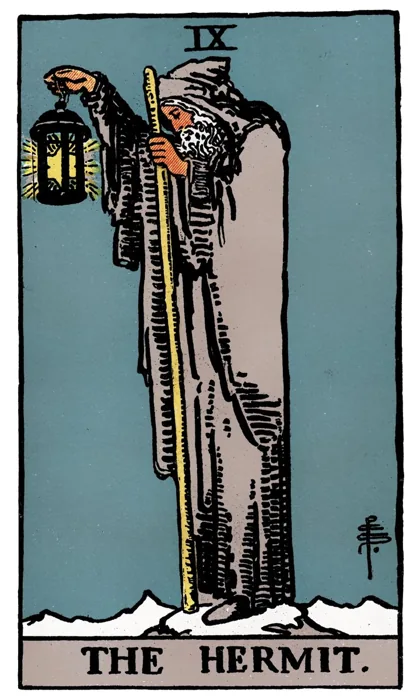
With The Hermit
With the Hermit, solitude may have a deliberate purpose: reflection, study, or finding your own account after too much outside opinion. Distinguish a nourishing retreat from isolation that simply repeats the same thoughts. A trusted point of contact can help the quiet remain connected to a wider world.
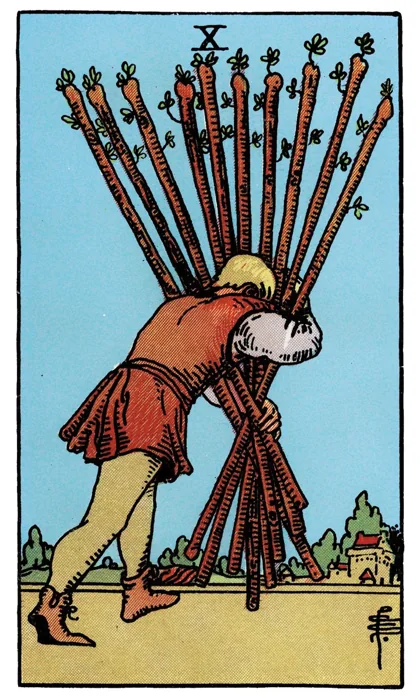
With Ten of Wands
With the Ten of Wands, the need for rest is tied to what you are carrying. A break may help, but the return will be difficult if the whole load is waiting unchanged. Consider which responsibility can be shared, reduced, finished, or declined before the pause ends.
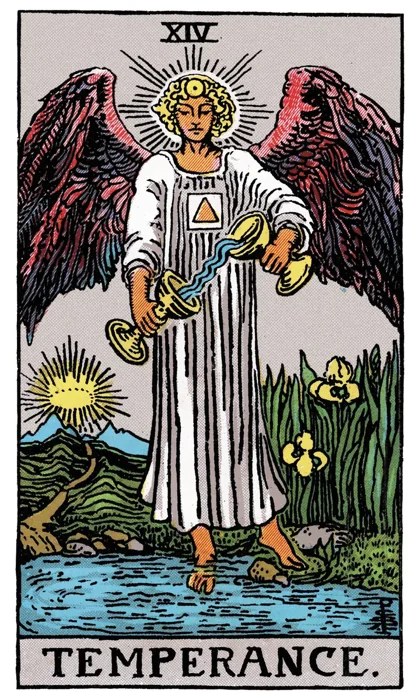
With Temperance
With Temperance, the question is how to build a sustainable rhythm after the retreat. Small adjustments may matter more than a dramatic promise to live differently. Try a pace that includes ordinary variation, so a demanding day does not automatically cancel every provision for rest.
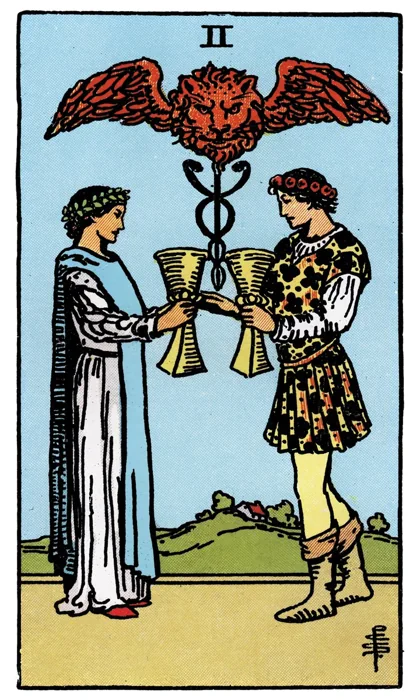
With Two of Cups
With the Two of Cups, space can be supported by a clear agreement. One person may need quiet while the other needs reassurance that the connection remains intact. A modest conversation about timing and contact can honour both needs without making either person responsible for guessing.
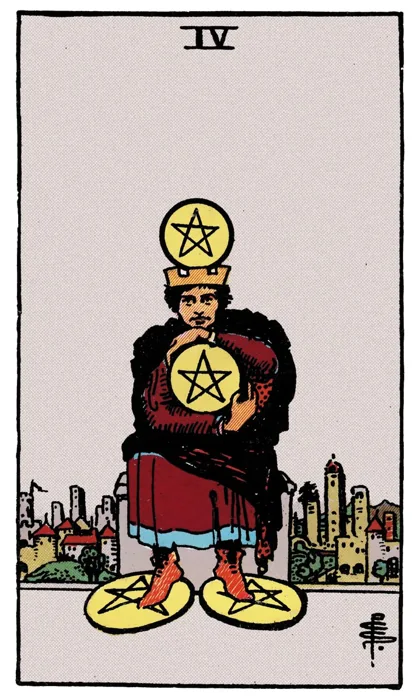
With Four of Pentacles
With the Four of Pentacles, protection may be becoming rigidity. The refuge is valuable, but every invitation may now look like an intrusion. Ask what you are preserving and whether one carefully chosen opening could support that purpose rather than threaten it.
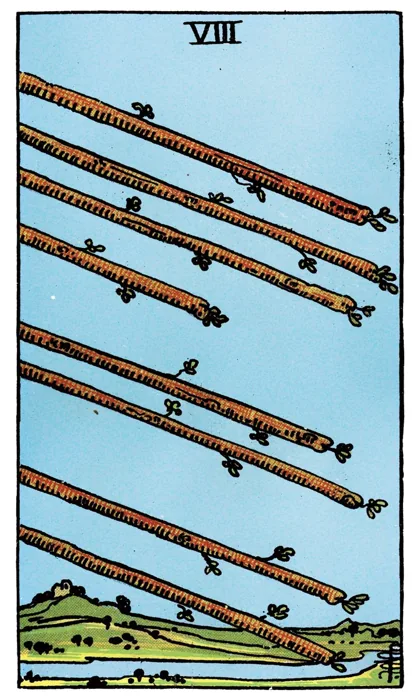
With Eight of Wands
With the Eight of Wands, events may move faster than your capacity to absorb them. Identify which messages truly require an immediate response and which merely arrive quickly. Speed in the surrounding world does not mean every part of your attention must travel at the same pace.

With The Star
With the Star, quiet may allow a modest sense of possibility to return. Do not hurry it into a new plan. The first sign may be interest in an ordinary pleasure or a future day that feels less crowded. Let that small change have its own scale.
The closed workshop and the room kept quiet
Imagine a workshop after the tools have been cleaned and put away. Nothing is being made, but the room has not ceased to matter. Its readiness includes the interval between tasks. The image gives craft a rhythm broader than production and allows the maker to belong there even with empty hands.
A friend keeps a room quiet while somebody sleeps. They keep unnecessary questions and visitors away, without asking the sleeping person to notice or be grateful for the effort. This is the social form of the Four, in which another person helps protect time that the tired person cannot easily defend alone.
A negotiator leaves the table before another sentence makes the disagreement harder to repair. The pause is neither a triumph nor a surrender. It preserves the possibility of speaking differently later. That modest act contains the card’s disciplined stillness: sometimes restraint is the most active contribution available.
Try a pause with one clear edge
Choose one matter that has occupied more attention than the next day genuinely requires. Write down its next necessary action and when you will review it. Then protect a small interval in which you do not rehearse, research, or explain it. Arrange any practical coverage first, so the pause does not simply move an urgent responsibility out of sight.
Afterwards, notice what changed and what did not. You may have a clearer thought, or simply have spent an hour that belonged to something else. Both observations count. If returning still feels unmanageable, make the next question about support or scope. The exercise is not to prove that you can rest correctly; it is to give your attention a little more room to live.
Artwork & interpretation
Waite describes the praying effigy and associates the card with retreat, solitude, and vigilance. This original essay develops a practical reading of protected rest, shared responsibilities, and returning from withdrawal; the funerary image is treated symbolically, not as a forecast. A. E. Waite, The Pictorial Key to the Tarot: Four of Swords.
The symbolic associations and examples offer ways to read a situation. They do not establish another person’s thoughts or fix an outcome.
A refuge should give you somewhere to recover, and eventually somewhere to leave.
Use the cards in a spread →