Cups · Queen
Queen of Cups
The private life beneath the surface
The Queen of Cups pays attention when someone's answer comes after an unusual pause. Irritation might conceal sadness; a pleasure may be difficult to admit. She notices such possibilities and stays curious about them. What she infers still needs care.
- Receptivity
- Intimacy
- Imagination
- Emotional judgment
15 min read
In this guide
An experience that needs to be understood
The Queen of Cups brings the emotional life of a situation into the foreground. Something may look settled on paper while remaining unresolved in the people who must live with it. The feeling may remain unsettled after a decision or an accepted apology. Even reaching a welcome milestone does not always produce the response you expected. This card gives that lag a place in the reading.
The Queen gives an experience time to become clearer. What first sounded like indifference may turn out to be a wish someone finds embarrassing to admit. Anger may soften enough for disappointment to become apparent. She can listen while that understanding develops. Accurately describing a feeling may itself change the situation, without an immediate attempt to solve everything it raises.
As a person in a spread, she can represent someone emotionally perceptive, imaginative, private, devoted, or quietly influential. The court title describes a mode of relating, not a required gender, age, family role, or appearance. It may refer to the person who understands you, the role you take around others, or a quality the situation needs.
The Queen's presence can make a connection feel unusually intimate. You have the impression that someone has understood more than you managed to say. This can be a real meeting of attention and experience. It can also become a powerful projection: the hope that another person will know you so completely that you will never have to risk asking. The distinction emerges through conversation and time.
Emotional perception is therefore a capacity that needs judgment. A subtle impression may identify something worth exploring; it does not establish the private truth of another person's mind. The Queen is at her most capable when sensitivity improves her questions. She becomes less reliable when sensitivity exempts her answers from being checked.
A cup with a lid, a throne beside the water
The Queen sits at the edge of the water, looking toward an elaborate covered cup. The vessel resembles a small ceremonial object more than something casually used at a meal. Her attention gives it importance. Whatever it contains is held, considered, and protected from immediate view.
The closed cup is a useful starting point for interpretation. Receptivity does not require unrestricted access to a person's interior. A feeling may need privacy before it can be spoken clearly; a memory may carry meanings that cannot be understood from its public outline. The lid can suggest care for something still forming. In a more difficult reading, the same enclosure can become secrecy or absorption in a story nobody else is allowed to question.
Water reaches the shore around the throne, while her feet remain on the small strip of land. The image allows a reading of proximity without complete immersion. She is close enough to attend to the changing surface, yet she has somewhere to sit. This is a practical model for emotional presence: enough contact to be affected, enough footing to remain able to respond.
Her gaze is concentrated. She is not scanning the horizon or performing her authority for an audience. That inward attention can sustain art, reflection, and intimate understanding. It can also make the surrounding world recede too far. A rich private life remains more trustworthy when experience outside it is allowed to answer back.
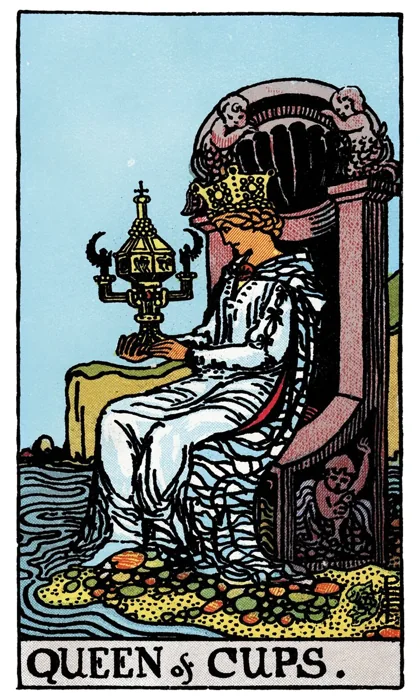
The covered vessel suggests an interior that deserves attention and privacy. The interpretation begins with what can be seen; what the cup contains remains open.
The shore gives the seated figure a place from which to attend to the water. Emotional contact is easier to sustain when a person retains some footing of their own.
A life rich in associations
The Queen of Cups can describe an inward, receptive period. Music and ordinary objects may bring particular people vividly to mind. In conversation, a slight change of tone can alter how you understand the whole exchange. Memory and present experience speak to each other quickly. You may know that something matters before you can explain why.
This richness need not arrive as vivid mental pictures. It may take the form of language, bodily response, remembered patterns, or a precise sense that one sentence does not fit the rest of the conversation. The card concerns the attention given to inner experience, rather than a single way of imagining or perceiving.
A person in this state may appear quiet while a great deal is happening internally. They can be moved by something others barely noticed and seem oddly unresponsive to something everyone else finds dramatic. Their emotional logic is often associative: the present event touches a history the room cannot see. Listening becomes easier when that history can be shared in manageable pieces.
The strength here is discrimination between emotional shades. You may miss someone without wanting the relationship back, or feel guilty without having acted unfairly. Relief after taking distance can coexist with the care you once felt. The Queen gives these distinctions room to exist without forcing them into a simple account of who is good and who is to blame.
The difficulty is taking an atmosphere too personally. A distracted friend becomes a disappointed friend; a tired room becomes evidence that you have failed to make people comfortable. Perception may be accurate about the change and mistaken about its cause. A direct question can release you from a responsibility you assigned yourself before anyone spoke.
The difference between intimacy and possession
The Queen's deeper subject is the interior life: the part of a person that cannot be completely exposed, explained, or made available on demand. To love someone includes encountering that limit. Even a close relationship contains experiences one person cannot fully enter. There is tenderness in accepting that another person remains more than your account of them.
This is where empathy can become presumptuous. “I know why you are doing this” may sound intimate while leaving no room for the person's own explanation. A perceptive observer can be especially convincing when partly right. The detail they have understood lends authority to the conclusions they have added.
A mature Queen can revise her interpretation without feeling that the connection has been withdrawn. When she asks about a feeling she has noticed, an unexpected answer can change her understanding. The person has room to differ from the figure she has been carrying internally. That capacity protects affection from becoming a subtle form of ownership.
There is also a contemplative dimension. Some experiences become clearer through sustained attention rather than force. A piece of writing, a grief, or an uncertain desire may need to be returned to over time. The Queen's stillness gives meaning somewhere to gather. Its value lies in what eventually becomes more perceptible and more livable, rather than in remaining indefinitely beyond explanation.
The pleasure of being received
In love, the Queen of Cups describes the quality of attention that makes a person feel received. Details are remembered. A change in mood is noticed without becoming an interrogation. Tenderness can be offered without requiring a dramatic occasion. Desire may grow through the experience of being safe enough to show what is ordinarily edited out.
This can create deep intimacy, but it needs reciprocity. One partner may become the translator of both people's feelings, the person who initiates every difficult conversation and finds language for every repair. Their skill makes the arrangement appear effortless. Over time, they may feel profoundly lonely inside a relationship described by everyone else as close.
The Queen can also idealise a bond. She sees what a person might become under loving attention and begins relating to that possibility as though it were already present. An isolated tender moment acquires more weight than a recurring absence. Understanding the reason for someone's difficulty then becomes a reason to postpone acknowledging its effect. Compassion can explain a pattern without making the pattern workable.
For a new connection, the card supports a slower kind of discovery. Let personal disclosure be met with care, and allow trust to be tested through ordinary events. Intensity of confession is not the only measure of closeness. Someone remembering what makes you comfortable, accepting a refusal, or returning to an unfinished conversation can tell you a great deal.
In an established relationship, the useful question may be whether you still know each other in the present. Familiarity can fix people in roles, such as being the sensitive or practical one. A past need for space may also become an explanation applied without checking whether it still fits. Make room for an answer that changes the role. The person you love may have been trying to outgrow your most affectionate description of them.
During conflict, name your experience before explaining theirs. “I felt alone in that conversation” leaves a different opening from “You withdrew because you cannot tolerate closeness.” The second statement may contain an interesting theory. The first gives the other person something they can actually answer without first accepting your entire account of their mind.
The work of noticing what others miss
At work, this card can describe attention to emotional context: how people receive information, what a client is struggling to articulate, or why a technically adequate process leaves everyone uneasy. Teaching, editing, design, management, and many other kinds of work benefit from someone who notices the gap between what is formally stated and what is being experienced.
That ability becomes useful through specific observation. You might notice a learner hesitate at a certain task, or hear customers repeat a question the instructions supposedly answer. A colleague's silence after particular feedback may also deserve attention. The Queen's task is to investigate the pattern. Assuming she already knows the hidden reason wastes the very sensitivity that brought it into view.
Creative work may draw strongly on memory, emotional association, and the exact quality of an encounter. A character can become convincing through a small contradictory action; an image can hold a feeling that a more explicit explanation would flatten. The Queen is comfortable allowing meaning to develop through form. She still needs revision, technique, and an eventual audience. Private significance alone does not ensure that the work communicates.
A common difficulty is unrecognised emotional labour. The person who reassures everyone, interprets conflicts, and receives private disclosures may have no official time allocated to that work. Their main tasks then suffer, and the additional contribution remains invisible. Availability needs terms: what support belongs in the role, what needs another resource, and which hours remain for concentrated work.
Kindness also needs the ability to give unwelcome information. Avoiding all disappointment can leave a student, colleague, or collaborator without a clear standard. Care becomes more useful when the person knows both that they matter and what the work requires.
What comfort is being asked to do
Money often carries emotional meanings that a purely numerical account misses. It can signify safety, freedom, gratitude, proof of love, or the ability to make a difficult day gentler. The Queen asks which meaning is active. A purchase may be perfectly affordable and still be a poor answer to loneliness; a modest expense may substantially improve everyday comfort.
At home, she values atmosphere and private significance. A familiar cup, a place to read, a remembered scent, or objects linked to important people can make a space inhabitable. The effect need not depend on luxury or a polished appearance. A home becomes more personal when its comforts follow the lives inside it rather than an image of how those lives ought to look.
Giving deserves particular attention. A gift can carry affection openly, or it can become a request that cannot be refused without appearing ungrateful. If you want reassurance, recognition, or more time together, ask for that directly. Making the material gesture larger will not necessarily make the unspoken need easier to understand.
Where resources are shared, explain their emotional significance without treating that significance as the whole decision. Both people need room for a preference. The fact that an arrangement feels reassuring to one person does not automatically make its cost or responsibility fair to the other.
Receptivity needs an interval of privacy
Being attentive to other people can leave a residue: the conversation continues internally, a remembered expression interrupts your own work, or you remain concerned about a person who has already moved on with their day. This does not require a mystical explanation. Sustained attention uses capacity, and unfinished concern can keep asking for more of it.
An interval without responding can help your own preferences become audible again. Quiet, familiar movement, writing, or an ordinary absorbing task may provide that interval. Choose something that returns you to your experience rather than another activity in which you must anticipate somebody else's needs.
The Queen's reflective quality can support a more accurate account of stress, but a card cannot identify a health condition or establish why a symptom exists. If distress persists, the appropriate support belongs in the real world. Sensitivity is neither a diagnosis nor an obligation to endure unlimited emotional exposure.
Listen closely enough to be corrected
The advice is to give an experience enough attention that its actual shape can emerge. Ask a question and leave room after it. Resist filling the first silence with the explanation that would make you feel most useful. Sometimes another person needs help finding words; sometimes they need you to stop supplying them.
Include desire as well as distress. The Queen is easily reduced to the person who receives everybody's pain, but her world also contains pleasure, imagination, erotic feeling, affection, and the private delight of being moved. A life of care needs these sources of nourishment. Otherwise emotional depth becomes indistinguishable from permanent seriousness.
The shadow can be gentle in manner and powerful in effect. Unrequested help can become difficult to refuse when disappointment is expressed through withdrawal. The recipient gradually learns which choices are needed to preserve warmth. A person may sincerely regard themselves as selfless while organising a relationship around being needed. Examine whether your care increases another person's freedom or quietly requires them to remain dependent on it.
Receiving is part of the practice. State one need without first making it reasonable through exhaustion, usefulness, or what you have done for everyone else. Let somebody have an opportunity to respond to you as a person, rather than as the reliable source of understanding.
When feeling loses its frame
Reversed, the Queen of Cups can describe emotional overflow, retreat into a private account of events, difficulty receiving care, or the discovery of needs long kept beneath other people's concerns. There is no single character judgment that usefully covers all of these. Start with the pattern that can actually be observed.
In one expression, perception becomes entangled with fear. A subtle signal is noticed, then rapidly developed into a complete story of rejection or betrayal. The feeling is real, but the explanation has outrun the evidence. A conversation may be needed; repeated internal readings of the same expression rarely provide the missing information.
In another, care has become overinvolvement. You feel responsible for another adult's mood, rescue them before they can respond, and then resent their reliance on you. The resentment may be telling the truth about your exhaustion while leaving out your part in maintaining the arrangement. Returning responsibility can feel unkind at first, especially if being needed has become reassuring.
The reversal can also describe emotional withdrawal after too much exposure. A person who usually listens becomes unavailable, brusque, or strangely blank. More disclosure may be the last thing they can receive. The useful response may be less demand and more practical support, followed by a clearer agreement about what they can offer.
There is a quieter, constructive possibility: a previously hidden preference is becoming difficult to ignore. You no longer want to be the understanding one in every exchange. You discover anger toward an arrangement you once called voluntary. The feeling need not be discharged indiscriminately to be taken seriously. It can become information for changing the relationship between care and obligation.
The common task is to restore a frame around feeling. Begin by separating what you experienced from what you inferred. Then consider which responsibilities belong to you and whether the help you want to give is actually wanted. The aim is enough clarity that emotional life can remain rich without having to govern every conclusion.
What changes the emotional picture
Court cards can describe people, attitudes, or roles within a situation. These pairings therefore work best as questions about the relationship between qualities, rather than claims about an unseen person's motives.

With The High Priestess
The High Priestess adds privacy and inward attention. An impression may need time before it becomes speakable. Respect what has not yet been shared, while avoiding the assumption that silence confirms your preferred interpretation.

With The Moon
The Moon increases ambiguity and the power of association. Feelings may be accurate about discomfort while uncertain about its cause. Separate observation, memory, and prediction before deciding what another person intends.

With Queen of Swords
The Queen of Swords brings clear language and a defined limit. Emotional understanding becomes more useful when the terms can be stated directly. This pairing can support compassionate feedback, a difficult refusal, or an honest request.

With Two of Cups
The Two of Cups asks whether emotional attention is mutual. A connection deepens when both people can be curious, vulnerable, and responsive. Notice whether one person has become the permanent interpreter of the other.

With Ten of Wands
The Ten of Wands makes accumulated responsibility visible. Caring may have become a workload that nobody has named. Reduce or redistribute actual duties as well as making room to discuss the feelings around them.

With The Devil
The Devil raises the possibility of attachment organised around need, guilt, or rescue. Ask what reward keeps each person in the arrangement and whether care is being exchanged for control. The pairing is a prompt to examine conduct, not proof of hidden malice.

With Three of Pentacles
The Three of Pentacles gives sensitivity a collaborative form. A useful observation can become a better brief, a teaching adjustment, or constructive feedback. Share what you have noticed in terms other people can examine and act on.

With The Star
The Star brings restoration and a less demanding kind of hope. Receiving steady care may help feeling become available again after disappointment. Allow small signs of ease to matter without making them promise a complete recovery.
The responsibilities of close attention
The witness is able to hear an experience without immediately making it about themselves. The artist gives inner life a form that another person can encounter. The keeper of confidences protects what has been entrusted to them. Each figure carries something of the Queen's attention, and each requires a different kind of restraint.
Their shadows are equally revealing. The witness can become indispensable by ensuring every experience passes through their interpretation. The artist can prefer a compelling emotional story to an inconvenient fact. The keeper of confidences can use privileged knowledge to maintain influence. Depth of access creates responsibilities of its own.
The Queen's authority is most persuasive when she can be trusted with what she does not control. Holding a confidence gives her no ownership of its speaker. She can be affected while leaving them in charge of their experience, including when their account changes her understanding. There is considerable strength in that kind of receptivity.
Let one answer surprise you
Choose a recent interaction that you have been interpreting privately. Write down what you observed, what you felt, and the meaning you assigned to it. Keep those three accounts separate long enough to see where certainty entered.
If a conversation is appropriate, ask an open question about the part you do not know. Then listen for an answer that changes something. If the uncertainty concerns your own preference, spend a little time naming it without first defending it. The Queen's attention should eventually make room for your inner life as well as everyone else's.
Artwork & interpretation
Waite describes a contemplative figure whose perception also leads to action. This essay develops an inclusive reading of emotional judgment and imagination, using the displayed artwork rather than treating historical gender stereotypes as requirements. A. E. Waite, The Pictorial Key to the Tarot: Queen of Cups.
The symbolic associations and examples offer ways to read a situation. They do not establish another person’s thoughts or fix an outcome.
To understand another person deeply, you must leave room for an answer you did not anticipate.
Use the cards in a spread →