Wands · Two
Two of Wands
The view from a life you may be ready to outgrow
The Two of Wands considers a direction from a position that already offers some stability. Your attention keeps moving beyond what is familiar. Before choosing, consider how the possibility would change your daily life and what it would ask of you.
- Direction
- Planning
- Ambition
- Choice
16 min read
In this guide
A wider horizon, seen from a secure place
From the outside, the situation may look satisfactory. Your routine works, and people around you know the part you play in their lives. Yet part of your attention keeps looking beyond it. The Two of Wands begins with that discrepancy: what you have built is real, and so is the possibility that you want something it cannot yet contain.
The Two of Wands concerns choosing a direction after the first enthusiasm has arrived. You are beginning to consider what pursuing the idea would require in everyday life. It may replace an existing commitment or need a different scale from the one you first imagined. Planning helps you decide which version is worth giving time to and what you want it to make possible.
You may be comparing a familiar arrangement with a possibility elsewhere. Distance or a more impressive title can make the new option look like progress before you examine its daily reality. Ask what you want to change about your life. More freedom may matter to you, or you may want room to develop a skill and influence the work. Compare the options against those wishes.
The Two of Wands usually begins from somewhere established. You have experience to draw on, and perhaps relationships or a routine that support you. Consider which parts of that base you want to keep while exploring what is missing. A limited trial may tell you enough to choose the next step. Sometimes an extension of your existing life offers more than abandoning it entirely would.
The Two can also describe strategic waiting. Some decisions improve when you gather information or allow an external process to reach a clearer stage. But waiting needs a purpose. Be specific about what you are waiting to learn and when you expect to learn it. Without that clarity, preparation can keep an imagined future comfortably beyond the need to choose.
In an outcome position, the Two may help you develop a more deliberate plan. You could finish the reading with a clearer sense of where to put your effort and which contact would help you begin. Choosing also means giving less attention to other possibilities. That can feel like a loss, even as it gives the preferred direction enough room to become part of daily life.
A whole globe that fits inside one hand
A figure in a red cap and cloak stands on a stone terrace, looking over water, land, and buildings. They hold a small globe in one hand and a wand in the other. A second wand is fixed beside them. The elevated position provides a broad view, while the enclosing stone reminds us that looking out is not the same as setting out.
The globe compresses an immense world into an object that can be held and contemplated. As a planning image, this is both useful and dangerous. A map makes comparison possible, but it removes weather, language, other people's intentions, and the tiredness of travelling. Plans simplify reality in order to guide us; they should remain open to correction by it.
One wand is held while the other appears secured to the terrace. This contrast offers a visual way to consider the relationship between established support and available movement. You may need both. The question is whether your foundation gives you freedom to choose or has become a reason that no change ever feels permissible.
The figure's face is turned away, so we cannot confidently name the emotion. They could be ambitious, absorbed, dissatisfied, or simply calculating. That ambiguity is valuable. A wider horizon can awaken appetite or expose the limitations of having everything visible except a compelling reason to move towards any of it.
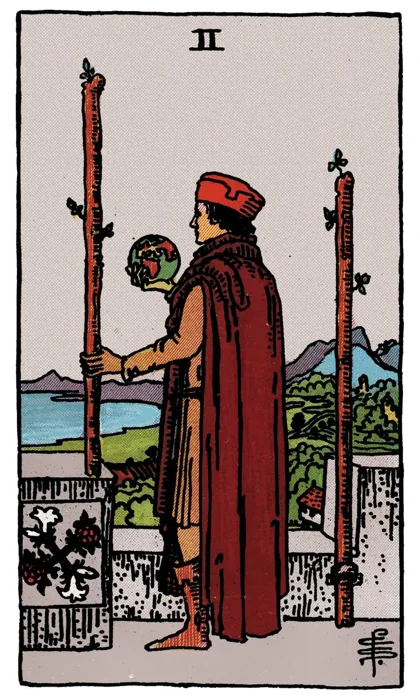
A globe makes distance manageable in imagination. Use that power to compare possibilities, while remembering that every place contains details the overview omits. The best plan includes ways to learn from those details.
The fixed wand draws attention to an existing base. Stability can support exploration, but it can also become an unquestioned limit. Identify which commitments genuinely matter and which are only familiar.
Restless, but not yet in motion
The inner experience of this card is often a mixture of confidence and hesitation. You can imagine doing more, but the present arrangement still has claims on you. One part wants to preserve what has been earned; another wants proof that life has not already narrowed into its final shape. Neither part is necessarily foolish.
Ambition becomes clearer when you give it a specific object. Wanting a larger life may mean wanting a quieter one, with more control over your time. It may mean challenging work, a different community, or the chance to use a neglected ability. Borrowed images of success can make these personal desires surprisingly difficult to hear.
The card can reveal an attachment to potential itself. While every option remains open, you can imagine being capable of all of them. Choosing one introduces limits and exposes you to being ordinary at first. The loss is partly imaginary, but it can still hurt. A real path asks you to trade some flattering possibilities for actual experience.
There may also be guilt about wanting change when the present is not terrible. You do not need to manufacture a crisis to justify examining your direction. Gratitude for an existing life and curiosity about another version can coexist. The responsibility lies in how you act on that curiosity, especially where other people share the consequences.
As a personal style, the Two suggests someone who sees possibilities and thinks in broad terms. They may be good at anticipating what comes next, yet slow to enter situations they cannot oversee. If this sounds familiar, practise making decisions at a scale where imperfect knowledge is tolerable. Confidence can grow through bounded experience rather than ever more comprehensive planning.
The difference between a horizon and an escape route
A horizon attracts partly because it is distant. Its problems have not yet acquired names, while the problems of the present are intimate and repetitive. This does not make the attraction false. It means you should compare an actual present with a sufficiently real alternative, rather than comparing daily life with an image edited of inconvenience.
The Two of Wands asks what expansion means to you. More territory can become more responsibility; more options can become more indecision. The valuable enlargement might be depth rather than size: a better understanding of your craft, a more honest partnership, or a greater ability to make choices without seeking permission from an imagined audience.
There is an ethical dimension to the elevated viewpoint. Looking over a landscape can make it appear available for your plans, while the people already living there disappear into the distance. In contemporary terms, ambition needs curiosity about those affected by it. A move, venture, or collaboration should include their realities, not only the benefits visible from your position.
A choice also gives form to desire. You may not discover your true direction by thinking until all doubt vanishes. Often you choose a plausible next step, encounter its demands, and refine your understanding. Direction can be deliberate without being final. This allows commitment to become a way of learning rather than a claim to perfect foresight.
The deeper freedom of the card lies in authorship. You begin to notice the difference between circumstances you inherited and choices you can now make. That freedom may be modest, but it is meaningful. Naming one available decision can be more transformative than imagining a future in which every limitation has disappeared.
Turn ambition into a question you can investigate
At work, the Two of Wands can describe strategic planning, career exploration, a proposed partnership, or deciding how far to develop an idea. Begin with the problem or opportunity, not the prestige of the possible solution. What would a change allow you to do that matters, and how would you know whether it was working?
If you are considering a new role or field, speak to people doing the ordinary version of that work. Ask about the repeated tasks, constraints, and forms of satisfaction. The visible achievements are only part of the occupation. You are choosing a pattern of days as well as a future description of yourself.
For a business or creative project, compare a few concrete paths rather than an unlimited menu. One may offer independence with slower growth; another may provide reach at the cost of control. Making the trade-offs visible helps prevent a decision in which every desirable feature is promised and none of the corresponding demands is admitted.
The card supports collaboration when each person brings a distinct perspective or resource. Yet shared excitement is not a working agreement. Discuss authority, effort, ownership, money, and how either person could leave. These conversations do not spoil the beginning. They make it possible to pursue ambition without relying on the hope that differences will somehow resolve themselves.
In an established organisation, a good plan should identify what will stop as well as what will start. Expansion without subtraction often means transferring the cost to people's time. If the proposal depends on everyone continuing their existing workload while building a new future, the attractive overview may be concealing an impossible set of daily expectations.
When planning has become endless, set a decision point. List the unknowns that genuinely change the choice and separate them from questions that can only be answered by trying. A small pilot, conversation, or application may resolve more than another comprehensive document. The plan should eventually make contact with someone who is not already persuaded by it.
Do your imagined futures have room for each other?
In relationships, the Two of Wands brings attention to direction. A connection may be moving from immediate attraction towards questions about how two lives could fit together. Where would you live, how much independence would each person retain, and what kinds of commitment do you actually want? These questions become kinder when asked before assumptions harden into expectations.
A partner may be considering a move, a career change, or another development that alters the shared future. Their desire need not be interpreted as rejection, but its consequences deserve discussion. Curiosity and honesty matter on both sides. One person's dream should not automatically become the other person's obligation to adapt.
The card can also describe looking beyond a relationship without deciding what that means. You may want more space, different experiences, or a life less organised around the couple. Distinguish a need that could be expressed within the relationship from a wish to leave it. Treating every restlessness as proof of incompatibility can prevent a useful conversation.
For someone single, the Two invites deliberate participation rather than waiting for chance to solve a question about companionship. Consider where you meet people, what you are available for, and which patterns you want to change. A clear intention can guide choices while leaving room for a person to surprise you beyond your imagined specification.
Distance may be literal, with a connection between different places. In that case, the romance of possibility needs a practical counterpart: visits, costs, communication, and some understanding of how the arrangement could develop. An indefinitely deferred future can sustain intensity while preventing either person from discovering how they function together in ordinary circumstances.
With friends and family, this card may ask for a conversation about changing roles. You can value an existing community while pursuing experiences outside it. Explain what is changing and what you hope to preserve. People may need time to adjust, but their initial discomfort does not automatically decide the limits of your life.
Price the ordinary version of the dream
For money, the Two is a planning prompt. Compare actual costs, available resources, and the consequences if a possibility develops more slowly than hoped. The purpose is to make a choice you can inhabit. A plan that only works under ideal conditions may describe an aspiration well while offering little guidance for a real decision.
If a move is being considered, look beyond the appealing neighbourhood or view. Travel time, daily expenses, social support, work arrangements, and shared responsibilities shape the experience of a place. Research should help you imagine an ordinary Tuesday there, not only the first exciting weekend. That comparison often clarifies what you are really seeking.
A secure base may be worth preserving during exploration. Savings, a manageable home, or a reliable routine can create room to test a new direction. Stability is not automatically the enemy of adventure. Sometimes it is what lets you choose thoughtfully instead of accepting the first opportunity because every existing support has already been removed.
Where resources are scarce, the available choice may be narrower than the image suggests. Avoid making limited options into a personal failure of imagination. Identify the decisions that are genuinely yours, the information you can obtain, and any practical support that could widen the range. A modest improvement in agency is still a meaningful form of movement.
Planning can consume the life it is meant to improve
Holding several possible futures in mind takes attention. You may find yourself mentally living elsewhere while the current day becomes increasingly neglected. The Two can be a prompt to set aside specific time for planning, then return to the life you are actually in. Exploration becomes more useful when it does not occupy every spare moment.
Notice whether research leaves you clearer or merely more stimulated. Endless comparison can produce the sensation of progress while making every option harder to choose. A useful session ends with an answer, a better question, or an action. If it only multiplies possibilities, reduce the scope and identify the decision you are trying to support.
Your capacity belongs in the plan alongside money and opportunity. A change that looks attractive on paper may require more travel, social effort, or uncertainty than you currently want. Those preferences are legitimate information. The card cannot assess health or stamina; it asks you to include your actual daily needs in the future you are designing.
Choose the next piece of evidence
Make the ambition specific enough to investigate. Replace wanting something bigger with a sentence about what you want to experience, contribute, or change. Then identify two or three realistic ways of moving towards it. This helps prevent the most glamorous option from winning before you have considered whether it serves the underlying desire.
For each path, write down what it offers and what you would give up. Then identify an uncertainty that could change your decision. A visit might answer it, or you may need a conversation with someone doing the work. Choose a small way to gather that information. The experience can alter how the options feel more usefully than comparing them again in the abstract.
The shadow is treating life as a view to be controlled. You may begin treating other people as pieces in your plan and take unpredictable events personally. Decisions then wait for an assurance of success that the situation cannot provide. Planning is at its best when it prepares you to respond, rather than promising that you will never need to adapt once the plan is chosen.
Another shadow is staying at the threshold because potential feels safer than participation. Give yourself a date to decide what happens next, allowing a smaller decision if the larger one remains premature. You can choose to explore seriously without yet choosing to relocate, resign, commit permanently, or burn every bridge behind you.
When the horizon becomes a place to hide
Reversed, the Two of Wands may describe planning that never reaches a decision. You might be seeking more information even though the relevant facts are available. Ask whether the remaining uncertainty concerns your feelings about leaving a familiar life. Regret may seem difficult to risk, or becoming a beginner again may be less appealing than the distant picture of success.
Alternatively, the plan may be moving too quickly because imagining a different future has become a way to escape the current discomfort. Before making a large commitment, investigate whether the new direction addresses the problem or merely changes its scenery. Some difficulties travel with us; others genuinely depend on the environment. Careful comparison can help distinguish them.
The reversal can indicate a plan that needs to become smaller and more local. An ambitious scope may be unsuitable for available resources, while a modest version remains promising. Revising the scale is not necessarily a retreat. It can bring the undertaking close enough to reality that you can finally learn whether it works.
In a partnership, look for incompatible assumptions about direction or unequal power in deciding it. One person may believe you are exploring together while the other has already settled the destination. Make the decision process visible. Agreement about the goal means little if there is no agreement about whose needs count along the way.
After examining the alternatives, you may decide to stay. That decision can change your relationship with a place you previously treated as temporary or inevitable. You might invest in it more deliberately or negotiate conditions that suit you better. The Two of Wands leaves room for this outcome: giving thought to your direction can lead to a renewed commitment to the life you already have.
What helps a possibility become a direction?
These pairings focus on choices, scope, and the relationship between plans and circumstances. They suggest lines of inquiry, not fixed instructions to stay, leave, travel, or commit.
With The Fool
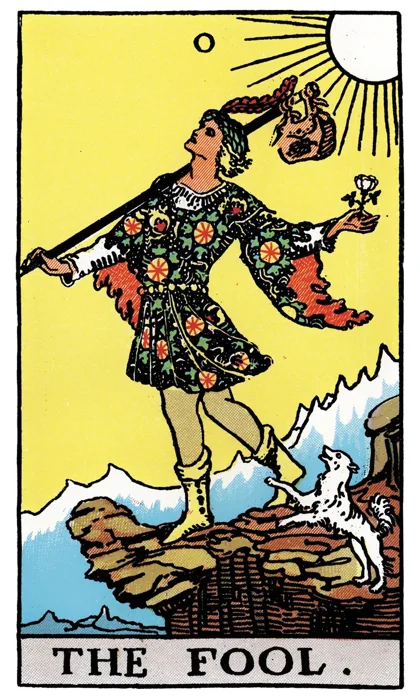
With the Fool, openness can help a carefully considered possibility become an experiment. Keep enough support for the first step to be manageable. You need not choose between total control and total abandonment of planning; a limited trial can make room for discovery.
With The Emperor
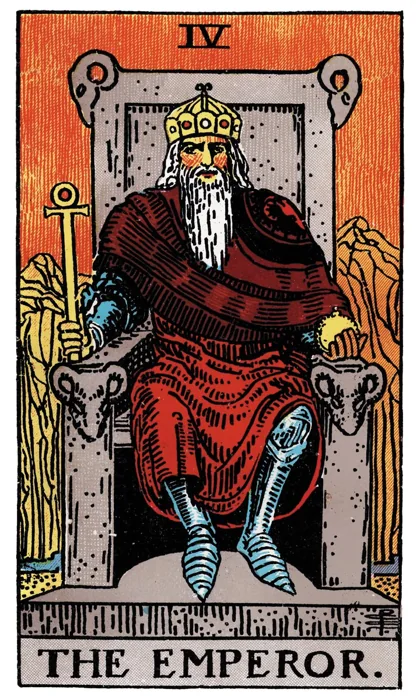
With the Emperor, ambition needs a workable structure. Clarify authority, responsibilities, resources, and the boundaries of the undertaking. Notice whether the structure supports a chosen direction or simply preserves an existing arrangement because its rules feel more familiar than its alternatives.
With The Lovers
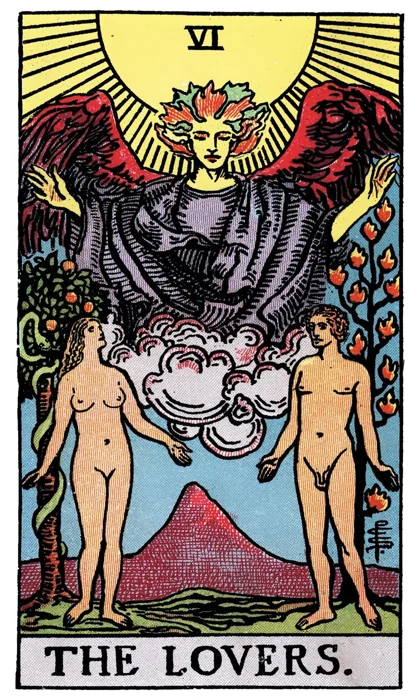
With the Lovers, a decision may reveal competing values or affect an important relationship. Name what each option asks you to prioritise. A choice becomes more honest when the people involved understand the trade-offs, rather than agreeing to an attractive but incomplete picture.
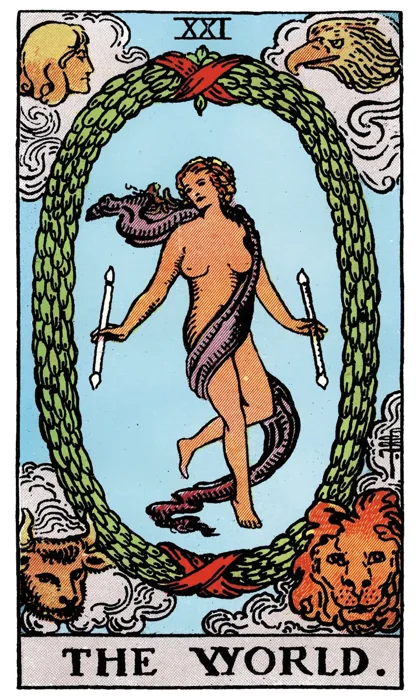
With The World
With the World, a completed chapter creates a base for wider exploration. Consider what is ready to travel with you and what can remain finished. The next direction does not have to prove the value of the previous one by repeating its form.
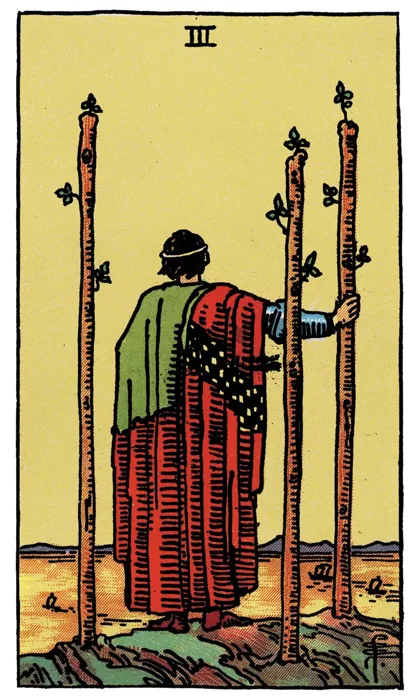
With Three of Wands
With the Three of Wands, planning is approaching the point of outward action. Identify the first commitment that lets other people or real conditions respond. The information you need may now exist beyond the terrace, where preparation must become participation.
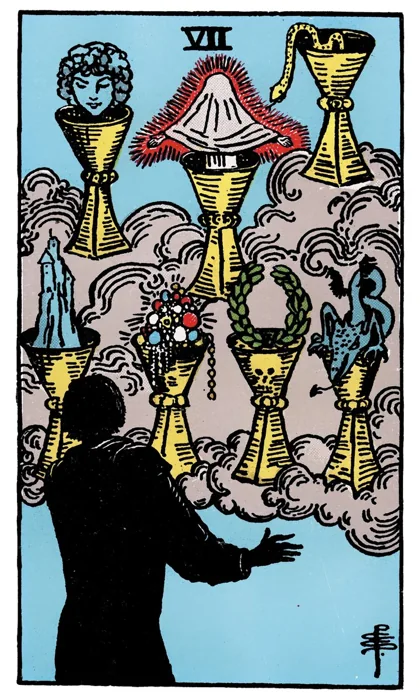
With Seven of Cups
With the Seven of Cups, many attractive futures can obscure a practical choice. Compare the daily reality of a few options instead of their most flattering images. Ask which possibility still interests you when its ordinary demands and limitations are included.
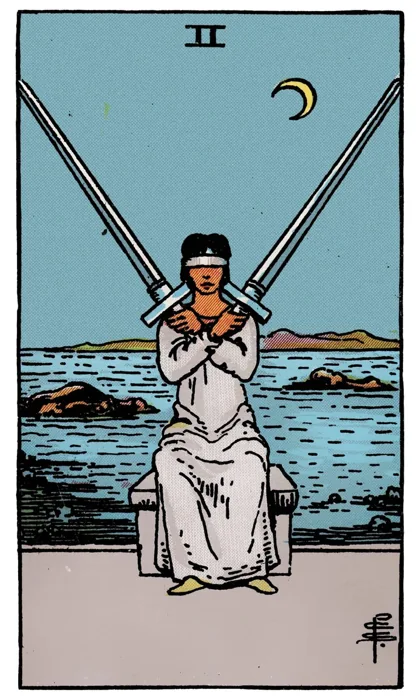
With Two of Swords
With the Two of Swords, a decision may be held in suspension by competing concerns. Separate missing facts from a conflict of values. More research can resolve the first; the second may require accepting that no option preserves every desirable thing.
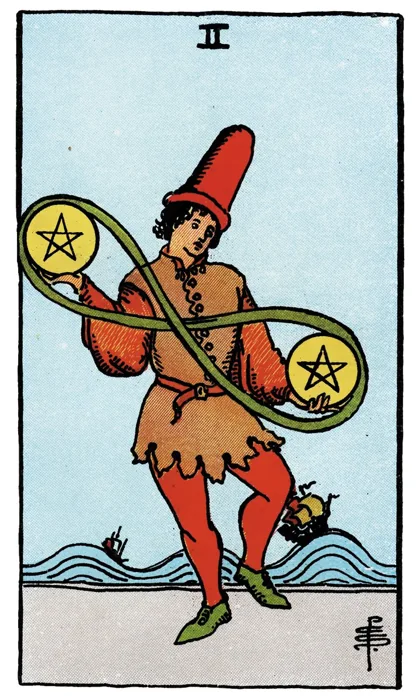
With Two of Pentacles
With the Two of Pentacles, a proposed direction must fit existing commitments. Test the schedule and resources before adding a new undertaking. A staged transition may offer more freedom than trying to maintain two complete lives at full intensity.
The mapmaker and the person on the balcony
The mapmaker offers an image of useful simplification. A map leaves almost everything out so that a traveller can see certain relationships clearly. Its value depends on remembering what it omits. In the same way, a good plan highlights direction and constraints while remaining humble about the experience of actually taking the road.
The person on the balcony can see far without leaving home. This position gives perspective, but it can also preserve a permanent separation between observing and participating. The archetypal question is when the view has done its work. At some point, knowing the landscape better requires entering a portion of it.
The apprentice choosing a field gives a more ordinary echo. Every path contains interesting possibilities, but each also requires time that cannot be spent elsewhere. Choosing does not establish which field is universally best. It begins a relationship between one person's capacities, values, and the demands of a particular kind of work.
Compare two actual Tuesdays
Choose a direction you are considering and describe an ordinary day in the present arrangement and an ordinary day in the alternative. Include work, travel, money, relationships, and the parts likely to be inconvenient. This makes the comparison less dependent on an ideal future competing with the least attractive version of today.
Then identify one fact you need and one action you can take to obtain it. Set a date to review what you learn. The aim is not to force a dramatic decision; it is to move from indefinitely contemplating a larger life towards discovering which specific change would make your own life more habitable.
Artwork & interpretation
Waite draws attention to a figure contemplating a globe from a position of established resources, allowing unease within apparent achievement. This original guide develops the image through contemporary questions about ambition, planning, perspective, and chosen direction. A. E. Waite, The Pictorial Key to the Tarot: Two of Wands.
The symbolic associations and examples offer ways to read a situation. They do not establish another person’s thoughts or fix an outcome.
You cannot explore every possible life, but you can choose a next step without settling your entire future.
Use the cards in a spread →