Major arcana · 0
The Fool
The freedom of not yet knowing
The Fool arrives before the explanation. Something has become possible, and for once the wish to find out is stronger than the wish to be certain.
- Beginnings
- Freedom
- Inexperience
- Trust
14 min read
In this guide
A beginning without a guarantee
There are moments when the life you know loses its authority. You may have respectable work and a sensible plan, with reasons for staying that you can explain perfectly well. Yet an unfamiliar possibility has acquired a force none of those reasons quite answers. The Fool belongs to that moment. He has not established that the new road is better. He has discovered that he wants to take it.
In a reading, the Fool can describe the moment you leave familiar surroundings or try something you had previously ruled out. An unplanned encounter may offer the same opening. There is little shared history in this new situation, so you have some freedom to discover how you want to behave. You might surprise yourself. The excitement also carries uncertainty, since the people you meet are discovering their part in it too.
The Fool is larger than the phrase “take a small step” suggests. A beginning can be as small as sending an application or attending a first class. Accepting an invitation may open a similar possibility. Sometimes it unsettles the whole arrangement of a life. A person who has always been competent becomes a beginner; someone who has always been needed discovers a wish to leave. The visible action may be modest while its meaning is enormous.
This is why the card resists a simple verdict of good or bad. An uncertain undertaking can revive a life that has become excessively managed. The same undertaking can also be a beautifully described refusal to deal with an existing problem. Enthusiasm alone will not distinguish them. What matters is whether contact with reality makes the person more curious and responsive, or merely more determined to avoid inconvenient information.
The Fool also brings a peculiar kind of social exposure. You may look naive before you look brave. Your reasons may sound incomplete because some of them can only be discovered through experience. Beginning asks you to tolerate that interval. It does not require proving that everyone who doubts you is narrow-minded, or that the outcome must vindicate your courage.
What the Fool carries towards the edge
The figure is dressed for the pleasure of being alive, with patterned clothes, a feather, and a face turned toward the open sky. At his feet, the rock ends. That difference between where he is looking and where he is standing holds much of the card's meaning. Possibility fills his field of vision; the immediate terrain receives less attention.
The little dog makes the scene harder to settle. It might be an excited companion, a warning, or an interruption from the bodily world the traveller is temporarily overlooking. We do not have to choose a single explanation. Read as a warning, it need not become an enemy of adventure. Sometimes the friend asking about your return ticket is helping the journey happen.
The rose and the bundle introduce another tension. One hand carries something delicate and apparently impractical; the other supports a modest amount of luggage. Beauty has been granted space, while equipment has been kept to a minimum. The image invites a question about what deserves to travel with you. Some possessions are useful provisions. Others are attempts to take the old life along so completely that nothing unfamiliar can reach you.
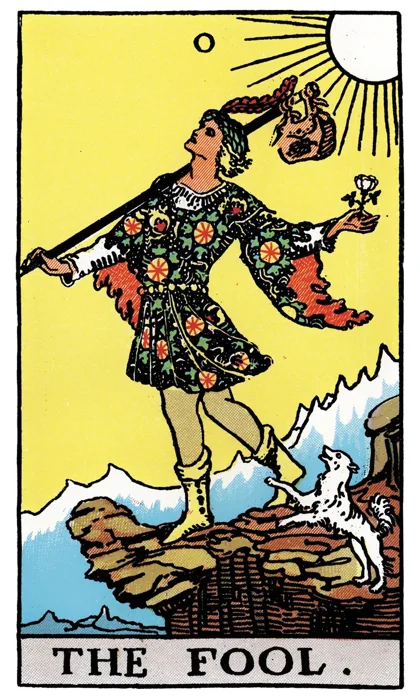
His attention reaches beyond the edge. The dog brings the eye back to the next step: the immediate condition that excitement can make easy to overlook.
The rose has a place even in this light luggage. A new life needs more than efficient equipment; it needs something the traveller actually wants to be alive for.
Lightness, and the trouble it can cause
The Fool can feel like a return of appetite. The world becomes interesting again. A conversation holds your interest late into the night. Even a familiar street may suggest somewhere new to explore, and you find yourself considering ideas you once felt unqualified to attempt. There is often humour in this state. You can survive looking ridiculous because the experience matters more than the impression.
As a person, the Fool may be candid, inventive, disarming, difficult to schedule, and unexpectedly perceptive. Someone uninvested in maintaining the approved explanation can ask the question everyone else has learned to avoid. That freedom is valuable. It can also make the person careless about rules whose purpose they have not bothered to understand. Not every convention is empty, and other people's caution is not always cowardice.
There is a difference between innocence and a cultivated refusal to know. Innocence meets a consequence and learns. Refusal turns every consequence into someone else's attempt to spoil the fun. That refusal can remain charming while other people take care of its consequences. Someone else remembers the deadline or arranges transport, then quietly deals with whatever the adventure left unfinished.
Age tells you little about which Fool you are meeting. A young person can be rigid with borrowed certainty; an older one can have earned a remarkable ease. Experience sometimes loosens the need to control every outcome. The mature Fool can say that a plan failed without deciding that trying was shameful. That is a much sturdier freedom than believing nothing can go wrong.
Who are you before the role arrives?
The zero above the figure suggests a space before a particular identity has taken shape. A beginner has no record of success or disappointment in this activity. Nobody yet expects them to be the expert or assumes they will give up. That freedom lasts for a while, until experience gives them preferences and their choices become habits that others recognise.
A deeper reading concerns the willingness to encounter life before deciding what it must confirm about you. This is difficult for someone whose survival or standing has depended on being capable. Such a person may be able to tolerate enormous workloads more readily than a beginner's question. The Fool touches the part of development that requires being visibly unfinished.
There is a spiritual dimension available here without making a promise of supernatural protection. Trust can mean allowing experience to contain more than you already understand. It need not mean assuming that desire makes an undertaking safe. A person can step beyond an inherited identity and still take care of their body, keep agreements, and listen when the terrain changes.
The card's sharper question is what you are protecting by remaining the person you already know how to be. Sometimes the answer is a necessary livelihood or a meaningful responsibility. Sometimes it is an image of yourself that has become too expensive to maintain. The Fool loosens that image long enough for another possibility to enter.
The beginner and the unfinished project
At work, the Fool brings the energy of the first draft, the unfamiliar field, the unlikely application, and the proposal nobody has yet learned to dismiss. He is useful where expertise has become so protective of established methods that an obvious question cannot be asked. A fresh pair of eyes may see a simpler route because they have not inherited the reasons it is supposedly impossible.
Creative work often needs this freedom at the beginning. An early draft may run far beyond its intended scope because the writer is still discovering what the story is about. A design can be uneven while its form develops. The Fool allows that exploration to continue long enough to produce material you can work with, before you judge it by the standards of a finished piece.
But an idea and a commission have different obligations. Sincere inspiration does not tell you how long the work will take. Underestimating that demand may lead to a missed deadline, and excitement can pull the result away from what the client requested. The difficult Fool is not necessarily dishonest. They can believe the promise fully while making it, then lose contact with the conditions required to keep it. Other people still have to deal with the result.
For a career change, this card describes entering a place where your previous competence may not immediately count. That can be humiliating or liberating, often both. Look for a real learning environment: a clear first assignment, someone who answers questions, and permission to make correctable mistakes. A dramatic leap is no proof of seriousness. Neither is indefinite preparation. The useful beginning is the one that puts you in contact with the work itself.
Freedom has ordinary expenses
The Fool's attitude to possessions can be refreshing. Something does not have to be owned merely because it is useful, and a home does not have to reproduce somebody else's picture of success. Travel, a temporary arrangement, or a simpler household can reveal how much effort was going into maintaining things you did not particularly enjoy.
The complication appears when lightness depends on someone else carrying the weight. A spontaneous departure may involve another person covering the rent. An inspiring new project may consume a shared reserve. The question is who bears the consequences if the optimistic version fails to arrive. Naming that person changes the meaning of the adventure.
In material decisions, the Fool is a reason to inspect unfamiliar territory carefully. Establish what is included, what continues after the first payment, and what happens if you change direction. An opportunity can remain exciting after these questions have been answered. If its appeal depends on leaving them unanswered, the uncertainty is doing too much of the selling.
A connection before it has a script
The Fool brings the pleasure of meeting someone before the relationship has settled into an explanation. There is curiosity, play, and a willingness to be a little unguarded. You may behave unlike your usual self because this person has not yet learned to expect the familiar performance. The experience can be precious even when its future remains undecided.
As a relationship pattern, the card favours spontaneity and room to move. An invitation can be enough for today without becoming a declaration about next year. That works beautifully when both people understand the arrangement. It becomes painful when one person hears an open beginning while the other hears an implied commitment that neither has actually discussed.
A partner with the Fool's spontaneity may make an evening affectionate and funny. Their generosity in that moment can coexist with difficulty being present when the relationship needs continuity. Sincerity does not automatically create reliability. Someone can mean everything they say tonight and still have little practice in carrying a feeling through inconvenience tomorrow. Look at what happens when a plan requires effort after the mood that produced it has passed.
In an established connection, this card can restore an area of life that has become all management. Do something neither of you is already good at. Meet outside the roles of organiser, provider, tired parent, or dependable companion. Shared novelty can make another person visible again. It will not, by itself, repair an agreement that one of you keeps breaking.
The card can also accompany the wish to leave. Sometimes a departure is the first honest act after a long period of performing contentment. Sometimes it repeats a pattern of escaping whenever closeness creates obligations. Consider what you are moving toward, and what you have been unwilling to say where you are. Freedom becomes more substantial when it can bear an honest conversation.
When enthusiasm outruns the body
A new beginning can restore a sense of vitality before the practical conditions of life have changed. That burst is useful, but it can disguise limits. You may agree to an early start despite knowing you will be out late. Another project then finds its way into the crowded week because you assume this new interest will keep supplying energy.
Give the experience a rhythm it can survive. Eat before the long excursion; leave room after the exciting event; notice when curiosity turns into an inability to stop. These ordinary supports do not diminish the adventure. They make it easier to remain open to what is happening instead of becoming too depleted to enjoy it. A card cannot diagnose a health condition or tell you that a risk has no consequences.
Go far enough to learn something
The Fool's advice is to make contact. Attend the class, send the proposal, begin the conversation, make the imperfect page. Choose an action that will give the unfamiliar world a chance to answer. You do not need to turn that first answer into a final judgment about your future.
The shadow is making a spectacle of freedom while avoiding the less glamorous work of choosing. A person who keeps every option open can end up unavailable for all of them. Leaving, too, can become a habit with its own rigidity. If every difficulty means you have chosen the wrong road, no road will ever last long enough to teach you much.
Keep enough provision to remain responsive. A manageable commitment, an honest account of the downside, and a way to ask for help can support a much bolder exploration than vague confidence. The Fool's courage is most interesting when he can hear the dog and still decide where to go.
The leap that keeps replacing the journey
Reversed, the Fool often brings the cost of a beginning into view. You may be excited about going ahead while overlooking how much the first step requires. Perhaps you have promised more than you can deliver, assuming your future self will somehow handle the difficult details. Look at whether the size of the commitment fits what you currently know and can manage.
Sometimes this becomes a habit of starting over. You greet a new course or relationship with certainty, then begin looking elsewhere when ordinary difficulties arrive. Moving to another city can serve the same purpose. It may feel easier to begin again than to stay through the boredom of learning or admit a mistake. Yet continuing through that uncomfortable stage is often how you develop the ability you were hoping to find ready-made.
Another expression is the beginning that never happens. More research reveals another qualification you could acquire. By the time you have it, a further preparatory task stands between you and the first attempt. The person appears responsible while remaining protected from experience. Here the reversed Fool asks whether caution is answering a real risk or preserving an identity that cannot bear an awkward first performance.
Sometimes the reversal describes a welcome return to the ground. You notice the cost, change the itinerary, withdraw an unrealistic promise, or admit that a desired opportunity does not fit this stage of your life. Such decisions need not be a failure of nerve. They can show that the experiment has already produced useful knowledge.
The surrounding circumstances help distinguish these possibilities. Look at what happens when a limit is named. Can the person revise the plan and retain their interest? Do they dismiss the limit, disappear, or invent a more dazzling proposal? Responsiveness is better evidence of a workable beginning than the size of the initial enthusiasm.
What the Fool meets on the road
A second card adds context to the beginning. The following pairings suggest ways to explore that context. Their relevance depends on your question and on where the cards fall in the spread.
With The Magician
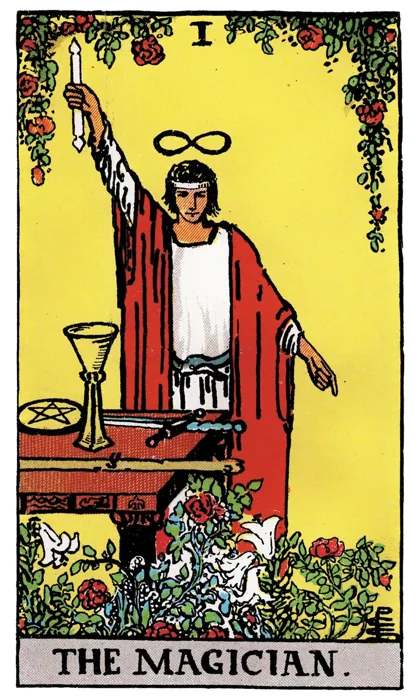
The Magician brings something the Fool has not yet assembled: the use of available skill. The combination can describe an inspired start becoming a deliberate act. It also asks whether an impressive presentation is supported by the ability to deliver.
With The Emperor
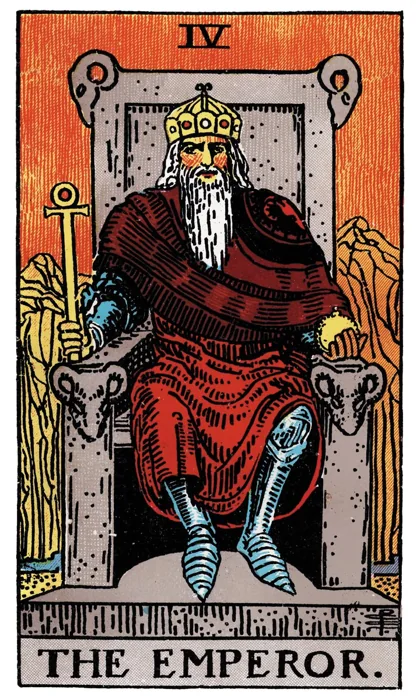
The Emperor introduces terms, structure, and responsibility. A new venture may need a budget or a clear agreement to remain possible. In a restrictive setting, the same pair can describe the tension between an inherited role and a desire to step outside it.
With The Lovers
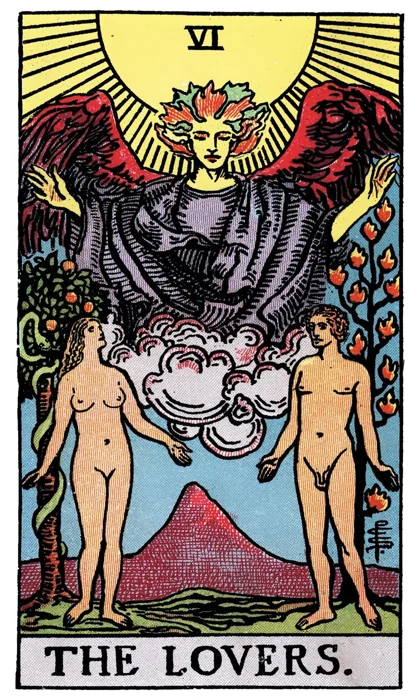
The Lovers brings a meaningful choice or encounter into the opening. Attraction may invite a different way of living, but the pair asks what choosing each other would actually involve. Mutual excitement is the beginning of that answer.
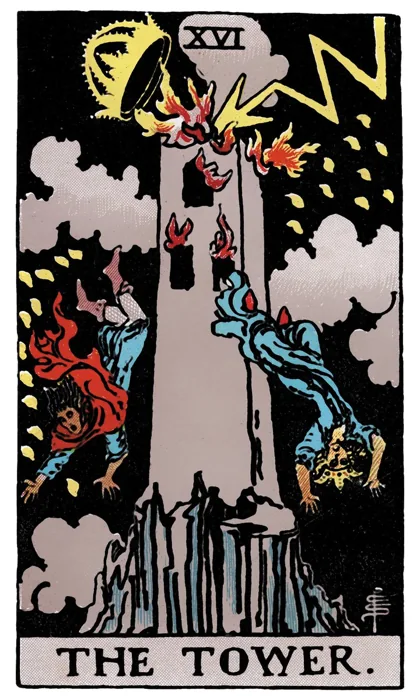
With The Tower
The Tower makes an existing structure part of the question. A beginning may follow disruption, or an impulsive move may test something already unstable. Examine the real vulnerabilities before acting; the cards do not establish that a particular accident or catastrophe will occur.

With The Star
The Star adds renewed trust after discouragement. A first attempt may matter because it shows that desire has returned. Protect the modest beginning from the demand to prove immediately that the entire future will be better.
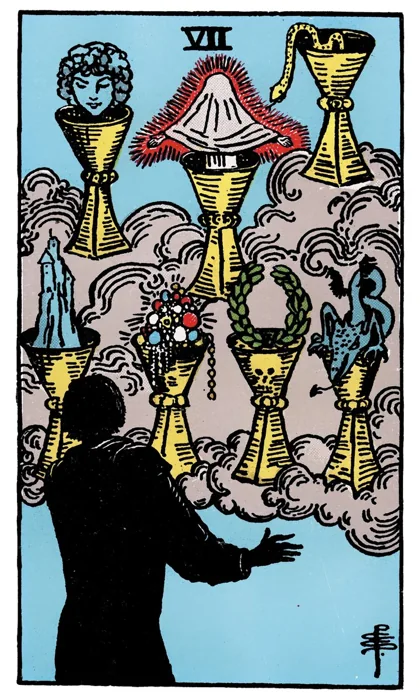
With Seven of Cups
The Seven of Cups increases imaginative possibility and the temptation to live inside it. Give one attractive future a concrete test. Otherwise the pleasure of imagining a new life may repeatedly replace the work of entering it.
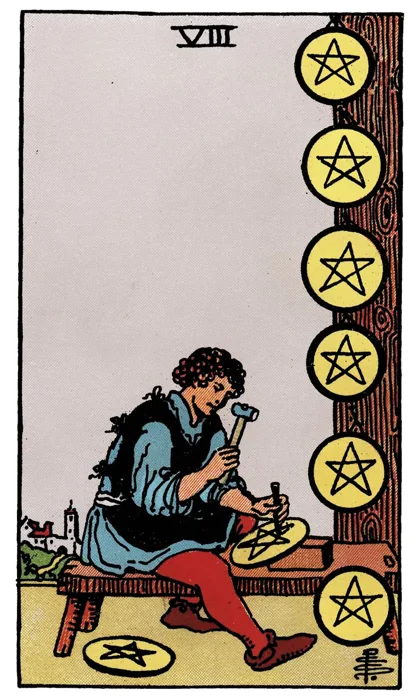
With Eight of Pentacles
The Eight of Pentacles brings apprenticeship. A fresh interest has somewhere to develop through repetition and feedback. This is a useful pairing when you need to let the early excitement become a practice without demanding that practice feel continuously new.
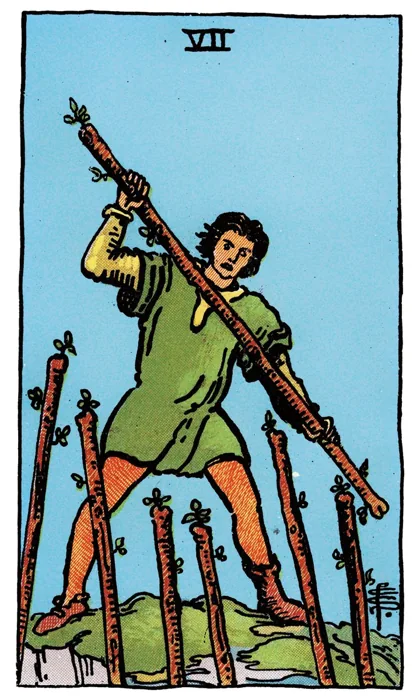
With Seven of Wands
The Seven of Wands raises the question of defending an unconventional choice. Distinguish a useful objection from pressure to remain familiar. You can take your decision seriously without making every doubtful person an opponent.
The newcomer who has not learned the rules
The Fool can be read through the newcomer, the wanderer, the apprentice, and the inconvenient questioner. Each enters a world before fully accepting its explanations. Their ignorance produces mistakes, but it can also reveal what established members have agreed not to notice.
The comic version survives by being underestimated. The tragic version mistakes exemption from convention for exemption from consequence. Between them stands the person willing to learn in public. That figure is less spectacular, perhaps, but far more capable of completing a journey.
In a story, the Fool's departure becomes interesting when it changes what the traveller can perceive. An endless series of arrivals is only movement. The journey acquires depth when an experience alters the way the next place is entered.
A first attempt with something at stake
Think of one possibility you have been keeping safely hypothetical. Choose a form of contact that can answer a real question: a conversation with someone doing the work, a first visit, a rough piece made for an actual reader. Give it enough substance that reality can disagree with your picture.
Afterward, write down anything that surprised you. Consider whether you want another attempt and what you would change if you made one. You now know a little more about the experience than you did before. Your interest might have grown, or you might want to approach it differently. You can also decide that you have learned enough to stop.
Artwork & interpretation
Waite describes an expectant traveller at the precipice, with a rose, bundle, and dog. The readings of those details and the everyday examples in this essay are our own. A. E. Waite, The Pictorial Key to the Tarot: The Fool.
The symbolic associations and examples offer ways to read a situation. They do not establish another person’s thoughts or fix an outcome.
The same openness that lets experience in can leave consequences out.
Use the cards in a spread →