Cups · Ace
Ace of Cups
A feeling becomes available before you know what to call it
The Ace of Cups notices a feeling as it begins to emerge. Someone's care may become easier to receive, or an experience may move you to make something. You can acknowledge what you feel while its meaning is still developing. There is time to decide what kind of relationship or commitment might follow.
- Openness
- Feeling
- Receptivity
- Nourishment
16 min read
In this guide
Something reaches you
A small kindness lands differently from usual. You stay with a piece of music you might usually have passed over. A conversation may feel unexpectedly intimate, leaving you more willing to care about something again. The Ace of Cups belongs to this first availability of feeling. Before there is a story about what it means, there is the simple fact that something has reached you.
The Ace of Cups often concerns becoming receptive to something that moves you. This can happen in a new relationship, but it can also change how you experience someone already in your life. Returning to a loved activity may bring a similar response. Something ordinary begins to feel meaningful again, giving you a sense of being nourished by an experience you can receive.
An Ace leaves much of a relationship still to develop. You can feel affection before you know someone well enough to trust them, and attraction may arrive before you discover whether daily life together would work. Give the feeling room without asking it to settle those questions. A commitment can be considered as you learn more about what the connection could support.
The card can also describe receiving. Help, affection, or recognition may be available, yet difficult to accept without immediately repaying or explaining it. Consider whether the offer can be received at its actual scale. A kind gesture does not always require a debt, and accepting care does not automatically mean surrendering independence.
Emotional renewal need not be dramatic. A moment of interest may be all you notice at first. You may feel less guarded, or find yourself wanting to make something beautiful. Do not reject a modest experience because the image looks abundant. The practical meaning lies in what is genuinely available, not in a requirement to feel overflowing joy on command.
In an outcome position, the Ace can suggest making room for a feeling as it develops. Give yourself a way to express it and let experience show you more over time. The card cannot promise a relationship or reconciliation, nor can it predict pregnancy or recovery. Consider what you are now able to receive and how to respond without deciding too quickly what it must become.
A cup held on an open palm
A white hand emerges from a cloud and supports a large golden cup on its palm. Water streams from the vessel into a pool covered with lily leaves and flowers. Above it, a white dove carries a small disc marked with a cross towards the cup. The scene combines offering, flow, and a setting capable of receiving what pours into it.
The hand does not close tightly around the stem. Its open support gives the image a different quality from grasping. Read symbolically, receptivity involves allowing contact without immediately controlling the experience. A feeling can be held with attention while remaining free to develop a meaning you do not yet understand.
The water does not remain sealed inside the cup. It moves into a larger body of water, where living things are already growing. This can suggest the relationship between a private response and the wider life that supports it. Affection, creative interest, or care becomes more substantial through the ways it enters ordinary action and relationship.
The dove and cross-marked disc introduce religious imagery into the scene. A contemporary reading can recognise that layer without requiring a shared belief: the encounter is treated as worthy of care, rather than merely useful or possessable. The image asks what changes when an emotional opening is met with attention instead of immediate demand.
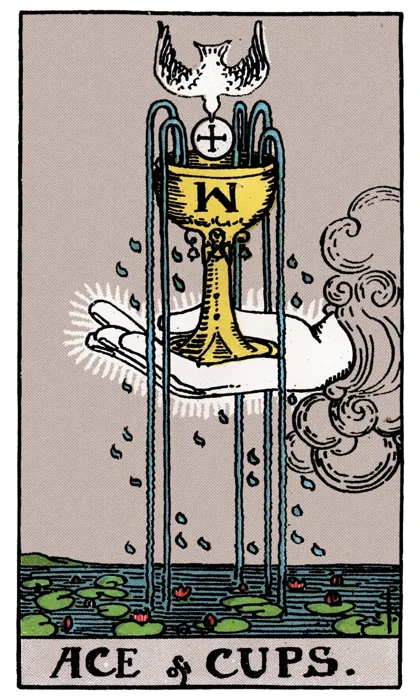
The open hand offers a way to think about receiving an experience. You can acknowledge affection, interest, or kindness without immediately defining its entire future. Attention can hold something gently while you learn what it means.
The flowing water joins a living setting rather than remaining a private possession. Ask what small expression would give the feeling a place in daily life: a conversation, a creative act, or accepting a form of care that is actually available.
The feeling may arrive before the explanation
The Ace of Cups can describe a response that is clear in its presence and unclear in its meaning. You feel moved, relieved, affectionate, or unexpectedly vulnerable without knowing exactly why. Allow a little time before deciding what the experience proves. Naming it too quickly can sometimes make it fit a familiar story rather than reveal its own shape.
Openness may include pleasure and discomfort together. To care about something is to become affected by it, and that can feel less controlled than indifference. The card does not ask you to remove every protection. It invites a proportionate response to what is present, with enough space to notice both the attraction and the conditions in which it feels workable.
You may find it easier to give than receive. Offering care keeps you active and useful; receiving it leaves you with the task of simply being the person to whom something is offered. Try noticing the impulse to repay immediately. Sometimes a sincere acknowledgement is sufficient, and the relationship can remain generous without being settled like an account.
Creative receptivity can begin with something small. A phrase may stay with you, or an image may evoke a feeling you want to explore. Try giving that response a form before explaining why it matters. Writing or drawing can help you discover which parts came from the original experience and which emerged as you worked with it.
If you are not feeling much, the Ace need not become an accusation that you are closed. The available opening may be very small, or the conditions may not support it yet. Begin with what you can honestly notice. A reflective card is useful only if it makes contact with your experience, not if it demands a more expressive personality than your own.
What it takes to let an experience reach you
Receiving is sometimes mistaken for passivity. Yet it can require attention, discernment, and the willingness to be changed by information you did not produce yourself. The Ace of Cups asks whether something can reach you before you decide how to use it. A conversation may need to be heard before it becomes a problem to solve.
Feeling gives information about your relationship with an experience, but it does not establish every fact about that experience. You can feel attracted to someone before you know whether you are compatible, and tenderness may remain despite a practical limit. Relief, too, can be genuine without establishing that an arrangement is sound. The opening becomes wiser when emotion can join observation rather than being required to replace it.
The cup also suggests that receptivity needs a form. Without boundaries, you may become responsible for every feeling around you; with no opening at all, care cannot easily enter. A usable emotional life includes both capacity and limits. You can be moved by another person while remaining clear about what you can actually offer.
There is a generosity in allowing a good experience to be modest. A kind encounter can matter without changing your life. Likewise, an afternoon spent making something can remain enjoyable without becoming the start of a vocation. When every meaningful feeling must justify a grand story, ordinary nourishment can become surprisingly difficult to receive.
The deeper invitation is to let care become part of life without making it a guarantee against pain. Openness carries uncertainty, as every relationship does. The answer is not to promise yourself that nothing will hurt. It is to choose suitable forms of participation and remain able to respond honestly as the experience develops.
Notice what you still care about making
At work, the Ace of Cups can concern finding personal meaning in an activity again. A welcoming collaboration may contribute to that feeling, or a creative idea may develop before you have a strategy for it. Look closely at what has engaged you. You might want more of one kind of task or contact with a particular audience, rather than needing to change your entire career.
For creative practice, begin with the response itself. Write the scene, explore the sound, or gather the material that keeps drawing your attention. Evaluation can follow once there is something to meet. Early emotional force is valuable, but it still needs craft if you want other people to encounter more than your explanation of what you intended.
A supportive workplace exchange may make participation easier. Someone listens, offers encouragement, or gives you room to learn without embarrassment. Notice what made the interaction useful so that it can become part of a working pattern. Warmth has practical value when it improves communication, trust, and the ability to ask for necessary help.
The card may also reveal how much care you bring to work involving other people. That care needs a workable role and boundaries. Feeling strongly about the outcome does not create unlimited time or make every responsibility yours. A sustainable contribution includes clear expectations about what you can provide and what belongs elsewhere.
If a project feels meaningful, do not assume that practical terms are therefore less important. Purpose and fair conditions should support one another. Clarify scope, payment, ownership, and the time required. A generous beginning can become strained if the participants avoid these questions because they want the connection to remain untouched by ordinary detail.
The professional shadow is asking the work to meet every emotional need. A project may provide meaning without supplying all your belonging, identity, and reassurance. Let it matter within a larger life. This can make both success and difficulty easier to assess, because neither has to decide the value of your whole existence.
Let affection become known through a real exchange
In love, the Ace of Cups can describe attraction, tenderness, a new connection, or a fresh emotional opening within an existing bond. It is a beginning of feeling, not proof of mutuality. If another person is involved, allow their words and actions to establish what they want. Your experience can be real even before you know whether it is shared.
Express interest at a scale the relationship can hold. A warm message, honest invitation, or small disclosure may be more useful than presenting a complete future to someone you are still getting to know. This gives the other person room to answer as themselves, rather than being asked to occupy a role already filled with your hopes.
In an established relationship, the card may invite a softer encounter after routine or strain. You notice affection beneath the logistics, or a conversation makes care easier to feel again. Let the moment matter without asking it to erase every unresolved issue. Warmth can support repair while the practical work of repair still remains.
Receiving affection matters alongside expressing it. When your partner offers something you welcome, allow time to experience it before deciding how to reciprocate. If the form of care does not suit you, discuss that difference. Knowing what each person finds meaningful helps you make room for offers you can receive with pleasure rather than obligation.
For someone single, the Ace can point towards a more receptive relationship with life as well as romantic possibility. Friendship, art, animals, a place, or a new interest may provide real emotional contact. You do not need to treat these as substitutes waiting to be replaced. A broader life can hold affection while leaving room for the kind of partnership you want.
The shadow in relationships is confusing openness with unlimited access. Caring about someone does not require immediate disclosure, constant contact, or responsibility for all their feelings. A beginning develops more safely through reciprocal knowledge and respected limits. The cup can remain open without being handed over to anyone who asks to fill it.
Generosity needs a form that both people understand
In material matters, the Ace may bring attention to a gift, a supportive offer, or a wish to use resources in a more caring way. Clarify the terms where necessary. A gift, loan, shared expense, and payment are different arrangements even when affection surrounds them. Clear understanding can preserve the warmth of the exchange.
Spending can express care, but it can also become a way to avoid a more direct emotional conversation. Ask what the gesture is meant to communicate and whether it fits your resources. The value of affection does not have to rise with the price. A thoughtful, manageable offer may reach someone more accurately than an impressive one shaped by anxiety.
At home, the card can invite small forms of nourishment: a place to sit comfortably, something beautiful you actually notice, or a routine that makes arriving easier. A home becomes emotionally available through use and association as well as appearance. Choose one change connected to daily experience rather than an ideal image of how comfort should look.
If you are receiving help, consider what would allow you to accept it with clarity. Ask about expectations instead of guessing, and name any limit you need. The card does not promise financial abundance. Its practical value is in examining whether resources can support care without making the relationship obscure, indebted, or difficult to speak about honestly.
Small experiences can be worth receiving in full
The Ace can invite attention to what leaves you a little more connected to life. It might be a conversation, a familiar song, time outdoors, or making something with your hands. Notice the effect without demanding that it transform the whole day. A modest experience does not become less real because a larger difficulty remains.
Emotional openness can also be tiring. You may need quiet after a meaningful encounter, especially if you have been holding a great deal in reserve. Give the experience some space to settle. You do not have to explain it immediately or become more socially available simply because you have felt something strongly.
The Ace cannot assess a health concern or tell you about fertility and recovery. You can use it to reflect on the care currently available to you. Consider what helps and whether a clearer limit would make support easier to receive. Respond to the needs you actually have; the abundant image does not require you to feel energetic when you do not.
Give the opening a small, honest expression
Notice what has moved you and respond at a suitable scale. Thank the person, make the invitation, write the paragraph, or allow yourself to enjoy the experience without immediately turning it into work. A feeling becomes more intelligible when it has an appropriate expression, rather than remaining either suppressed or inflated into a complete story.
Practise receiving something without rushing to neutralise it. This may mean accepting a compliment, a practical offer, or a moment of affection that you actually welcome. You can remain discerning about terms and boundaries. The exercise is simply to let the good part register before deciding what must happen next.
The shadow is idealising the source of a feeling. Because an encounter makes you feel alive, you assume the person, place, or project must be entirely good for you. Continue learning. Gratitude and attraction can coexist with questions about compatibility, limits, and whether the experience remains nourishing in ordinary conditions.
Another shadow is giving until the gesture becomes a hidden request to be needed. Ask what you are freely offering and what you hope to receive. Naming your own need can be more generous than expecting another person to discover it beneath a stream of care that was never entirely without conditions.
Allow a new feeling the conditions it needs to develop
Reversed, the Ace of Cups can describe difficulty receiving care, an emotional beginning that remains private, disappointment in an offer, or a feeling that is too crowded to become clear. It does not automatically mean the absence of love. Ask whether the issue is availability, expression, reciprocity, or the conditions surrounding the experience.
A person may care and still be unable or unwilling to offer the relationship you want. That distinction can be painful, but it is useful. Look at the actual arrangement rather than treating a strong feeling as evidence that practical limits will disappear. Your response deserves care even when it does not become the beginning you hoped for.
The reversal can also suggest that giving has exceeded capacity. You provide reassurance or attention while your own needs remain difficult to name. Reduce the unchosen obligation and make the exchange clearer. Care becomes more sustainable when it includes the person offering it, rather than using their depletion as proof of sincerity.
Sometimes the feeling needs a private form before it can be shared. Writing, making, or a quiet conversation with someone trusted may help you understand it. Privacy is useful when it allows experience to develop. If it becomes a permanent rule that nothing vulnerable can ever be expressed, consider one smaller, more manageable act of contact.
A constructive reversal can mean declining an offer that does not suit you, even when it is presented warmly. You do not owe openness to every invitation. Receptivity is more meaningful when it can distinguish what nourishes from what merely asks for access. The cup remains yours to hold, and you can choose what relationship to have with what is offered.
What form can the feeling take?
These combinations explore openness and its practical expression. They do not establish pregnancy, another person's feelings, or a guaranteed relationship outcome.

With The High Priestess
With the High Priestess, a feeling may need quiet attention before expression. Notice what is present without forcing an immediate explanation. Allow observation and time to distinguish the experience itself from the assumptions you are tempted to build around it.

With The Empress
With the Empress, care can take a tangible, creative form. Attend to the conditions that help something develop: time, materials, comfort, and responsive attention. This can describe emotional or artistic growth; it is not evidence of pregnancy or a forecast about fertility.

With The Star
With the Star, a modest opening may restore some willingness to hope. Let the actual kindness or renewed interest register without asking it to guarantee the future. Small experiences can matter while a larger process of rebuilding remains unfinished.
With Ace of Wands
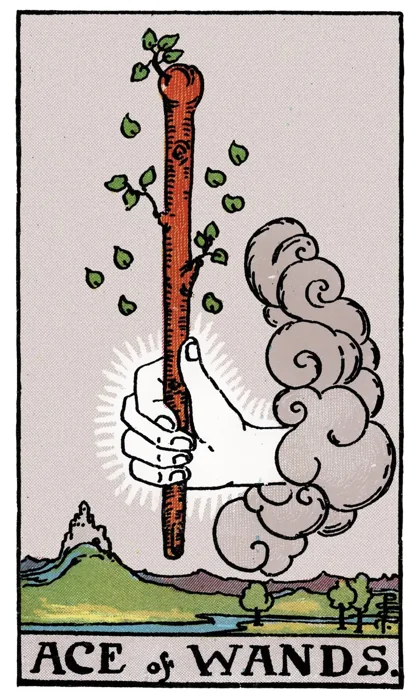
With the Ace of Wands, feeling and creative or physical interest may arrive together. Give the energy a clear, manageable expression. A strong beginning can be enjoyed while you continue learning what it asks of you and whether the conditions can support its development.

With Two of Cups
With the Two of Cups, an inner response begins to seek a reciprocal exchange. Express what is appropriate and allow the other person to answer. Mutuality becomes known through communication and behaviour, rather than through the intensity of one person's hope.

With Four of Cups
With the Four of Cups, an offer may be present while your capacity or desire to receive it is limited. Examine the fit without accusing yourself of ingratitude. You may need a different form, more time, or a clearer understanding of what you actually want.

With Queen of Swords
With the Queen of Swords, tenderness benefits from clear language and boundaries. Say what you feel without making claims about what the other person must feel. A precise conversation can protect an emotional opening by giving both people room to understand its terms.

With Six of Pentacles
With the Six of Pentacles, care may take a practical form. Ask about any expectations attached to the offer so you understand whether it is a gift or something to be returned. Knowing the terms can make it easier to accept useful support and trust the warmth with which it is offered.
The offered drink and the first line that matters
The offered drink gives care an ordinary form. Someone notices your presence and makes a small act of welcome. Its significance may exceed the object itself because it establishes a relationship: for this moment, your needs have entered another person's attention. Receiving the gesture lets that relationship become real.
The first line that matters to its writer offers a creative echo. Something felt but not yet understood begins to find language. The line may not explain everything, yet it changes the relation to the experience. Feeling has become something that can be returned to, shaped, and eventually shared.
The cup at a shared table suggests receptivity with a boundary. It has a form and a capacity, and it can be filled again. As a metaphor, it makes care neither limitless nor permanently scarce. What matters is the ongoing relationship between what is offered, what can be held, and what is allowed to flow into life.
Receive one small thing without enlarging the story
Notice one experience that touches or nourishes you, however modestly. Describe what actually happened and what you felt, keeping those observations separate from conclusions about the future. If a response is appropriate, choose a small one: thanks, an invitation, a creative note, or simply a little time spent with the experience.
Then ask what would help you remain open at a sustainable scale. You may need a boundary, a quieter setting, or less pressure to explain. The Ace of Cups becomes practical when something meaningful can reach you without being required to solve every emotional question your life contains.
Artwork & interpretation
Waite describes the offered cup, flowing water, dove, and cross-marked disc, connecting the image with nourishment and contentment. This original guide develops emotional receptivity, creative response, and care while distinguishing a meaningful feeling from a guaranteed future. A. E. Waite, The Pictorial Key to the Tarot: Ace of Cups.
The symbolic associations and examples offer ways to read a situation. They do not establish another person’s thoughts or fix an outcome.
You can let a feeling be real without asking it to tell you the whole future.
Use the cards in a spread →