Wands · Page
Page of Wands
The pleasure of discovering what you might be able to do
The Page of Wands wants to try something before knowing whether they will be good at it. An invitation can introduce an unfamiliar interest and change the course of a day. Let the first experience teach you something without requiring it to settle your future.
- Curiosity
- Exploration
- Expression
- Apprenticeship
16 min read
In this guide
You do not have to be good at it yet
Someone offers you a tool and asks if you would like to try using it. An invitation to an unfamiliar place can open a similar possibility. For a moment, the usual account of your abilities loosens. Perhaps you could learn this. Perhaps there is something here for you. The Page of Wands belongs to that exploratory moment, when interest has become personal enough to invite an attempt.
The Page suggests curiosity developing through participation. An encouraging message may introduce an interest you want to explore, or you may be looking for a first way to express it. Compared with the Ace of Wands, the impulse has acquired a person who wants to engage with it. There is a hand on the possibility now, even if the method and destination remain uncertain.
A Page may describe how you are approaching something unfamiliar, regardless of your age. An experienced adult entering another field can feel enthusiastic while becoming unexpectedly self-conscious about basic questions. Give those questions room. They can reveal details experienced people have stopped noticing and help a newcomer understand the work rather than merely learn to appear knowledgeable.
Messages and invitations fit this card because they introduce something that has not yet become an undertaking. Read the actual offer. Is it an opportunity to explore, a request for work, or an attractive suggestion with no practical arrangement behind it? Interest deserves a response, but not every lively announcement deserves an immediate promise.
The Page may also describe the discovery of your own voice. You may want to show work you previously kept private. Speaking up in a group you have mostly observed can involve a similar first step. The first expression may be rough or overly eager. That is part of learning. Allow room for revision without interpreting every awkward attempt as evidence that you should have remained silent.
In an outcome position, the Page can mark a beginning worth pursuing. An encounter may leave you with enough experience to ask a better question or know what to learn next. A useful contact may give that interest somewhere to develop. These gains matter when you are still discovering the subject. You can value what the first attempt taught you while leaving its longer future open.
A close look at something still growing
The Page stands on dry ground and holds a tall leafy staff with both hands. Their face turns towards its upper end, as though examining it. A feather rises from the cap, and the patterned tunic carries small dark creatures. Low pointed hills appear behind the figure. The scene is sparse, allowing the act of attention to become its centre.
Unlike the mounted Knight, the Page is standing still. The interest has not yet become a charge across the landscape. This is a useful distinction: exploration includes looking closely, asking, and handling the material before deciding what to do with it. Stillness can contain considerable appetite when attention is actively meeting something unfamiliar.
The staff is taller than the person and continues to put out leaves. It offers a visual reminder that the subject is larger than the learner's present understanding. That relationship can be exciting rather than humiliating. There is room to grow because there is more to discover, not because the beginner is deficient for not already knowing it.
The bare landscape gives the living staff particular emphasis. An interest may feel vivid even when the surrounding conditions are not especially encouraging. Read as a metaphor, the card asks what small signs of life you can work with now. It does not require you to pretend that enthusiasm has already transformed the whole environment.
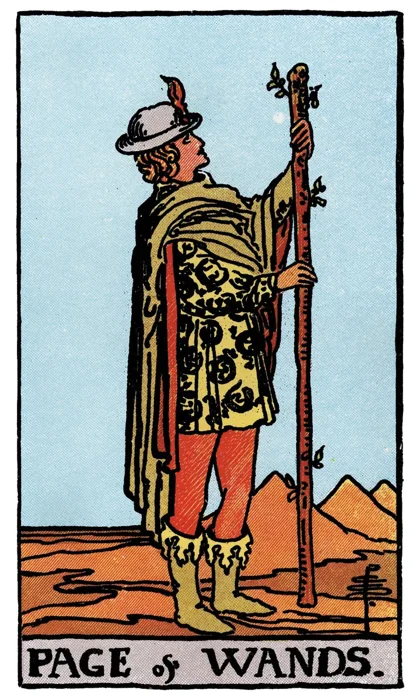
The gaze is directed towards the object itself. Learning becomes easier when curiosity briefly takes precedence over how competent you appear. Notice what the material does before deciding what the attempt says about you.
The landscape offers no elaborate workshop or audience. A first encounter can happen with modest resources. Look for a manageable way to participate before making ideal conditions a requirement for discovering whether the interest is yours.
Being interested is a form of permission
The Page of Wands can feel like waking curiosity after a period organised mostly around obligation. You notice something for its own sake. The experience may be playful, restless, or unexpectedly absorbing. Before asking how to make it useful, give yourself a little time to learn what part of it holds your attention.
Embarrassment often accompanies this card. You want to participate, but being visibly inexperienced feels exposing. You may overexplain, joke about your lack of ability, or wait until you have secretly become good enough to begin publicly. A supportive setting can help. So can choosing a first attempt whose purpose is learning rather than proving talent.
The Page's confidence is provisional and responsive. Encouragement can open a door; a careless remark can make the entire interest feel foolish. This sensitivity does not mean the interest is false. Early work has little internal evidence to stand on. Seek feedback from someone who can distinguish a developing attempt from a finished statement of ability.
There may be several interests at once, each suggesting a different possible self. You do not need to settle your identity before exploring. At the same time, give each activity enough contact to reveal more than its attractive surface. A few genuine attempts teach more than collecting the names and equipment of many imagined future selves.
If the card describes another person, approach their enthusiasm without either idealising or patronising it. They may have fresh observations and limited experience together. A good response makes room for both. Start by asking what they have noticed and offering the context that would help them understand it. Limited experience is no reason to dismiss everything they say.
A beginner can see what familiarity has made invisible
Expertise makes action possible by turning many decisions into habit. The beginner has fewer habits and therefore asks questions that may seem naive. Some are basic; others expose an assumption everyone else has stopped examining. The Page of Wands gives value to this unsettled relationship with a subject, where not knowing can become an opening for attention.
There is a difference between openness and pretending that knowledge does not matter. The Page needs instruction, practice, and an honest account of limits. Curiosity becomes stronger when it can receive correction without being extinguished. A useful teacher protects the willingness to try while helping the learner become more accurate about what the task requires.
An interest does not need to become a career to have a place in your life. You may enjoy how an activity fills an afternoon or find that learning it makes you notice more of the world. It might also bring you into a community you value. Allow yourself to discover those effects before requiring the interest to earn money or recognition.
Trying something also changes the meaning of desire. From a distance, you want the imagined result. Through participation, you discover whether you enjoy the process, what frustrates you, and which difficulties invite another attempt. The Page's task is to let experience refine the wish rather than defend the original fantasy against everything it learns.
This is a renewable role. You can be accomplished in one part of life and exploratory in another, or return to a familiar subject with a new question. Maturity does not require abandoning the Page. It can mean knowing how to create conditions in which curiosity remains available without asking it to manage responsibilities it has not yet learned to carry.
Give curiosity a task small enough to finish
At work, the Page may concern an assignment that introduces an unfamiliar area. Choose a limited task that gives you direct experience of it. Making one sample, for example, can reveal demands neither you nor a supervisor anticipated. A short training session may be enough for another situation. The result gives you a better basis for planning than a large commitment made before you have tried the work.
If you are changing fields, distinguish relevant experience from knowledge you still need to acquire. You do not arrive empty-handed, but neither does past competence remove the need to learn local methods. A clear account of both makes you easier to work with. You can contribute while remaining honest about where guidance is needed.
For creative work, the Page favours sketches, experiments, and early expressions that are allowed to be uneven. Keep a record of what surprises you. The unusual mistake may contain a direction; the polished imitation may teach technique without becoming your voice. Exploration needs enough freedom to notice which is which.
An invitation may be exciting because someone sees potential in you. Ask what support comes with the opportunity. Who will explain the task, review the work, and answer questions? Being given responsibility can be encouraging, but an arrangement that calls itself a learning opportunity while providing no instruction may be asking a beginner to absorb avoidable risk.
If you are teaching or supervising, offer feedback that points towards the next attempt. Explain what works before choosing the adjustment that would help most. Correcting every weakness at once can make the next attempt harder to approach. The aim is to build judgement as well as compliance. A learner should gradually understand why a choice matters, not merely learn to anticipate your approval.
The professional shadow is an endless enthusiasm for starting without enough attention to finishing. Keep the experiment small, but give it an endpoint. Completing a modest piece of work allows curiosity to meet the satisfaction and inconvenience of delivery. You learn whether the interest survives beyond its most flattering, possibility-filled stage.
An invitation to know someone, one encounter at a time
In relationships, the Page of Wands can describe flirtation, playful messages, a new social interest, or a wish to bring more spontaneity into an existing connection. The atmosphere may be lively without being defined. Let communication establish what is actually being offered. A charming exchange can be enjoyed without being treated as a promise of lasting commitment.
Curiosity is the useful quality here. Ask about the person rather than filling the gaps with a character you would like them to be. Early attraction often provides energy faster than knowledge. Shared experiences, ordinary conversation, and responses to small differences gradually reveal whether the connection has room for two actual people.
In an established relationship, try something that lets you discover each other again. An unfamiliar activity gives you both room to learn, while an open question may reveal how an old preference has changed. You can also bring play into a familiar routine. Shared history remains part of the bond, with room for the person beside you to keep developing.
Enthusiasm can be uneven. One person wants frequent contact or an immediate adventure, while the other enjoys the connection at a slower pace. Name the difference before interpreting it as a verdict on attraction. A workable rhythm includes both people's capacity, rather than making the more excited person's tempo the measure of sincerity.
For someone single, this card can support a small act of participation: answer an invitation, begin a conversation, or enter a setting where interest comes naturally. You do not need to arrive with a polished social identity. A genuine question often creates more contact than a performance designed to conceal every trace of uncertainty.
With friends and younger people, the Page can suggest encouragement that does not take over. Share an activity, notice an interest, or make room for a first attempt. Respect the other person's ownership of the discovery. Your support is most useful when it helps them learn what they want, rather than turning their enthusiasm into a project that belongs to you.
Borrow the tool before buying the whole workshop
Materially, the Page invites a modest experiment. Before investing heavily in a new interest, identify the least expensive way to experience its central activity. Borrow, rent, use an introductory session, or begin with adequate equipment. The purpose is to learn what you need through use, rather than purchase certainty about an identity you have not yet tried.
A course or opportunity may be worthwhile, but enthusiasm should be accompanied by a clear description of what is offered. Check the content, time commitment, practical support, and cost. A promise to reveal your potential can sound compelling while saying little about what you will actually do or learn. Specificity makes the choice easier to assess.
At home, the card can describe a small creative project, a new way of using a space, or the pleasure of making something yourself. Choose a scale you can finish and discuss changes that affect other people. An exploratory idea becomes more enjoyable when it does not leave the household indefinitely arranged around your unfinished attempt.
Limited resources need not make curiosity illegitimate. It may require a slower or less elaborate form. Look for access through a public space, a shared tool, or an exchange of knowledge. The card is not a forecast of money arriving; it is a prompt to find a practical route between wanting to explore and having the means to begin.
Keep enough appetite for the second session
Newness can make effort feel unusually easy. You stay with the activity longer than intended and assume the same energy will be available every day. Give the interest a pace you can return to. Stopping while some curiosity remains may protect it better than using the first burst to create an exhausting schedule.
If energy is limited, exploration can be small. Read a page, observe a demonstration, make a rough note, or try one movement suited to your circumstances. The Page does not demand exuberance. Sometimes renewed interest appears before the capacity to do much with it, and recognising that interest is already meaningful information.
The card cannot assess health or attention. Its practical question is which conditions help you engage without turning curiosity into another obligation. Notice the time, setting, company, and level of difficulty that make a first attempt possible. A suitable environment can matter more than a stern instruction to become more motivated.
Ask the question you think you should already know
Give one interest a manageable first attempt. Decide what you want to learn from it before you begin: perhaps whether you enjoy the activity, or how a particular technique works. You can then assess the experience against that purpose. An awkward result may still answer your question or show you what to investigate next, even though the work is far from polished.
Seek instruction without handing over all judgement. A capable guide can save you unnecessary confusion, while your own experience tells you what fits and what still needs explanation. Ask why a method works. Curiosity becomes more independent when it learns principles rather than collecting rules it must follow without understanding.
The shadow is treating enthusiasm as a substitute for reliability. You volunteer, announce, or promise because the possibility feels vivid, then struggle when the ordinary work arrives. Make commitments that reflect what you actually know about your time and skill. A small honest offer is more generous than a large exciting one you cannot sustain.
Another shadow is waiting to feel talented enough to begin. Talent cannot be reliably measured from the imagined attempt. Allow yourself some unremarkable practice and a few questions that feel obvious. The Page's courage is often quiet: remaining interested in the subject while the first evidence of your ability is still incomplete.
When it becomes difficult to give curiosity a fair attempt
Reversed, the Page of Wands may describe a false start, an unconvincing invitation, scattered enthusiasm, or a wish you keep dismissing before trying. Locate the interruption. Are you uninterested in the activity, unclear about how to begin, or worried about the exposure of being seen learning? Each possibility calls for a different response.
If you are starting many things, reduce the number of active experiments. Keep a place for other ideas without treating each as an immediate assignment. One small finished attempt can create more freedom than a dozen beginnings that remain mentally open. You are choosing where to learn now, not forbidding yourself to become interested elsewhere later.
Discouragement may follow feedback that was too broad or poorly timed. Return to a specific question about the work. What is one adjustment you can make, and what would it teach you? A judgement about your supposed nature is usually less useful than information about a technique, choice, or skill that can actually change.
A message or invitation may need clarification before you act. Excitement can conceal vagueness about the task, expectations, or support. Ask directly. The reversal does not mean bad news is inevitable; it can simply remind you that an announcement is not yet an agreement and that the practical details deserve attention.
A constructive reversal can make exploration more private. Keeping an idea to yourself for a while may reduce the pressure to perform. The interest can develop through practice before you decide whether to share it with a larger audience. Privacy is helpful when it supports actual practice. If it becomes another condition that postpones all participation, make the first step smaller again.
What helps the beginner become involved?
These pairings consider early attempts and opportunities to learn. A court card can describe a way of approaching a situation, so the combinations should not be used to infer someone's age or gender. Nor can they establish that person's character or intentions.
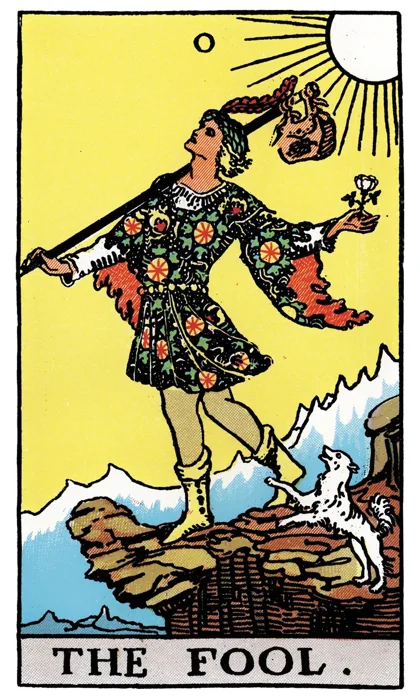
With The Fool
With the Fool, curiosity may benefit from a first experience that does not require a grand plan. Keep the attempt small enough to learn from. Openness becomes useful when you remain attentive to the actual situation, including the information that differs from your initial expectation.
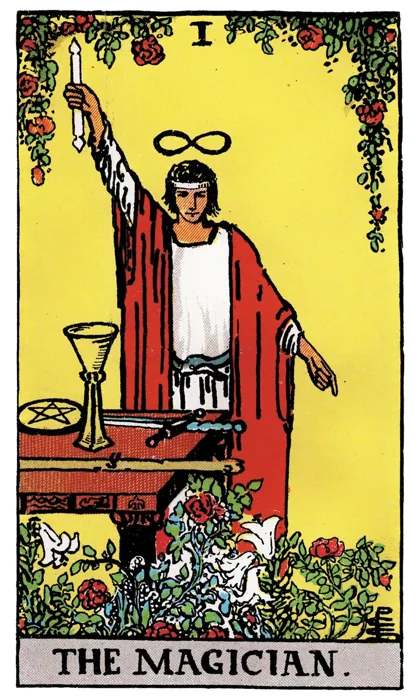
With The Magician
With the Magician, a new interest meets usable tools or existing skill. Make one concrete thing with what is already available. You may discover that an ability developed elsewhere can support the beginning, while still leaving specific techniques that need patient learning.
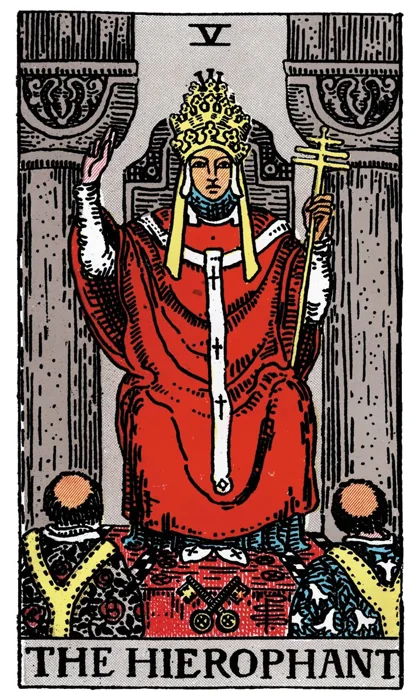
With The Hierophant
With the Hierophant, instruction can give curiosity a workable path. Look for a teacher or tradition that explains its methods and permits questions. A structure supports learning best when it develops understanding, rather than requiring the beginner to imitate without knowing why.
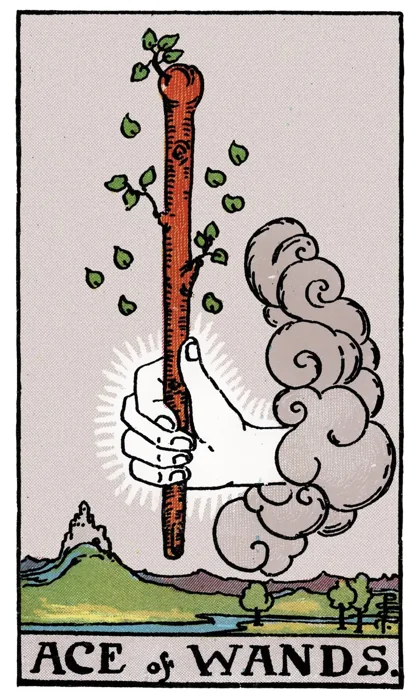
With Ace of Wands
With the Ace of Wands, inspiration is becoming a personal experiment. Follow the interest into an actual task before building an identity around it. The first attempt can tell you what you enjoy and what the possibility requires beyond its initial excitement.
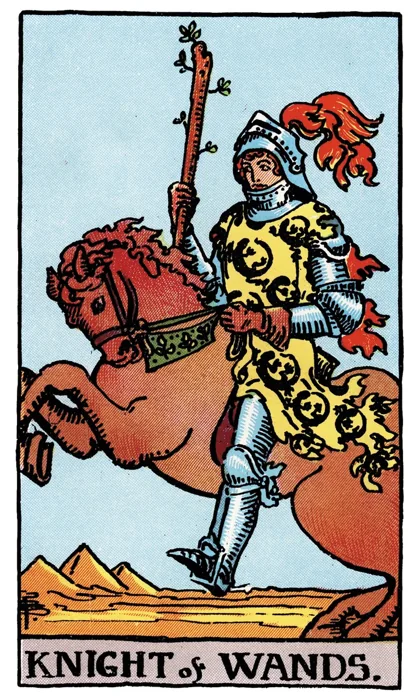
With Knight of Wands
With the Knight of Wands, the urge to act may outpace the learning. Preserve the Page’s curiosity while borrowing the Knight’s willingness to participate. A clear, limited challenge can provide adventure without asking inexperience to manage every consequence at once.
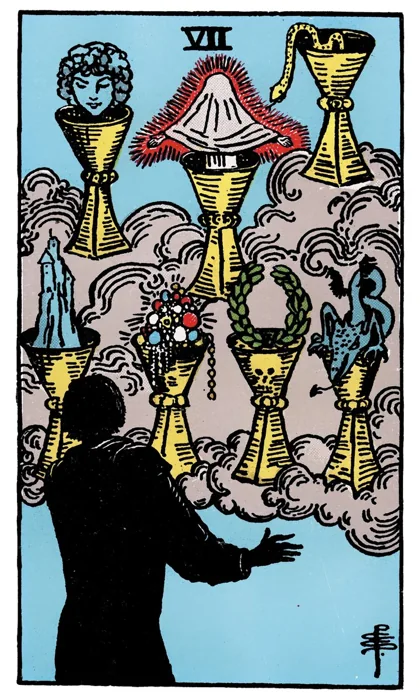
With Seven of Cups
With the Seven of Cups, several imagined futures may compete for attention. Choose one activity to experience directly and let the others remain possibilities for now. Contact with the work will clarify more than comparing the most attractive images of each potential identity.
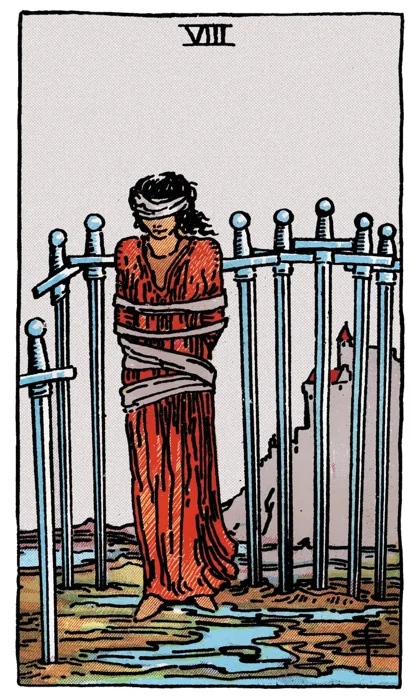
With Eight of Swords
With the Eight of Swords, embarrassment or restrictive assumptions may prevent a first attempt. Identify which limits are practical and which are predictions about how you will appear. A supportive setting and a smaller task can make participation more available.
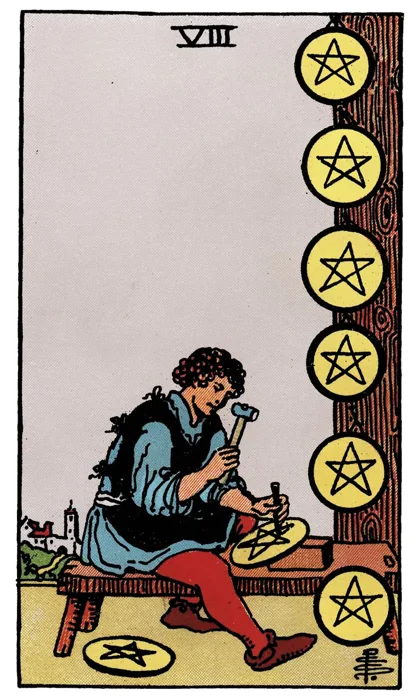
With Eight of Pentacles
With the Eight of Pentacles, curiosity finds a rhythm through practice. Choose a repeatable exercise and notice small improvements. The aim is to preserve interest while developing skill, so that the pleasure gradually includes doing the work as well as imagining what you could become.
Finding a way into an unfamiliar experience
The apprentice gives the Page a relationship with knowledge. They arrive with attention and limited experience, while the workshop offers materials, methods, and other people's judgement. A good apprenticeship gradually transfers responsibility. Its success is visible when the learner can make increasingly informed choices without needing every movement approved.
A messenger introduces a possibility from outside a familiar life. An invitation may reveal a kind of activity the recipient had never considered joining. What follows depends on their response. They can ask about the opportunity and decide whether to explore it further. The message opens that choice without determining what it must become.
The first open notebook offers a quieter echo. There may be only a few rough marks, yet something has crossed from admiration into expression. The page does not know whether it belongs to a lifelong practice. It only records that, on this occasion, interest was allowed to become an attempt.
Arrange one encounter with the thing that interests you
Choose an interest you keep discussing or saving for later. Find a short, affordable way to experience its central activity this week. Decide what you want to learn from the attempt and avoid making purchases or announcements that turn it into a larger commitment before you have begun.
Afterwards, write down what surprised you, what held your attention, and what you would like explained. Choose a next step only if the experience gives you a reason to take one. The Page of Wands becomes practical when curiosity is permitted to learn, including learning that a different interest may suit you better.
Artwork & interpretation
Waite presents the Page in a messenger role and associates the card with announcements and the qualities of its suit. This original guide develops a contemporary reading of curiosity, learning, early expression, and responsible experimentation through Pamela Colman Smith’s image. A. E. Waite, The Pictorial Key to the Tarot: Page of Wands.
The symbolic associations and examples offer ways to read a situation. They do not establish another person’s thoughts or fix an outcome.
You can take an interest seriously without requiring it to become a permanent identity.
Use the cards in a spread →