Cups · Ten
Ten of Cups
A life whose happiness has room for other people
The Ten of Cups wants a shared life in which people can remain themselves. Happiness develops through ordinary interactions, including how a disagreement is received. Knowing there will still be room for you when you return makes belonging feel dependable.
- Belonging
- Shared joy
- Home
- Common values
15 min read
In this guide
The good thing is the life between you
Some happiness develops through familiar daily surroundings. You enter a room knowing where your things belong and that someone will notice if you seem unusually quiet. They understand why a particular pleasure matters to you, which makes sharing it enjoyable. The Ten of Cups describes how these ordinary interactions can give life a dependable place to be shared.
In a reading, the card can concern a household, a partnership, a circle of friends, a community, or a hoped-for form of belonging. Its central question is the quality of the connections holding the arrangement together. The setting may be impressive or very ordinary. What matters is whether the people can experience it as a life they are participating in, rather than a picture they are required to maintain.
The card can describe a moment when several parts of life feel compatible. Daily arrangements give affection a place and allow people to act on shared values. The future seems possible because its responsibilities no longer rest entirely on one person. This may follow considerable effort. The ease visible now does not mean that nobody has had to learn how to make room for anyone else.
The Ten also brings a question about the definition of happiness being used. Sometimes the desired picture has been inherited so completely that nobody has asked whether it fits the actual people involved. A shared life becomes more credible when its form can be chosen and revised: who belongs, what commitment means, which routines matter, and what each person needs to remain fully present.
In a future-facing position, the card can help you name the quality of life you want to build towards. It does not promise marriage, children, reconciliation, or permanent harmony. Those are particular outcomes with their own conditions. The more useful question is which present choices support welcome, mutual care, and a future the people involved genuinely want.
Its hopeful quality deserves room. A practical reading need not dismantle every good image until only warnings remain. People can build a life that suits them, with dependable affection and a household where they feel safe enough to enjoy themselves. The Ten asks how to recognise and participate in that goodness while allowing it to remain human.
The adults look up; the children are already playing
Ten cups form an arc across the sky. Below, two adults stand together with raised arms, while two children hold hands and dance nearby. A small house, trees, water, and open ground give the scene a settled landscape. The picture places the emotional ideal above the people and an ordinary place to live behind them.
The children are not looking at the cups. Their happiness has its own immediate form. This detail gives the scene more life than a uniformly posed celebration would have. People can belong to the same good arrangement without experiencing it in identical ways or directing their attention towards the same thing.
The adults' gesture can be read as gratitude, recognition, or delight in what has become possible. Yet the house is still at a distance. The image captures a moment of seeing the shared life as a whole. It does not show the daily tasks through which that life continues to function. Those tasks belong in a practical interpretation even when they remain outside the picture.
The family shown is one particular image of belonging. Its emotional structure can be read more broadly: people whose lives are connected, a place they can return to, and a sense of shared future. The card need not require the viewer to reproduce the exact household in the illustration before its meaning becomes available.
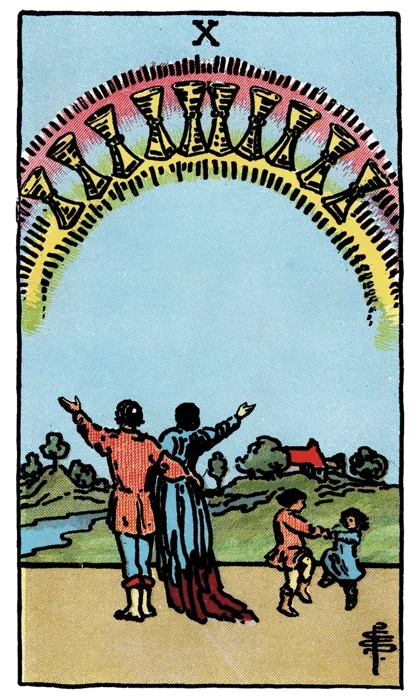
The arc gathers the cups into one image. Ask what unites the future you want with other people, and whether everyone involved recognises their own hopes somewhere within it.
The children have their own activity inside the shared scene. Belonging becomes more generous when people can enjoy the same life differently, without having to perform a single approved version of happiness.
The relief of not having to hold the whole world alone
Internally, the Ten can feel like a loosening of vigilance around belonging. You do not have to keep proving why you should be included. There is room to arrive tired, be ordinary, or have a preference that differs from someone else's. The security lies less in constant reassurance than in repeated experience of being allowed a place.
For someone who has long expected closeness to become conditional, this ease may initially feel unfamiliar. A peaceful evening can seem strangely uneventful. There may be an urge to test the connection or search for the hidden cost. The card invites attention to what the present relationship actually does, rather than requiring either immediate trust or automatic suspicion.
As a personal attitude, the Ten can bring warmth, loyalty, and the wish to make life hospitable. You notice how a room feels to the people entering it. You think about shared rituals and the continuity that allows affection to become more than occasional sentiment. This can be a substantial form of creativity.
The shadow appears when responsibility for the atmosphere becomes a private burden. You may find yourself constantly watching moods and trying to smooth over disagreements. Someone else's disappointment then feels like evidence that you have failed to create a good life. Shared happiness cannot remain shared if one person must quietly manage all the conditions under which others are allowed to experience it.
A mature Ten can tolerate differences in mood and desire. One person can be happy while another has a difficult day; someone can need solitude without rejecting the household. Belonging grows stronger when these differences can be understood without turning each of them into a referendum on whether the whole relationship is working.
Happily ever after still has an ordinary morning
Stories often stop when the desired household or community has been formed. The Ten invites a look beyond that stopping point. People still need rest, privacy, meaningful activity, and a fair share of practical work. The happy ending becomes a beginning for another kind of task: learning how to keep a shared life responsive to the people actually living it.
There is a tension between a common world and individual freedom. Belonging asks for some shared habits and commitments; it also needs room for each person to remain more than their role in the group. A family, partnership, or community becomes restrictive when difference is treated as disloyalty. Its continuity becomes healthier when people can change without immediately losing their place.
The card can also expose the distance between an image of happiness and its felt reality. A household may possess every expected sign of success while offering little ease to the people inside it. Conversely, an unconventional arrangement may provide reliable affection and a deep sense of home. The exterior form deserves less authority than the lived pattern.
Shared values become meaningful through ordinary decisions. Who gets uninterrupted time? Whose work is treated as important? How are mistakes repaired, and who is expected to absorb inconvenience? These questions may seem less inspiring than the rainbow, but they reveal what the rainbow means on a day when nobody is feeling particularly poetic.
The deeper promise available here is a form of continuity that includes revision. A good shared life does not have to stay identical to remain recognisable. New needs, changed capacities, departures, and additions can all require a different arrangement. The attachment is to the people and the quality of care, rather than to a scene that must never be allowed to move.
Make the life together fit the people living it
In a partnership, the Ten can describe affection that has acquired a shared world: routines, jokes, plans, mutual friends, and a familiar way of returning to each other. The pleasure lies partly in continuity. There is less need to make every meeting remarkable because the connection is present in the ordinary fabric of the day.
If commitment is being discussed, look beyond the milestone itself. What does each person imagine daily life becoming? How much closeness, privacy, shared responsibility, and independence feels welcome? Agreement about the name of a relationship does not automatically establish agreement about the life expected inside it.
The card has room for chosen family, enduring friendship, and community as well as romance. Belonging may be distributed across several relationships rather than concentrated in one partner. This can make a life more generous, because no single person is required to provide every kind of understanding or companionship.
Family relationships bring the question of welcome without erasure. Are people allowed different values, identities, temperaments, and ambitions while remaining loved? A peaceful gathering can be pleasant, but its peace deserves examination if someone must hide a central part of themselves to preserve it. Harmony gains depth when it includes honest recognition.
In conflict, the Ten asks what kind of shared life the conversation is intended to protect. Winning may be less useful than identifying the need, correcting a pattern, or changing an unfair arrangement. This does not mean preserving closeness at any cost. A common future is meaningful only if participation remains something the people can freely and honestly choose.
For a relationship that is already good, the advice may be simple: notice what makes it good and continue doing some of it deliberately. Appreciation can name specific acts rather than relying on the assumption that affection is obvious. Familiar care is easy to overlook precisely because it has become dependable.
A good culture can be felt in ordinary treatment
At work, the Ten can concern belonging within a team, shared purpose, a supportive culture, or the relationship between employment and the rest of life. Look for how people are treated on ordinary days. A welcoming message means more when questions, mistakes, boundaries, and different working styles are handled with consistent respect.
Shared purpose can make difficult work meaningful. People understand why the effort matters and can see their contribution inside the larger result. The card is strongest where this purpose supports clear responsibilities and mutual consideration. An inspiring mission cannot indefinitely compensate for confusion or a workload that leaves everyone depleted.
The language of family at work deserves careful attention. It may express real warmth, but it can also make ordinary boundaries feel like betrayal. A healthy team can value its people without claiming every part of their loyalty or time. Clear terms help goodwill remain voluntary rather than becoming an unspoken requirement.
For career decisions, the Ten may shift the question from what looks successful to what supports the life you want to share. Schedule, place, energy, and the atmosphere you bring home can matter alongside the role itself. A good professional choice has to fit somewhere in an actual life.
Creative or community projects may thrive through a sense of welcome. People return because participation feels meaningful and because there is room for them to contribute. Fair decisions and clear explanations help people trust that atmosphere. Remember the people whose quiet maintenance makes it possible to return. Belonging is often supported by work that receives little public applause.
The shadow is avoiding every necessary disagreement because the team wants to remain nice. Problems then become private resentment or fall repeatedly on the most accommodating person. A culture that can discuss a difficulty without threatening membership is usually more cohesive than one that permits only cheerful accounts of how things are going.
Let shared resources answer shared needs
In the material sphere, the Ten asks how resources support the people who share a life. A home is more than an appearance or an achievement; it is a setting for daily needs. Consider whose comfort, access, privacy, and interests are represented in its arrangements, especially where one person's preferences have become the unexamined default.
Shared spending can reveal different ideas of security and enjoyment. A welcoming gathering may matter to one person while someone else needs a quiet space. For another, security means being able to make plans without constant uncertainty. Naming those meanings can make practical conversations clearer. The aim is to understand what each request is trying to provide, rather than treating every difference as carelessness or deprivation.
The image of a successful household can become expensive to maintain. Celebrations, possessions, and appearances may start serving an audience more than the people involved. Ask what actually improves the shared experience. An ordinary arrangement that supports rest and affection can be more valuable than a polished one nobody has time to enjoy.
The card does not establish property outcomes, future income, or the financial security of a relationship. Its reflective question is whether material decisions fit the common life being chosen. Where practical terms matter, make them explicit; affection is easier to preserve when people understand what has been offered and what remains their responsibility.
A shared life should also make room for recovery
Company can restore energy when it permits ease rather than performance. You can share a room while quiet or out of sorts, without being asked to explain every minute. Joining a meal need not make you responsible for managing the occasion. These modest permissions can make belonging feel real.
A household or community also has different rhythms. Some people recover through conversation, others through uninterrupted time. Treating one pattern as the only sign of affection can make closeness unnecessarily tiring. A useful shared routine leaves room for different ways of returning to participation.
The Ten cannot assess health through an image of happiness. It can prompt a practical question about where rest and care come from in the current arrangement. If one person repeatedly provides recovery for everyone else while having no place to receive it, the apparent harmony may need a fairer structure.
Ask what makes this a good place to return to
Identify one ordinary practice that makes a relationship or group feel welcoming. It may be a reliable check-in, a shared meal, room for a different opinion, or the way someone notices when help is needed. Give that practice attention. A common life is sustained by repeated acts more than by an occasional declaration of how much it means.
Ask the people involved what feels good to them and what is harder than it looks. Leave room for an answer you did not anticipate. The purpose is to learn about the shared experience, not to collect reassuring statements that the arrangement is already perfect.
The shadow is compulsory happiness: everyone must appear content because the group has invested in being a happy one. Under that rule, disappointment becomes disloyalty and difficulties have nowhere to go. Make it possible to name a problem while remaining part of the relationship.
Another shadow is assuming that a familiar ideal should fit everyone. The useful question is which form of belonging serves the actual people. You can respect an inherited picture without requiring your present life, or somebody else's, to reproduce it exactly.
The picture and the lived experience need a conversation
Reversed, the Ten can describe strained belonging, conflicting ideas of a shared future, pressure to maintain appearances, or a departure from an inherited definition of happiness. Start with the actual mismatch. The reversal does not automatically mean a family breakdown or the end of a relationship.
People may agree that they want a life together while imagining quite different versions of it. One assumes constant togetherness, another substantial independence; one wants a familiar household model, another something less conventional. The disagreement becomes more workable when the expectations are spoken before being treated as promises already made.
Sometimes the group appears harmonious because one person has stopped bringing their needs into the room. The reversal can ask who is absent from the official account of happiness. A fairer arrangement may initially produce more visible disagreement because previously hidden experience has finally been allowed to enter the conversation.
The card can also support choosing a form of belonging that differs from what you were taught to want. You may build home through friends, a small household, or relationships with different boundaries. The test is the quality of care and freedom within the arrangement, rather than its resemblance to a familiar image.
Repair, where it is wanted and possible, needs particular changes. Better listening, a fairer division of work, clearer boundaries, or a revised plan can make more difference than repeated assurances that everybody loves each other. Affection remains valuable; the reversal asks what structure would allow it to be experienced more consistently.
What supports a shared life, and what must it make room for?
These pairings explore the conditions of belonging. They do not guarantee marriage, pregnancy, reconciliation, or a particular family future.

With The Hierophant
With the Hierophant, inherited customs may give a shared life continuity, or impose a form that no longer fits. Ask which value the tradition carries and whether its current practice serves the people involved. Meaning can survive a thoughtful change of form.

With The Lovers
With the Lovers, a common future depends on choices that each person can genuinely endorse. Speak about values and everyday expectations, not only the strength of the feeling. A shared direction becomes more credible when the commitments inside it are understood.

With Temperance
With Temperance, different rhythms and needs can be brought into a workable relationship. Look for an arrangement that allows adjustment rather than requiring perfect similarity. The quality of the shared life may depend on how well it accommodates ordinary differences.

With The Sun
With the Sun, joy may be easier to express openly and share with others. Allow the good moment to be enjoyed without making it compulsory for everyone to feel the same way. Warmth becomes more generous when it has room for individual experience.

With Two of Cups
With the Two of Cups, the wider shared life rests on a real exchange between people. Return to the conversation at the centre of the arrangement. Mutual recognition matters even when routines and responsibilities have made the relationship appear self-sustaining.

With Nine of Cups
With the Nine of Cups, ask how private satisfaction and collective happiness support each other. One person's contentment should not require another person's silence. A good arrangement can make room for individual pleasures alongside things people enjoy together.
With Ten of Pentacles
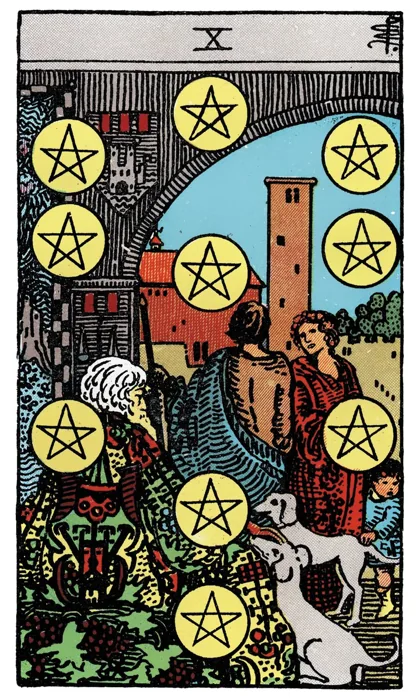
With the Ten of Pentacles, belonging meets the structures that help a shared life continue: resources, responsibilities, history, and practical agreements. Let the emotional ideal and the material arrangement be discussed together. Neither should be assumed to take care of the other automatically.
With Four of Wands
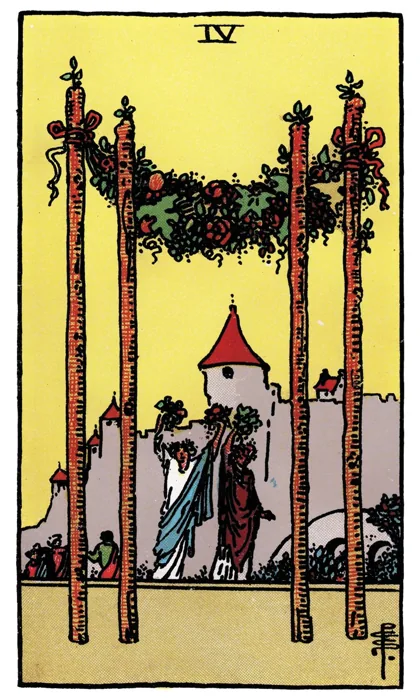
With the Four of Wands, a gathering or milestone can make belonging visible. Enjoy the occasion while noticing the everyday relationships it celebrates. The event is most meaningful when it expresses a welcome that continues after the decorations have come down.
How a place becomes home
The returning traveller recognises home through small permissions: a familiar place to sit, a voice that does not require explanation, an ordinary task resumed. The meaning lies less in the building than in the relationship between the person and the life that has room for them.
A shared table gathers different appetites into one occasion. The meal works because nobody has to become identical to belong there. Attention to the people present gives the ritual its warmth; the exact menu matters less than the experience of being expected and considered.
The house with an open room offers a picture of belonging that can develop. The arrangement has enough continuity to be recognisable and enough space to accommodate change. A shared life remains alive when new needs can enter without being treated as an attack on everything already built.
Make one ordinary act of belonging more deliberate
Choose a relationship or group that matters to you. Name one thing that makes participation feel good and one recurring difficulty that receives too little attention. If appropriate, ask another person for their version before deciding what needs to change. The differences between your accounts are useful information.
Choose one modest action that improves the shared experience: clearer expectations, a fairer task, time together that someone actually wants, or space that has been missing. The Ten of Cups becomes practical through a life people can keep entering honestly, including on days when nobody resembles the happy picture.
Artwork & interpretation
Waite describes the adults contemplating the cups while the children enjoy their own activity, and associates the card with contentment, love, friendship, and home. This original reading extends those themes to chosen belonging, shared values, domestic labour, and the difference between a happy image and a livable arrangement. A. E. Waite, The Pictorial Key to the Tarot: Ten of Cups.
The symbolic associations and examples offer ways to read a situation. They do not establish another person’s thoughts or fix an outcome.
A happy picture becomes a livable home only when the people inside it are allowed to be real.
Use the cards in a spread →