Pentacles · Knight
Knight of Pentacles
The person who returns to the task
The Knight of Pentacles keeps a commitment through ordinary days, including those when the initial enthusiasm has faded. Careful maintenance makes this reliability possible. There is also a point at which a routine can outlive its purpose. The card asks you to examine whether the work still matters and whether the method can adapt when circumstances change.
- Reliability
- Methodical effort
- Maintenance
- Sustained commitment
16 min read
In this guide
The promise is still there on an ordinary Tuesday
The initial excitement has passed, the task is no longer new, and someone still turns up with what is needed. That is the Knight of Pentacles. This card's value often becomes clearest through contrast with an absence: work proceeds without needing rescue because someone has remembered the practical details. Other people can rely on the agreement instead of repeatedly checking that it will be kept.
Upright, the Knight can describe dependability, careful planning, routine, sustained effort, and the willingness to maintain what matters. The pace may be deliberate because the person wants to understand the conditions before committing. Caution can protect quality and trust. It becomes less useful when the wish to avoid error prevents any movement or makes every unfamiliar method seem inherently irresponsible.
As a court card, the Knight may represent a person, a role, or a quality the situation needs. It is not restricted by age or gender. You may embody it when carrying a long project, keeping a practical promise, or establishing a routine that lets something important survive the fluctuations of mood. The common feature is continuity of action, not a fixed personality type.
This Knight differs from the Eight's focused practice by emphasising responsibility over time. The task may not teach something new each day. It still needs doing because people, resources, or a chosen purpose depend on it. Maintenance can be meaningful work even when it produces no dramatic before-and-after image to display.
Careful work can move promptly when the situation requires it. Look at what each stage of the process achieves and whether its timing suits the task. If nobody can explain a delay beyond saying that this is how things are done, the routine may be protecting people from uncertainty. Spending longer on something does not by itself make the result more dependable.
Its invitation is to choose a commitment you can actually sustain and give it clear conditions. Define what will be done, how often, with which resources, and when the arrangement will be reviewed. Reliability becomes more humane when it includes limits and communication, instead of an unspoken promise that one person will keep carrying the load regardless of what changes.
The horse stands while the rider considers the field
An armoured rider sits on a dark horse, holding a pentacle forward. The horse appears still rather than charging, and cultivated fields extend across the landscape. The figure has the equipment of a knight but the setting of sustained practical work. Movement is possible, yet the image gives weight to readiness, attention, and the ground that must be crossed.
The still horse makes this Knight distinct from the urgency of the Knight of Swords and the restless energy of the Knight of Wands. Stillness does not automatically mean failure to act. It can be a pause to assess the route or the condition of the task. The reading needs the actual circumstances to distinguish preparation from reluctance to begin.
The pentacle is held visibly, suggesting a responsibility or purpose that remains in view. Unlike a vague determination to be useful, a particular commitment can be examined. What exactly is being carried? Who depends on it, and what would count as completing or maintaining it well? Specificity keeps duty from expanding until it includes everything within reach.
The worked earth gives the scene a relationship with seasons and repetition. A field requires more than one burst of effort. It also changes, and the work must respond to those changes. Read this as a reminder that consistency is not identical to performing the same action forever. The purpose can remain steady while the method adapts to the conditions.
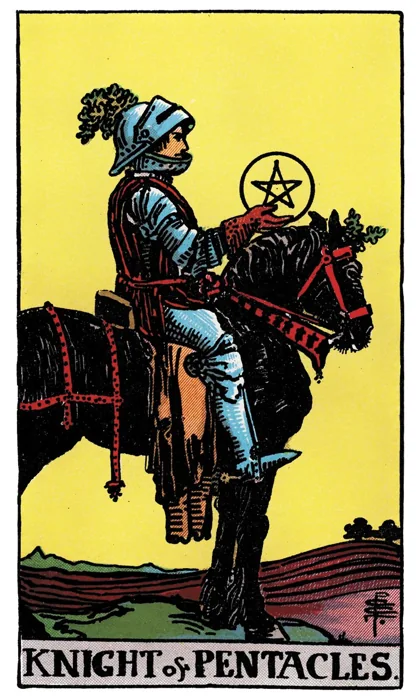
The held pentacle gives the commitment a visible object. Define what you are actually responsible for, so that being dependable does not silently expand into being responsible for everything another person leaves undone.
The horse is capable of movement while the field suggests continuing care. Ask whether the pause and method fit present conditions. Steadiness can include adapting the work as the ground changes.
Being dependable can become difficult to put down
The inner Knight often takes satisfaction in knowing that something is handled. The agreement you intend to keep is supported by preparation: you have checked the details and have what you need to carry it out. This can create a quiet sense of integrity. Your conduct does not depend entirely on whether the task happens to feel inspiring that day.
As a temperament, the card may be patient, practical, loyal, and less interested in announcing intentions than carrying them out. The person can be easy to underestimate in a culture that rewards visible enthusiasm. Their contribution becomes clearer over time, when other people's declarations have changed and the ordinary work still has someone responsible for it.
The private difficulty is fear of becoming unreliable. You may continue an obligation long after the conditions have changed because renegotiating feels like a moral failure. Ask whether the original agreement included the present scope and duration. Keeping your word can involve communicating a limit honestly, rather than silently allowing the word to grow into something you never chose.
There can also be discomfort with novelty. A familiar routine provides a dependable account of what to do and how to judge whether it was done properly. A new direction removes that certainty. The Knight's growth lies in recognising that careful experimentation is not the same as carelessness. You can test a different method without abandoning the values that made the old one useful.
Its more flexible expression allows duty and desire to remain in conversation. You honour commitments, but also ask whether they still belong in the life you want. A person is more than their capacity to keep something running. Reliability becomes a chosen strength when it leaves room for rest, pleasure, and an occasional change of direction.
Maintenance is a promise made repeatedly
The Knight explores the difference between declaring a value and building a practice around it. Care, craft, loyalty, and responsibility become visible through repeated conduct. A promise has a life after the moment it is made, and that life is often ordinary. The card respects the work of carrying intention through days that do not feel especially meaningful.
It also asks what deserves continuity. Repetition can preserve something valuable, but it can also keep an outdated arrangement alive because stopping would disturb a familiar order. The question is not whether consistency is good in itself. It is whether the repeated action still serves the purpose that justifies its place.
There is an ethical tension around dependable people. Groups may rely on them while allowing their reliability to conceal unfair distribution. The person who notices and completes the task keeps receiving it because everyone knows it will be done. Appreciation is incomplete if it never changes the conditions under which that person is expected to continue.
The deeper promise is trust with realistic limits. You can become someone whose commitments are credible precisely because you do not make them indiscriminately. A clear refusal, a negotiated change, or an honest warning about capacity can protect trust better than an unconditional yes followed by private depletion. Steadiness does not need to be infinite to be substantial.
Make the method reliable enough to share
At work, the Knight supports planning, implementation, follow-through, and the care of recurring tasks. Break a larger commitment into steps that can be carried out under ordinary conditions. Identify dependencies and the information needed at each stage. A good method reduces avoidable uncertainty without pretending that the whole project can be protected from every change.
The card can represent a colleague whose work is consistent and whose estimates are considered. Value that contribution without making it an excuse to transfer every difficult task to them. If you occupy the role, make capacity visible. Dependability should include accurate information about what can be delivered, not an obligation to preserve a reassuring image until the deadline exposes the actual limit.
For long projects, choose a rhythm that does not rely entirely on excitement. A regular appointment with the task can keep it present during less inspired periods. Review the rhythm when it repeatedly fails to fit the day. The purpose is to support the work, not to create another standard through which you can accuse yourself of lacking discipline.
The Knight also favours maintenance that prevents larger problems. Keeping records and caring for equipment helps prevent recurring issues from becoming emergencies. A completed handover gives the next person what they need to continue that care. Such work can be overlooked because its success appears as the absence of disruption. Make its value and ownership visible enough that it is recognised and appropriately shared.
In creative work, this card helps a substantial project survive beyond its first attractive scenes or ideas. Returning to the material lets you develop the middle and resolve inconsistencies that the first burst of enthusiasm may have left untouched. At the same time, do not let a production routine replace judgement. A chapter that no longer serves the book does not become necessary because it was scheduled.
The professional shadow is process used to avoid responsibility for a result. Every step is followed while the task's purpose goes unmet, and suggestions are rejected because this is how the work has always been done. A reliable method remains accountable to outcomes. Change it deliberately when evidence shows that the task would be better served another way.
Affection can look like keeping the ordinary agreement
In relationships, the Knight can describe loyalty, consistency, practical support, and the willingness to build trust over time. Someone arrives when they said they would, remembers the recurring need, or handles a task without requiring applause. These acts can carry affection even when the person is less fluent in dramatic expressions of it.
For a developing connection, a slower pace may allow both people to learn how the relationship works. Look for steady participation rather than speed alone. Caution can be sincere, but the card cannot guarantee that waiting will produce commitment. Ask what is actually being offered and whether the present pace fits both people's needs.
In an established partnership, routines may provide safety and ease. You know how certain things will be handled and can spend less energy negotiating every detail. Preserve what works while noticing when the routine stops making room for desire, play, or change. Reliability supports intimacy; it does not automatically supply every form of intimacy a relationship may need.
The difficult expression is treating duty as a complete answer to emotional distance. You may handle practical provision and organisation, staying physically present while avoiding conversations about what either person feels. Practical care is valuable, but it may not answer a request to be heard. Ask what kind of response is wanted before assuming that another useful act will resolve the issue.
The Knight can also show a person staying because leaving would violate their self-image as loyal. A commitment deserves serious consideration, including efforts to repair what is workable. It does not require indefinite participation in an arrangement that has become harmful or fundamentally incompatible. The actual conditions and available support should guide the decision, not a symbolic demand to endure.
Its warmer possibility is a relationship in which consistency creates room for spontaneity. Because the essentials are dependable, both people can relax, disagree, or try something new without fearing the whole bond will disappear. The promise becomes a foundation beneath living people, rather than a set of obligations that keeps the relationship formally intact while neither person feels free inside it.
A practical plan needs ordinary conditions in mind
In material matters, the Knight encourages attention to recurring commitments, maintenance, and the sequence through which a goal might be approached. Use actual figures, terms, and relevant expertise for financial decisions. The card cannot guarantee steady income or determine a suitable plan. It can help frame questions about whether the arrangement is understandable, realistic, and maintainable.
A careful pace may be useful when a decision has ongoing consequences. Consider what the resource will require after the initial acquisition and whether that fits your life. The least dramatic option may be suitable, but familiarity alone does not prove it is best. Compare relevant information rather than treating caution as a substitute for assessment.
At home, the Knight can support routines that make the place dependable: someone takes responsibility for each essential task, including keeping supplies available and arranging maintenance before a crisis. Keep the routine proportionate to the household. A system should reduce friction for the people living there, not turn the home into a workplace where every deviation requires correction.
The shadow is becoming the only person who knows how everything functions. Share appropriate information and allow others to take ownership of their part. They may use a different method while still meeting the need. A household becomes more secure when reliability is distributed rather than concentrated in one person who is never allowed to be unavailable.
A sustainable rhythm can include variation
The Knight asks what kind of routine supports you under ordinary, imperfect conditions. A plan that works only when you are unusually rested or motivated is not yet a dependable plan. Consider the actual starting point, the time available, and what a smaller version would look like when capacity changes.
Consistency does not require identical output every day. Different circumstances may call for different amounts of work, and maintenance can sometimes mean doing less so that a practice remains possible later. The card is not a prescription for a particular regimen. It invites a rhythm that respects the life in which the commitment must continue.
Watch whether rest has to be earned through complete exhaustion. There is always another useful task available, so that standard can make stopping impossible. A deliberate endpoint can protect the next period of effort as well as the person making it. You can be reliable without asking your whole life to become evidence of continuous usefulness.
Promise the work you can actually carry
Choose the commitment and define it clearly. What is the task, what does completion or maintenance require, and where are the limits? Then build a practical rhythm around the actual resources available. A smaller credible promise often serves people better than a larger one whose hidden costs are left for your future self to absorb.
Include a point for review. Conditions change, and a method that once fit may need revision. Knowing when you will assess the arrangement can make it easier to continue without turning every difficult day into a referendum on the whole project. It also prevents duty from becoming a contract with no remembered beginning and no imaginable end.
The shadow is stubbornness dressed as integrity. You keep the method because changing it would suggest the earlier choice was imperfect, or keep the obligation because renegotiation would disturb your identity as dependable. Integrity can include correction. The more useful question is what responsible action looks like now, with the information and conditions you currently have.
The routine is carrying less life than it used to
Reversed, the Knight can describe stagnation, delay, rigid habits, or work that continues mechanically without meaningful progress. Examine the process. Is there a missing decision, an unsuitable method, or a task that no longer serves its purpose? The reversal asks for a specific account of the blockage rather than a broad verdict that you have become lazy or incapable.
Another expression is inconsistent follow-through. Plans are made but not translated into steps that fit ordinary life. Reduce the gap between intention and action by clarifying the next task and its conditions. If the commitment repeatedly fails to happen, ask whether you actually chose it and whether its scope fits the resources you can provide.
The card may also show overwork concealed beneath a reliable surface. You keep going because others depend on you, while resentment or depletion grows. The appropriate response may involve renegotiation or shared responsibility, not a more efficient private routine. A system that requires one person to exceed their capacity is not made dependable by their willingness to keep trying.
Sometimes the reversal marks a deliberate break from an overly controlled life. You allow a different method, take a new route, or discover a desire that does not fit the established schedule. Let the experiment remain proportionate. Freedom need not be proved through an abrupt abandonment of every useful structure or every promise that still matters.
A constructive reversed Knight restores purpose to the pattern. The task is reduced, the method updated, the responsibility shared, or the commitment ended honestly. What remains can then be carried with more genuine consent. Reliability becomes a strength again when it supports a life that can change, rather than a role the person is no longer allowed to put down.
What makes this commitment sustainable?
These pairings explore consistency, method, and responsibility. They do not guarantee another person's loyalty, prescribe a pace for every situation, or make endurance the only responsible choice.
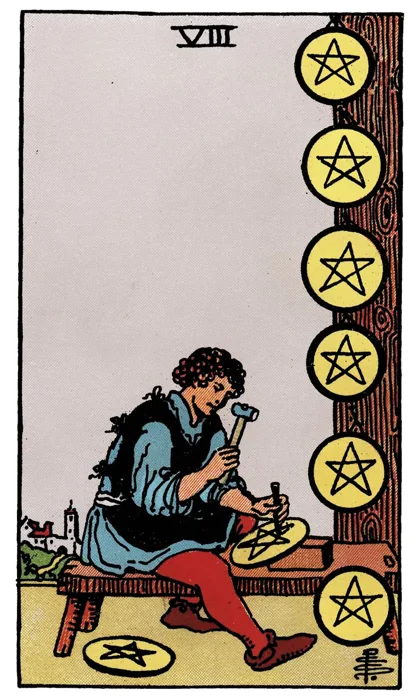
With Eight of Pentacles
With the Eight of Pentacles, deliberate practice can become a dependable method. Clarify which skills still need refinement and which tasks simply need consistent execution. Keep feedback available so that reliability does not become repeated performance of an error that familiarity has made difficult to notice.
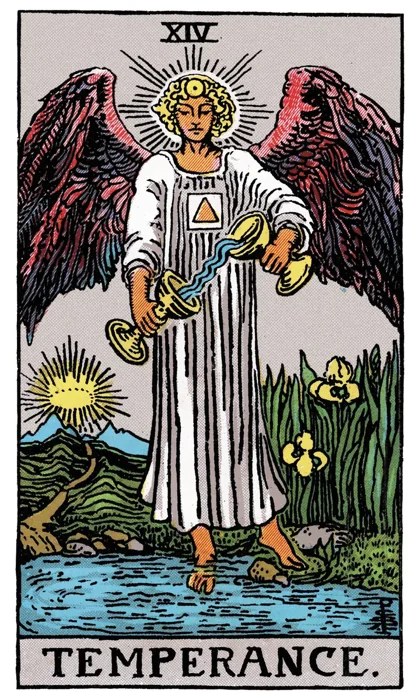
With Temperance
With Temperance, sustainability depends on proportion and adjustment. A steady commitment may need a different pace or combination of tasks to fit the wider life. Small revisions can protect continuity more effectively than alternating between rigid effort and complete abandonment of the routine.
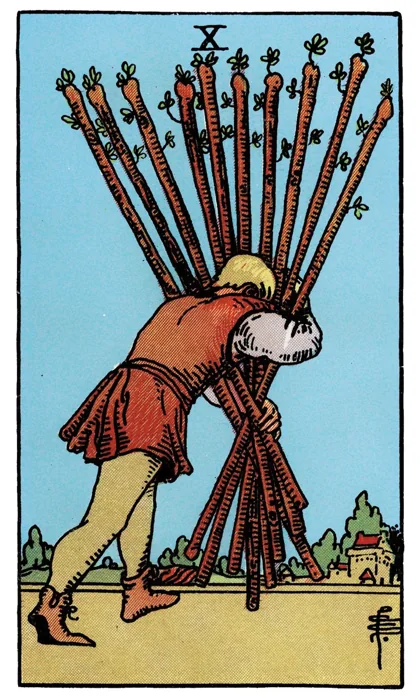
With Ten of Wands
With the Ten of Wands, the dependable person may be carrying an unreasonable load. Identify what belongs to others and what can be reduced or renegotiated. The pairing should not be read as an instruction to endure more simply because you have demonstrated the ability to keep going.
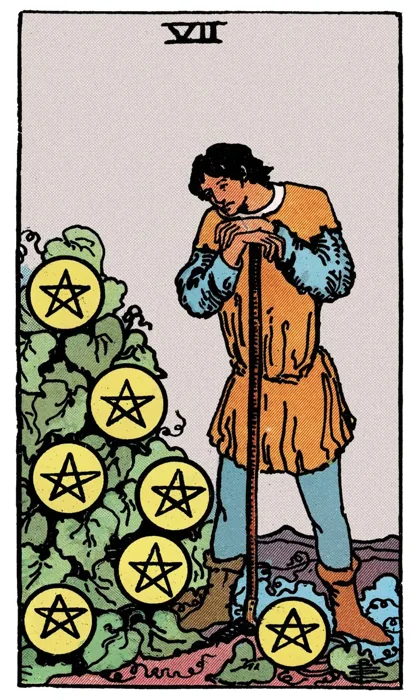
With Seven of Pentacles
With the Seven of Pentacles, review whether the method is producing worthwhile development. Continued effort deserves a present reason, not only a history of commitment. Choose the next stage based on what the work now shows, including the possibility that a different approach would serve the same purpose better.
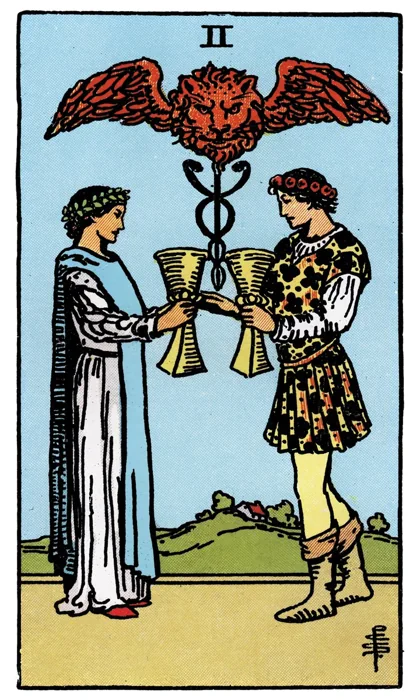
With Two of Cups
With the Two of Cups, trust can grow through ordinary agreements kept over time. Make sure the arrangement is mutual and leaves room for both people’s needs. Practical reliability is a strong foundation, while listening, desire, and the ability to renegotiate remain part of the relationship built upon it.
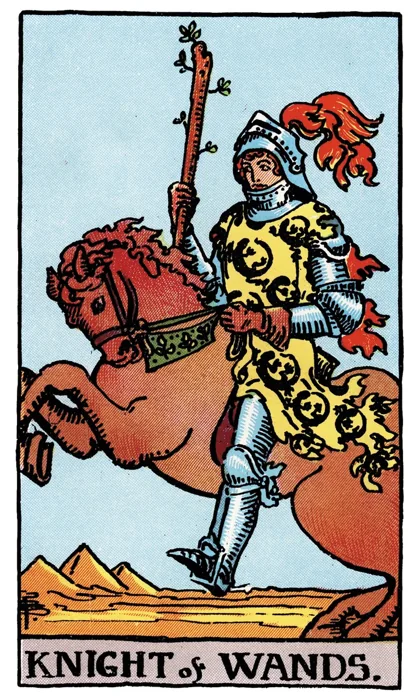
With Knight of Wands
With the Knight of Wands, sustained method meets a stronger appetite for movement and experiment. Consider which tasks need consistency and which would benefit from a fresh approach. The aim is not to make one temperament defeat the other, but to give initiative a way to continue after the first burst.
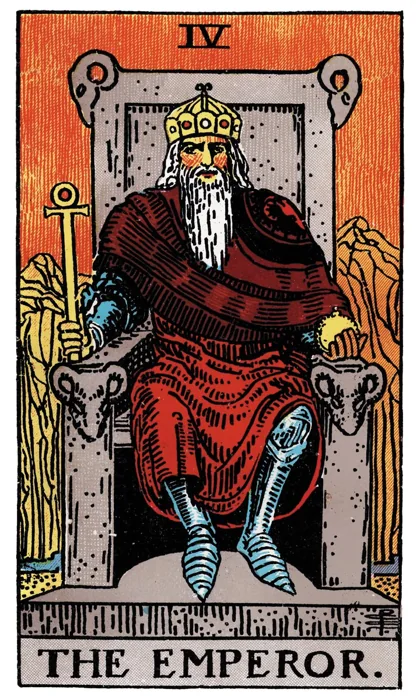
With The Emperor
With the Emperor, clear structure can make a commitment easier to maintain. Define roles, resources, and the limits of responsibility. A dependable system should distribute work appropriately instead of using authority to make the most conscientious person absorb every gap in the plan.
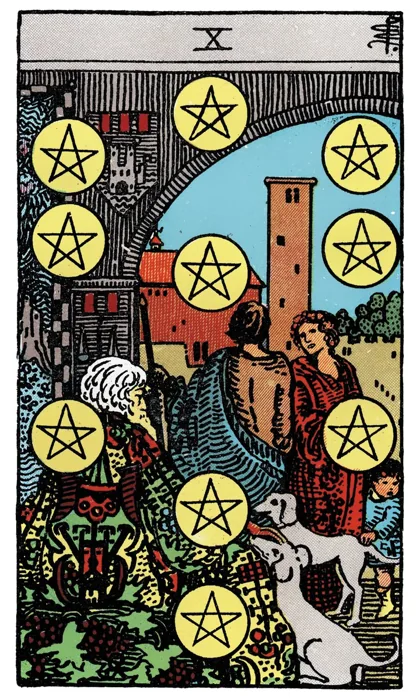
With Ten of Pentacles
With the Ten of Pentacles, recurring care supports something intended to last. Consider maintenance, documentation, and who can carry the work when you are unavailable. A durable structure becomes more trustworthy when continuity is shared rather than dependent on one person’s permanent readiness to serve.
The keeper of the road and the faithful clock
A road is usable because someone clears, repairs, and checks it after the opening ceremony has been forgotten. The work rarely receives the attention given to construction, yet it keeps the original promise available to everyone who travels there. The Knight values this continuity while asking whether the maintenance is adequately resourced.
A clock keeps time reliably until its mechanism needs attention. Insisting that it has always worked does not repair it. The image offers a modest lesson about routine: dependability includes noticing wear and responding to it, rather than treating the need for maintenance as a betrayal of the object's purpose.
A person returns to a shared task after the enthusiasm of the group has faded. Their steadiness matters, but the task should not quietly become theirs forever because they were the one who remembered. The Knight's story is most humane when loyalty is recognised through shared responsibility, not merely admired from a distance.
Build a promise with a visible limit
Choose one recurring task that genuinely matters to you or to people you have agreed to support. Define a manageable version, the resources it needs, and a realistic rhythm. Include what you will communicate if circumstances prevent the usual arrangement. Make the promise clear enough that others do not have to infer its boundaries.
After a suitable interval, review both the result and the cost. Compare what the routine achieved with the load it placed on you, and use that comparison to decide what should change. The Knight of Pentacles becomes dependable through this combination of follow-through and honest adjustment, allowing the commitment to remain substantial without requiring the person carrying it to remain unchanged forever.
Artwork & interpretation
The historical description emphasises an enduring horse and the rider’s practical responsibility. This original essay explores reliability, maintenance, and chosen limits without treating slowness as inherently virtuous or duty as an unlimited obligation. A. E. Waite, The Pictorial Key to the Tarot: Knight of Pentacles.
The symbolic associations and examples offer ways to read a situation. They do not establish another person’s thoughts or fix an outcome.
Consistency earns trust when it serves the task; an unchanged method can become stubbornness when the task or the life around it has changed.
Use the cards in a spread →