Swords · Knight
Knight of Swords
A clear direction at a dangerous speed
The Knight of Swords acts while others are still discussing the problem. A firm grasp of an argument can make that intervention effective, particularly when a decision has been delayed. Acting on an incomplete account can also hurt someone. Before pushing ahead, check whether the situation calls for urgency or whether waiting has simply become uncomfortable for you.
- Decisive action
- Intellectual conviction
- Urgent communication
- Impatience
16 min read
In this guide
The answer arrives already moving
The Knight of Swords has heard enough to form a direction and is halfway across the room before everyone else has finished discussing the options. There is relief in this energy. Someone finally accepts responsibility for a stalled task, or says the difficult thing that has held up a decision. There is also risk: the movement may begin before the problem has been fully understood by the person most certain of the solution.
Upright, the Knight can describe determination, rapid communication, advocacy, a forceful decision, or concentrated effort towards a defined aim. It is especially useful where hesitation has become an excuse and the necessary action is reasonably clear. The card brings willingness to face resistance. It does not wait for every participant to feel comfortable before acknowledging that something needs to change.
As a person or temporary role, this Knight is quick-minded, direct, and often compelling. They can organise a complex matter into a sentence that makes action seem possible. Their certainty may help others find courage. It may also make disagreement feel like obstruction, especially when they have identified so closely with the cause that questions about method sound like attacks on the cause itself.
The central distinction is between urgency and acceleration. Some situations have an actual deadline or require prompt intervention. Others merely provoke impatience, anger, or excitement. Before moving, ask what happens if you take enough time to verify the essential facts. A brief pause that improves direction may serve the task better than an immediate display of commitment.
The Knight is not automatically an aggressor, and speed is not automatically foolish. There are moments when clarity needs a person willing to carry it into action. Define the objective and choose a response proportionate to it, keeping a way to receive new information as you act. This lets you adjust the method without losing the purpose.
In a future position, the card can prompt preparation for a faster pace or a direct conversation. It cannot guarantee the arrival of a particular person or message. Consider which decisions may need an answer, what information should be ready, and which boundaries would help you remain deliberate if the atmosphere becomes urgent.
Everything leans into the charge
An armoured rider charges on a pale horse, sword raised. The horse stretches forward while the rider leans into the movement. Clouds stream across the sky, trees bend, and red fabric trails behind. Unlike the watchful Page, this figure has committed to a direction. The image shows a thought being acted on with enough force to affect people beyond the thinker.
The raised blade points towards a purpose, but the picture does not show the destination. We can see resolve more clearly than we can assess the wisdom of the mission. This is an important limit for interpretation. The appearance of confidence, effort, or courage does not by itself tell us whether the objective is justified or the method effective.
The horse carries the force of the decision. It can be read as the practical system through which an idea becomes action: the body, a team, a schedule, or the people asked to move with you. A rider focused entirely on the target may forget to notice what is being demanded of the means of getting there.
Wind intensifies the scene. The Knight is not acting in still conditions, and the environment will affect the charge whether or not it is acknowledged. Read that as a reminder to keep receiving information. A plan that cannot adjust to circumstances may preserve its original purity while losing its usefulness in the actual world.
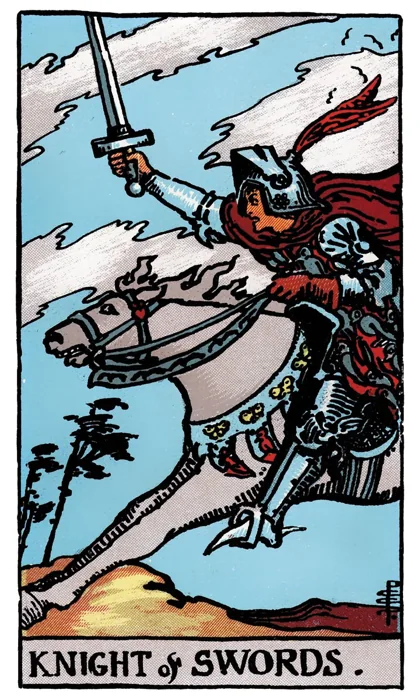
The rider has chosen a direction. Ask whether the essential facts support that direction and whether the people affected have a way to supply information before the decision carries them along.
The horse gives the rider’s intention practical force. Consider the body, team, or resources carrying your plan. A compelling goal still needs a method that acknowledges what the journey demands.
Conviction can feel like relief
The inner Knight often appears after too much indecision. At last, a direction. Your thoughts are clear enough to put into words, and you have a sense of what should happen next. That coherence can feel exhilarating, especially if you have spent a long time accommodating ambiguity or avoiding conflict. The card recognises the energy released when thought becomes a commitment.
As a temperament, the Knight may love argument, precision, and the challenge of a difficult problem. They can be generous with their effort and impatient with vague excuses. They are often easier to trust in a crisis than in a slow conversation: when something must be done, they act; when something must be understood gradually, they may try to hurry the understanding into a decision.
Anger can sharpen this energy. You see an inconsistency or an injustice and want to correct it immediately. The useful question is what correction would actually require. A forceful statement may be necessary, but the satisfaction of delivering it is not the same as producing change. Give the desired result as much attention as the moment of confrontation.
The Knight can also be escaping a feeling through action. If you keep moving, you do not have to sit with uncertainty, embarrassment, or hurt. This does not make the action wrong, but it may explain why any suggestion to pause feels unbearable. Ask whether you would choose the same method if you were not also trying to stop feeling something.
Maturity appears as the capacity to remain direct without becoming unreachable. You can hear a correction, alter the route, or let someone finish a sentence without losing your resolve. The strongest Knight does not need every obstacle to be an enemy. Some obstacles are information about how the goal can be reached more responsibly.
An idea enters the world through other people
The Knight explores the moral life of conviction. An idea may be coherent in thought and complicated in application. Once acted upon, it meets people with different information, capacities, and stakes. The question is not whether conviction should be abandoned, but whether it can remain answerable to what happens when it becomes real.
There is a temptation to treat resistance as proof of righteousness. If people object, perhaps that means you are brave enough to challenge them. Sometimes it does. Sometimes the objection identifies a genuine cost or a missing fact. A cause becomes less trustworthy when disagreement is automatically reclassified as evidence that the disagreeing person must be defeated.
Consider what the problem warrants before deciding how forcefully to respond. A minor error may be resolved quietly, while a persistent pattern could need a direct challenge. Power affects what either response will cost the people involved. The Knight is most effective when the action fits those circumstances. Feeling certain and irritated is only part of the information needed to judge that fit.
Its deeper promise is courage capable of revision. Acting with incomplete information leaves you something to learn. You may need to change a method as a result, while continuing to defend the value that first moved you to act. That flexibility does not weaken commitment. It makes commitment capable of surviving contact with a world more complicated than the original argument.
Move the task, and keep the route visible
At work, the Knight favours concentrated action on a clear problem. A deadline is near, a decision has been delayed, or an obstacle needs someone to address it directly. Define the result and the essential constraints before accelerating. People can work quickly together when they know what matters, who decides, and which changes require a pause.
The card may describe a colleague who is excellent at unblocking work but difficult to interrupt. Their speed can make a team feel both grateful and left behind. If this is your role, communicate the direction early enough for relevant expertise to enter it. A plan announced after everyone is already expected to comply has missed a valuable opportunity to become better.
For negotiations and difficult messages, directness can be useful. Explain the issue and what you want done about it, including when a response is needed. Avoid adding a character judgement where a factual description would do the work. The most effective message may be shorter and less satisfying to write than the one that explains every reason you are angry.
In creative work, the Knight can produce a strong burst of drafting, editing, or problem-solving. Use the momentum for a defined passage or decision. Then allow another mode of attention to assess what speed has missed. A forceful first version can be valuable without being exempt from revision, and editing need not be treated as a betrayal of the initial energy.
The shadow is urgency exported to everyone else. An ambitious person makes a sudden commitment and assumes the team will absorb the consequences. Before promising, check capacity and dependencies. A deadline becomes more credible when the people doing the work have participated in estimating what it requires.
If conflict is already underway, distinguish the outcome you need from the opponent you want to defeat. Those aims can diverge. A concession, clarification, or alternative route may achieve the practical goal faster than a complete victory in the argument. The Knight becomes professionally effective when it can recognise that difference while still moving decisively.
Directness needs somewhere for the answer to go
In relationships, the Knight can bring bold contact, intense conversation, intellectual attraction, or a quick move towards defining what happens next. Someone says what they mean and makes uncertainty feel briefly unnecessary. That can be exciting. It also helps to ask whether the pace leaves both people enough room to discover their own answer.
As a romantic style, this energy may pursue with confidence and enjoy a partner who can challenge it. Attraction can grow through debate, shared purpose, and the sense of being mentally met. But a person who excels at pursuit may still need to learn the slower tasks of intimacy: hearing a concern without immediately solving it, or accepting a difference that neither person needs to win an argument about.
During conflict, the Knight may speak a truth in a form that makes it harder to hear. Accuracy does not settle timing or proportion. Ask whether your words describe the issue or aim to overwhelm the other person into agreement. A conversation needs room for a reply; otherwise it is a declaration wearing the shape of a discussion.
Sometimes a direct boundary is exactly what is required. You may have explained enough and need to state what you will do. Clarity can be brief: the behaviour is unacceptable, the arrangement must change, or you will leave the conversation if it continues. A boundary concerns your participation. It does not require forcing the other person to endorse your whole account.
For questions about another person's feelings, the Knight may suggest a style of expression to consider, not private knowledge of their mind. Fast messages, passionate disagreement, or decisive pursuit can have several meanings. Look for consistent conduct and stated intentions over time. Speed alone does not tell you how durable the attachment will be.
The difficult pattern is turning a partner into an intellectual opponent. You answer vulnerability with a rebuttal, locate the inconsistency in a feeling, or keep correcting details while missing the request for care. Not every statement is a proposition awaiting defeat. Sometimes the more intelligent response is to ask what the person needs you to understand before you explain what they have wrong.
Do not let a deadline do all the thinking
In financial or practical decisions, the Knight asks for a distinction between a real deadline and pressure to decide quickly. Verify essential terms, identify what cannot be reversed easily, and obtain suitable advice where the consequences warrant it. The card's momentum does not certify the quality of an offer or make hesitation an automatic failure of courage.
A decisive administrative push can be helpful when neglected tasks have accumulated. With the relevant information in hand, choose a manageable set of tasks you can reasonably finish. The useful speed comes from preparation and focus. Rushing through documents you do not understand may create more work than the burst of activity resolves.
At home, one person's efficiency can become another person's experience of being overruled. Before reorganising shared space or committing shared resources, establish who needs a say. A sensible proposal can still be introduced in a way that removes consent. Let the people living with the result help shape it before the decision becomes a completed fact.
The material shadow is proving conviction through an immediate purchase, move, or commitment. Consider whether the action serves the underlying aim or merely makes your decision feel undeniable. You can be serious about a direction while taking the time needed to check its conditions. Deliberate preparation is often part of decisive action, not its opposite.
A sprint needs an ending
The Knight can describe a period of intense focus in which everything unrelated to the goal becomes background. This can be productive for a bounded task. It becomes harder to sustain when the finish line keeps moving and every new demand is treated as equally urgent. Decide what the sprint includes and what signals that it is over.
Notice who or what carries the pace. Your attention may feel willing while other needs, relationships, or obligations are being pushed aside. A plan should include the practical consequences of its intensity. If every successful effort creates a larger recovery burden, the method may need adjusting even when the immediate output looks impressive.
The card does not assess health or prescribe a regimen. As a reflective prompt, it asks whether action is being chosen or used to avoid stopping. You are allowed to complete a task without immediately finding another emergency worthy of the same intensity. An ordinary interval can be part of responsible follow-through.
Check the direction, then make the move
Name the outcome in a sentence that does not require someone else to be humiliated. Identify the essential facts, the people affected, and the smallest decisive action that serves the aim. This gives conviction a practical route. It also makes it easier to recognise when an argument has drifted away from the result you actually wanted.
Build one point of reassessment into the action. What new information would make you slow down, change course, or stop? Deciding this before you begin can protect you from treating momentum as a reason to continue regardless. The ability to steer is especially important when the initial direction feels morally or emotionally compelling.
The shadow is the belief that certainty grants unlimited force. It does not. You can be correct about the problem and careless about the response. Accepting that distinction allows a more useful form of courage: you act directly and pay attention to the consequences, remaining able to revise your approach without returning to indecision.
Momentum without a workable direction
Reversed, the Knight can describe haste, argumentative communication, a poorly aimed intervention, or a plan moving faster than its information. You may be reacting to the emotional pressure of the moment. Before adding another action, reconstruct the sequence: what happened, what did you infer, and what result are you now trying to produce?
Another expression is blocked decisiveness. You know what needs saying but keep rehearsing an ideal version that will remove all conflict. The card may invite a clear, limited statement rather than an explosive release of everything withheld. Directness is a skill that can be practised before frustration has supplied all the energy for it.
It can also show a cancelled charge. New information changes the plan, a deadline moves, or you recognise that the proposed action would cause unnecessary harm. Stopping may feel embarrassing if you announced your certainty publicly. Correcting the course is still more responsible than forcing reality to absorb the cost of preserving your original declaration.
In a conflict, the reversal may mark escalation that has become detached from the issue. Participants answer tone with tone, each new message justifying the next. Reduce the exchange to the decision or boundary that actually needs attention. Some conversations require a pause or a different channel before they can become useful again.
The constructive reversed Knight learns pacing. You retain the ability to act, but no longer need speed to prove commitment. Letting a colleague question the plan may improve it before you begin. Even waiting to reread a difficult message can help you recognise and remove its most punishing sentence. Resolve remains, with less collateral damage.
Where is the charge taking you?
These pairings explore the purpose, timing, and consequences of decisive action. Read them against the actual stakes rather than treating urgency or confrontation as automatically necessary.
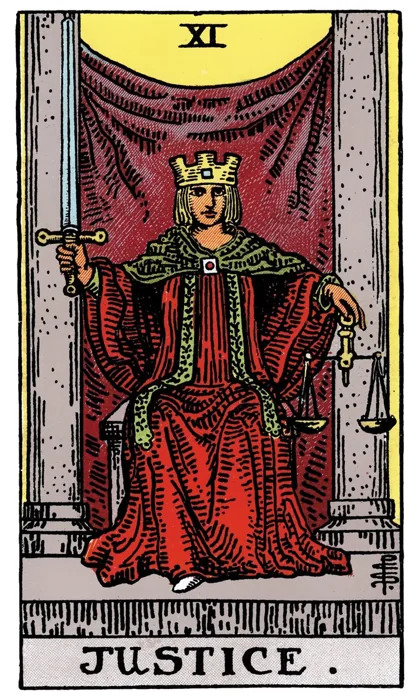
With Justice
With Justice, direct action needs a fair account of facts and responsibility. Make the claim specific, preserve relevant evidence, and use an appropriate process. Conviction can motivate you to seek accountability, but it should not decide the verdict before the matter has been properly examined.
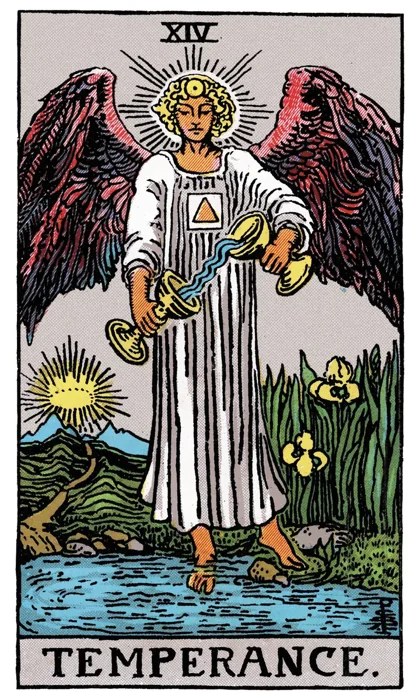
With Temperance
With Temperance, pace and proportion become central. The goal may be sound while the method needs adjustment. A measured sequence can achieve more than one overwhelming intervention, especially when several people must understand and sustain the change after your initial burst of energy has passed.
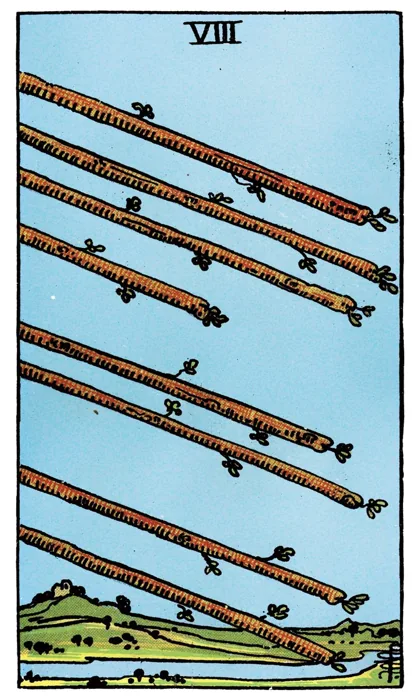
With Eight of Wands
With the Eight of Wands, developments may feel especially fast. Clarify which messages require immediate action and which can wait for verification. Keep essential decisions visible so that speed does not produce conflicting assumptions. Rapid movement is easier to manage when the destination and responsibilities remain explicit.
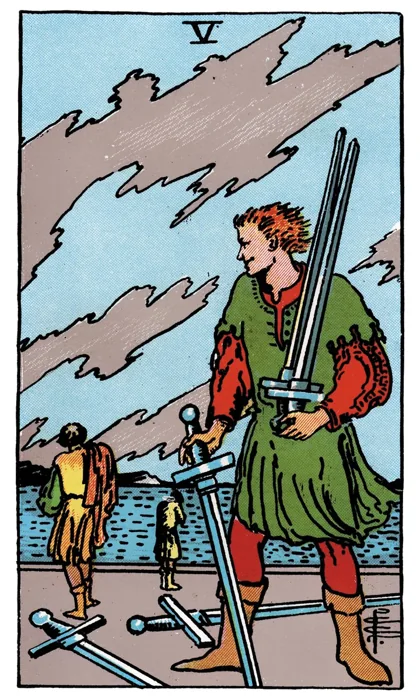
With Five of Swords
With the Five of Swords, ask whether the exchange is still serving a useful aim. The wish to defeat someone may be overtaking the problem. Consider what a practical resolution would look like, and whether another sharp response moves you closer to it or merely raises the cost.
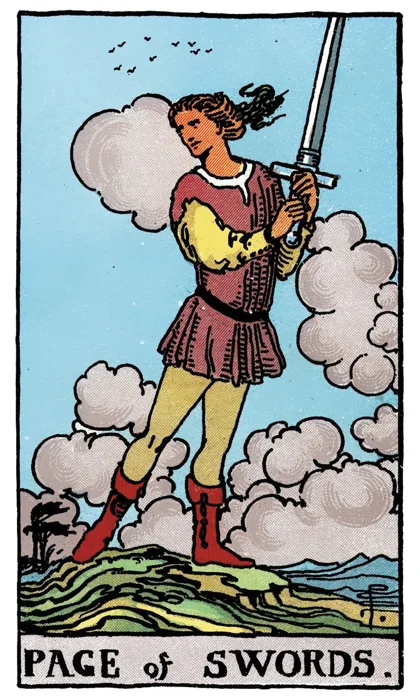
With Page of Swords
With the Page of Swords, an observation is becoming a plan. Check that the observation has been tested before it is used to justify a charge. Let curiosity remain active during action; a new fact can improve the route without making the initial question foolish.
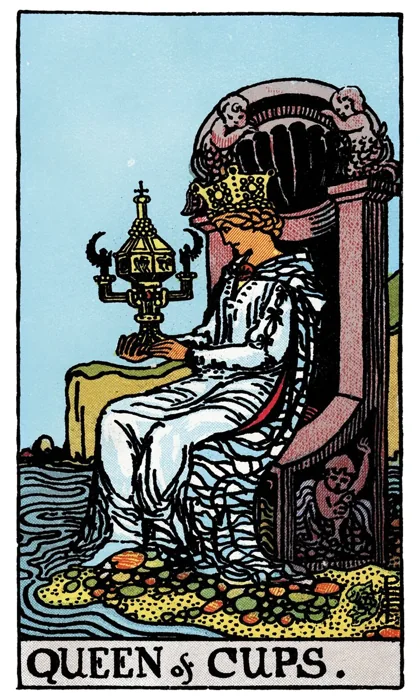
With Queen of Cups
With the Queen of Cups, bring emotional context into a direct conversation. Understanding how the issue is experienced can help you choose words that are both clear and usable. Care need not dilute the message, and force need not be the price of being taken seriously.
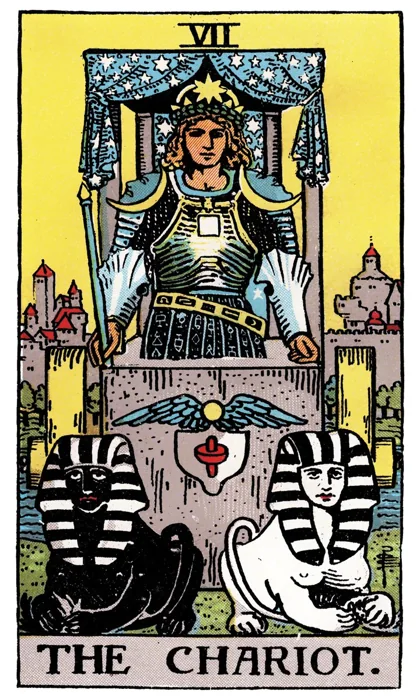
With The Chariot
With the Chariot, strong direction can become sustained achievement if the moving parts are coordinated. Align commitments, capacity, and the definition of success. Two cards of drive also invite a check: are you choosing the destination, or has forward motion become its own unquestioned purpose?
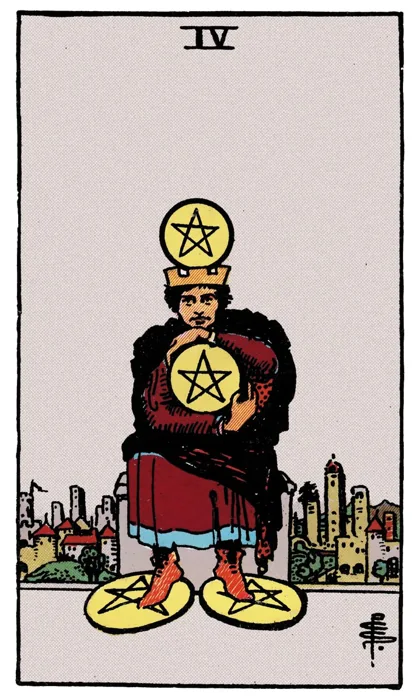
With Four of Pentacles
With the Four of Pentacles, decisive change may meet a strong need for security. Identify what is actually being protected and what could safely move. Neither bulldozing the concern nor allowing it to veto every adjustment is likely to produce a workable agreement.
The advocate and the courier
An advocate stands up when a room would prefer to avoid the issue. Their clarity changes what can be said aloud. The skill that makes the intervention valuable is not merely volume or fearlessness; it is enough understanding of the situation to direct pressure where it can produce a justifiable result.
A courier carries an urgent message through difficult weather. Speed matters because the message has a real purpose and destination. If the destination is wrong, speed only delivers the error sooner. This image captures the Knight's dependence on prior clarity: movement serves thought, and cannot substitute for it.
A rescuer arrives with a plan and discovers that the people needing help know something the plan omitted. Listening delays the first dramatic act but improves the rescue. The Knight's maturity lies in accepting that correction without making the emergency about the rescuer's authority or need to appear decisive.
Make a direct action easier to trust
Choose a manageable situation in which you have delayed a necessary message or decision. Write the desired result, the facts supporting it, and the people affected. Remove any sentence whose main purpose is to punish. Then make one clear request, decision, or boundary proportionate to what actually needs to happen.
Afterwards, assess the result rather than the intensity. Did the action create clarity, move the task, or protect a necessary limit? What response or new information should influence the next step? The Knight of Swords becomes dependable when decisiveness remains connected to observation all the way through the charge.
Artwork & interpretation
The historical image foregrounds forceful movement and martial resolve. This original essay considers how conviction becomes action, with particular attention to proportion, communication, and the ability to revise a course. A. E. Waite, The Pictorial Key to the Tarot: Knight of Swords.
The symbolic associations and examples offer ways to read a situation. They do not establish another person’s thoughts or fix an outcome.
A sound argument can still be carried too fast, too far, or without enough regard for its effects.
Use the cards in a spread →