Swords · Ten
Ten of Swords
The point beyond which the old arrangement cannot continue
The Ten of Swords depicts a painful ending with little room left to deny it. Something may have failed or reached the limits of what it can become. Recognising the specific loss helps you see what returning to it is costing you. Life continues beyond this ending, even when that is difficult to imagine from where you are now.
- Finality
- Exhausted options
- Painful recognition
- Aftermath
16 min read
In this guide
There is nothing left to win in this particular fight
The conversation has happened too many times. The project has used its last extension. A relationship, role, or explanation can no longer be sustained by one more effort to make it work. The Ten of Swords describes that hard limit: the point where continuing to argue with the facts becomes another way of being hurt by them. Recognition may arrive before acceptance feels remotely possible.
Upright, the card can represent a painful ending, defeat, a sense of betrayal, or the collapse of an expectation that organised your life. It can also show sheer exhaustion with an approach that has run its course. The emphasis is on finality within a specific situation. Before applying the image to everything, ask which agreement, possibility, or version of events has actually become untenable.
The picture is severe, but the card is not a prediction of physical death or violence. Nor does it prove that someone has betrayed you. It gives form to the experience of being finished with something, or feeling finished by it. What happened still needs to be established through the circumstances themselves. An arresting image should sharpen a question, not manufacture an accusation.
Sometimes the Ten brings an unwelcome kind of clarity. While an outcome remained uncertain, you could bargain with it: perhaps explaining yourself differently would help, or making a concession might buy another week. Once the answer is known, that bargaining has less to attach to. The clarity may hurt, yet it also releases some energy from an argument that no longer has a workable object.
There can be a smaller, almost theatrical expression too. A rejection feels like the end of an entire vocation; an embarrassing afternoon becomes social death. The feeling deserves kindness, but its scale can be examined. Is this an actual ending, or a painful event that your current account has made total? The card is useful when it makes that distinction more exact.
Its constructive movement begins with protecting what remains. Preserve the work you can reuse, attend to immediate needs, tell the people who need to know, and stop adding new promises to an arrangement that cannot carry them. You do not have to transform the ending into an inspiring lesson before you are allowed to respond practically.
A dark sky with a narrow opening
A figure lies face down, with ten swords entering the back. A red cloth covers part of the body. Beyond the foreground is water, a distant shore, and a band of yellow light beneath a black sky. The composition places an extreme image of defeat beside a horizon that has not disappeared. Both belong to the card, and neither should be used to erase the other.
Ten blades are excessive for a single fallen figure. As symbolism, that excess can suggest repeated injury, the cumulative force of a situation, or a mind adding one final conclusion after another. It does not tell us the identity of an attacker. A careful reading can explore the experience of betrayal without claiming to know that a particular person secretly intended harm.
The figure is still. Unlike the figures in earlier Swords scenes, this person is no longer negotiating, carrying, avoiding, or defending the blades. One interpretation is that the old struggle has reached its limit. The useful question shifts from how to prevail within that struggle to how the aftermath will be handled.
The light sits at the horizon, not around the body. This is an important distance. Possibility can exist before someone feels able to reach it. The image offers no timetable for recovery and no reason to call the loss fortunate. It simply places the event within a world larger than the foreground, where another phase may eventually become visible.
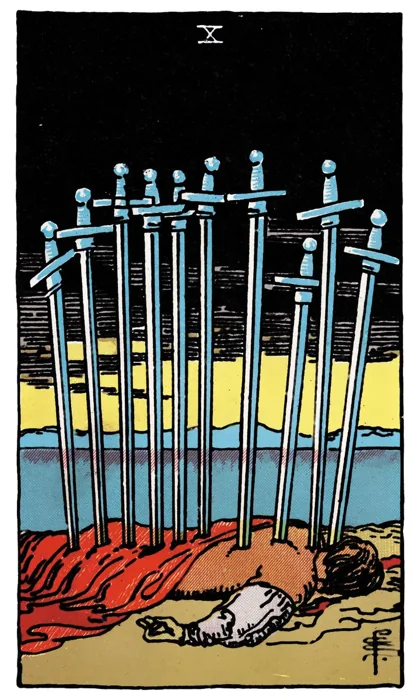
The excessive number of blades gives finality a visible form. Treat that intensity as symbolic language for an experience, not as evidence of a literal event or the secret intentions of someone in your life.
Light is present at a distance from the figure. Possibility need not be immediately usable to exist, and its presence does not require gratitude for what has been lost. Give the aftermath its own time.
When one ending tries to become your name
The inner Ten can sound like a final sentence about the self: I failed; I should have known; I have nothing left. An event has become an identity. It may help to restore the nouns and dates. Describe the project that ended or the person who left. If a strategy failed, include the conditions under which you tried it. Precision does not make the loss small. It prevents it from silently claiming everything else.
You may feel anger at how long you kept hoping. That anger can turn against the earlier version of you who accepted explanations or made another attempt. Remember what that person knew at the time. Persistence may have been reasonable before new information arrived. Updating your judgement does not require humiliating yourself for not having today's knowledge sooner.
Another feeling is relief that seems disloyal to the seriousness of the ending. You are devastated, yet no longer have to wait for the next argument or rescue the next impossible deadline. Relief and grief can coexist. The presence of one does not prove the absence of the other, and you need not select a single emotion to make your account credible.
As a temporary personal stance, the Ten may describe someone who has become attached to being beyond help. If nothing can matter again, no new risk has to be taken. This stance can offer protection for a while, but it may later become another restriction. Notice when the account of what happened stops describing the past and starts forbidding the future.
The more workable expression is modest: you accept that the plan has been abandoned and stop offering to rescue it. In a relationship, this might mean no longer seeking a final explanation from someone who is unwilling to speak. The pain may remain. What changes is where you place the next piece of effort, and whether it still has to be spent obtaining an answer already given.
Finality is a boundary around the loss
The Ten challenges the belief that effort can always reverse an outcome. Effort matters, but relationships, projects, bodies, institutions, and circumstances have limits that determination cannot simply overrule. Recognising a limit is not the same as declaring effort meaningless. It is a way of directing effort towards something it can still influence.
Finality can also contain a loss. If this chapter has ended, it need not continue consuming an unlimited share of every subsequent chapter. This does not demand forgetting or immediate forgiveness. It means allowing the event to have a boundary, even when its consequences continue. Something can remain part of your history without retaining authority over every possible next decision.
The card's severity resists sentimental accounts of transformation. Not every ending arrives with a visible benefit, and nobody is obliged to be grateful for harm. Meaning may develop later, or the most honest meaning may be that something should not have happened. A useful reading makes room for that truth while still asking what care and choice remain available now.
There is also a difference between surrendering an impossible demand and surrendering yourself. You may stop seeking approval from one source while retaining your work, values, or capacity for attachment. The Ten asks what has been fused together. Which larger part of life have you mistakenly made dependent on this one outcome continuing to exist?
Close the project without erasing the work
In work, the Ten may describe a cancellation, a role ending, a failed strategy, or a project that cannot meet its conditions. Start with the actual status. Is a decision final, or are you reacting to a serious but repairable setback? Clear information matters because the next actions differ: recovery within the project, a negotiated handover, or deliberate closure.
Where closure is real, make it legible. Record the completed work alongside any outstanding tasks, making clear who will handle each one. Preserve appropriate documents and reusable work. An orderly ending is not a denial of disappointment. It reduces avoidable confusion for everyone affected and prevents an abandoned commitment from continuing as an invisible obligation.
A professional setback may also disturb your account of competence. You worked hard and the result still failed. Look at scope, resources, timing, demand, and decisions as well as individual performance. Learning becomes more accurate when failure is neither assigned entirely to you nor explained away entirely by other people. A useful review identifies specific changes, not a permanent label.
A creative project may reach the end of one version. Perhaps a collaboration has finished, or the structure you chose can no longer carry the material. Preserve the parts you value before deleting anything in frustration. Some distance can help you recognise what could take a different form. Other parts may have done all they can and be ready to leave behind.
The shadow at work is continuing to spend resources because stopping would make the loss official. Past effort cannot be recovered merely by adding more effort. Ask whether the current proposal has a credible path under present conditions. If the only reason to continue is that you have already given so much, the decision deserves a more honest review.
After an ending, resist demanding immediate reinvention from yourself. There may be practical tasks requiring attention before a new professional identity emerges. Necessary administration may come first, with suitable support to help you through it. Let your next plan reflect the capacity you actually have. A workable transition can begin before you know what the whole next chapter will be called.
An ending needs truth more than one last argument
In love, the Ten can describe a rupture, a final recognition, or the painful exhaustion of repeatedly trying to secure an unavailable relationship. It does not order a breakup. Ask what is true in the actual connection: has an agreement ended, has trust been repeatedly damaged, or has a difficult conversation triggered a feeling of total finality that needs checking?
If someone has clearly ended contact, repeated attempts to obtain a more satisfying explanation may prolong the wound. You may never receive an account that makes the ending feel fair. Respecting the stated boundary can protect both people while leaving room to process the loss elsewhere. Closure is not always something the other person can or will supply.
When betrayal has occurred, the card can reflect the collapse of the story in which the relationship felt safe. The practical questions include what happened, what remains uncertain, what accountability is offered, and what conditions would be necessary for any future contact. Do not let the vivid image stand in for evidence or pressure you into a decision before those questions are addressed.
Within a continuing relationship, an old way of interacting may need to end. Perhaps every disagreement becomes a trial of loyalty, or one person always absorbs the consequences. A promise to begin again matters only if the pattern changes in observable ways. Ending the pattern may be the task; whether the relationship can survive that change depends on both people's conduct.
The Ten can also describe the identity lost with a relationship: the future partner you expected to be, the household you imagined, the family role you occupied. These secondary losses deserve acknowledgement. Missing that future does not necessarily mean the relationship should resume. It may mean you are mourning more than the other person's daily presence.
If you are supporting someone after a rupture, avoid rushing to the bright horizon. They may need help with food, belongings, messages, or an ordinary evening before they need a theory about why this will improve their life. Hope is often more credible when it arrives as practical company rather than a demand to reinterpret the pain.
Contain the consequences that can still be contained
In material matters, the Ten asks you to distinguish a confirmed loss from fear about a possible one. Read the actual agreement, decision, or account. Where money, housing, or legal obligations are involved, qualified advice may be needed. The card can frame the emotional experience of an ending, but it cannot establish your rights, liabilities, or financial outcome.
A useful response to a confirmed setback is containment. Work out how far the remaining resources can meet immediate needs, and who could help clarify the next steps. Avoid letting shame delay access to accurate information. The fact that an arrangement has failed does not remove your right to ask questions or receive whatever assistance is available.
At home, the card may accompany packing away a finished chapter. Objects can hold the life you expected to live, making ordinary sorting surprisingly difficult. You need not decide the meaning of every possession at once. A temporary box, a trusted helper, or a clear distinction between urgent and later tasks can make the practical work less absolute.
Be careful with gestures intended to make a new beginning feel real through sudden spending or destruction. A dramatic act can create additional consequences while you are already dealing with enough. Give irreversible choices the time and information they require. You may respond cautiously, handling ordinary paperwork without a public declaration. That does not make the ending any less real.
Stop asking the exhausted part to make the whole plan
The Ten can describe the moment when a familiar source of effort is no longer available. You cannot argue yourself into another round of the same task. Treat that limit as information about the present arrangement. What can be postponed, transferred, reduced, or ended so that the remaining essentials do not depend on an impossible continuation?
The card is not a medical assessment. Its image of collapse should not be used to diagnose illness or predict harm. If your actual condition is affecting daily functioning, seek appropriate support for that condition. Symbolic recognition can make a need easier to name, but it does not replace care grounded in what is happening.
Attention after a loss may return repeatedly to the moment everything changed. You do not need to settle the entire meaning each time. Sometimes a smaller question is kinder and more useful: what needs doing in the next hour, and what can wait until there is more capacity? The future can be approached in pieces.
End the extra injury
Name what has finished as specifically as possible. Then identify one action that keeps reopening the wound without producing useful information: checking for a reply, revisiting a closed negotiation, or repeating an explanation to someone who has already refused it. Consider what boundary would reduce that additional injury while preserving the practical communication still required.
Make room for an aftermath rather than demanding an instant beginning. Close accounts where appropriate, retrieve belongings, communicate changed commitments, and seek company or expertise where needed. These tasks may look unglamorous beside a dramatic image. They are how a life is protected while its larger meaning remains unsettled.
The risk is allowing one loss to become your account of everything. One rejection becomes proof that nobody will want you; one failure proves all future attempts pointless. The opposite shadow is forced optimism, which refuses to admit that anything valuable was lost. Both make the story less accurate. Let the loss be substantial and bounded, with consequences that deserve care and a future that remains unwritten.
An ending loosens its hold, or remains unfinished
Reversed, the Ten can suggest the first movement after a period of feeling defeated. You begin answering messages, making practical arrangements, or imagining a day that is not organised entirely around the loss. This is not proof that everything is repaired. It is evidence that the event is beginning to share space with other parts of life.
Another expression is resistance to finality. You keep one small possibility alive because acknowledging the ending seems unbearable. Sometimes a decision genuinely remains open; sometimes the remaining possibility exists only because you keep restating it. Ask what current evidence supports another attempt and what conditions would have to differ from the attempts already made.
The reversal can also show an ending interrupted by necessary unfinished business. A relationship has ended but belongings remain; a role has ended but a handover is incomplete. Practical contact need not mean the emotional agreement has resumed. Agree who will handle the remaining tasks and when, keeping contact focused on that purpose. This can prevent administration from restarting the original struggle.
Where recovery is underway, old feelings may still return. That does not mean you are back at the beginning. Compare what you can now do with what was possible before: perhaps you can ask for help, decline contact, or think about something else for part of the day. Progress can be visible in these ordinary freedoms before it feels like a new identity.
Read the reversed Ten through movement rather than a guaranteed reversal of fortune. Is life becoming more available, or is the ending being prolonged? What concrete step would support the former? The card's useful promise is limited: the story about being permanently finished may itself be ready to change.
What has ended, and what continues?
These combinations help define the scope of the ending and the kind of response it may need. They do not establish betrayal, physical danger, or an unavoidable future event.
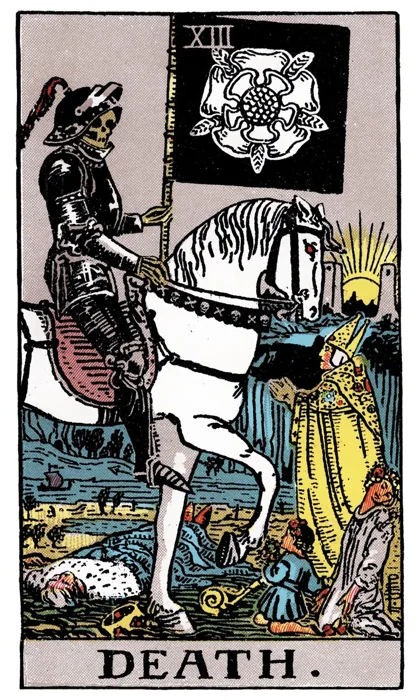
With Death
With Death, an ending may require both acknowledgement and practical change. Identify what can no longer continue and what needs to be handled respectfully. The pairing can describe a major transition, but it is not a prediction of physical death. Let the actual circumstances define its scale.
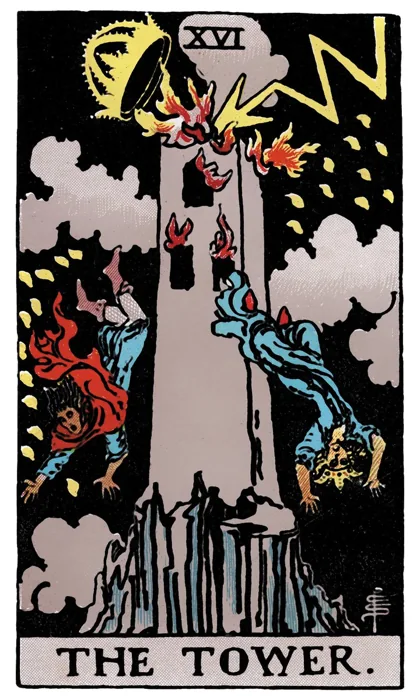
With The Tower
With the Tower, the ending may follow a disruption that exposed an unsustainable arrangement. Focus first on the facts and immediate needs. Understanding why the structure failed can come later; it should not become a condition you must satisfy before accepting useful help.
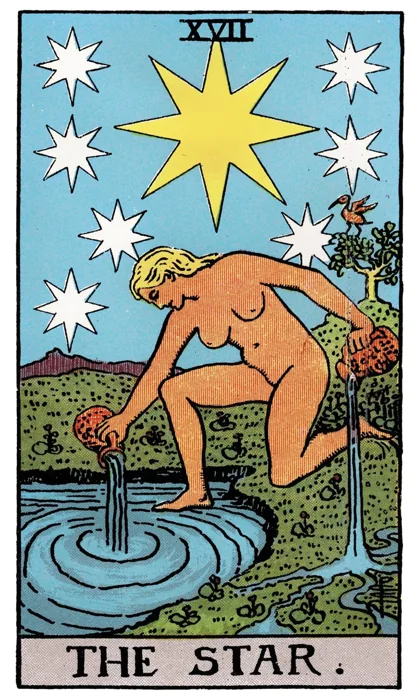
With The Star
With the Star, recovery may begin through modest signs of interest, trust, or possibility. Allow those signs without demanding that they justify the loss. A small wish for the future can coexist with grief about what ended, and neither feeling needs to defeat the other.
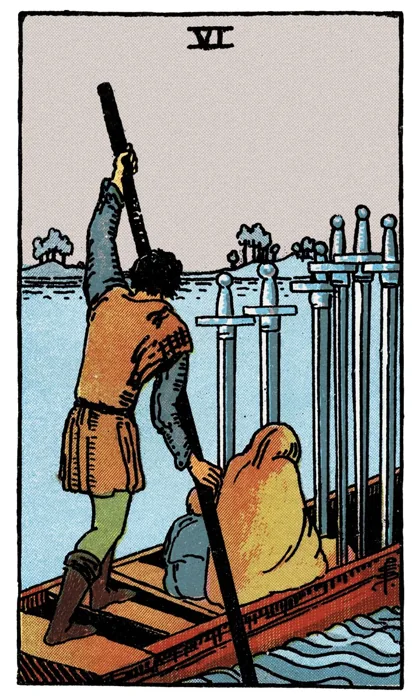
With Six of Swords
With the Six of Swords, the aftermath may need a practical passage away from the old setting. Consider transport, support, information, and what must be carried forward. Moving on is more workable when its conditions are named, rather than treated as an attitude you should immediately possess.
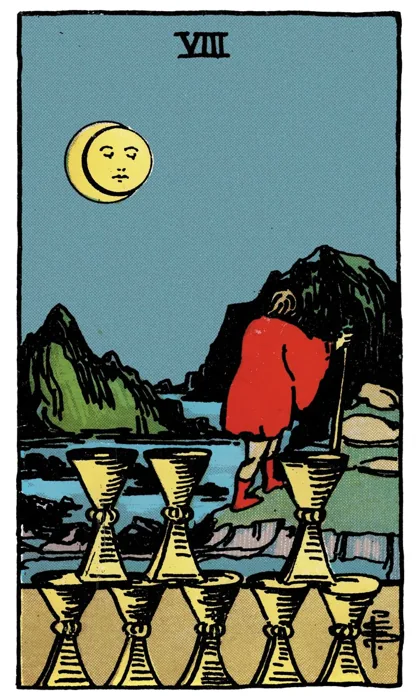
With Eight of Cups
With the Eight of Cups, you may be recognising that continued attachment cannot make an exhausted arrangement nourishing again. Leaving can contain affection and sorrow. Ask what you are still hoping another attempt will produce, and whether present evidence supports that hope.
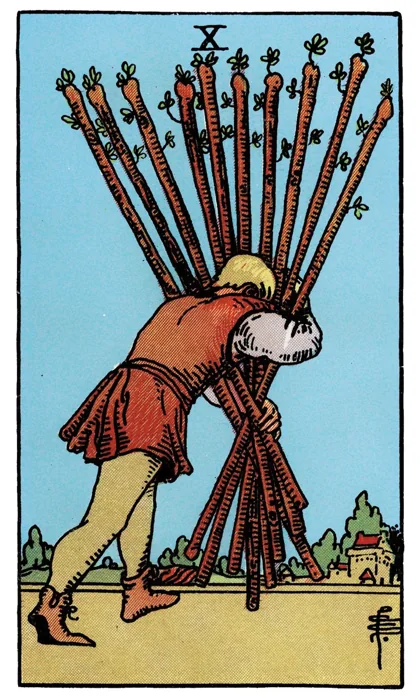
With Ten of Wands
With the Ten of Wands, a burden may have reached the point where persistence alone is no longer a reasonable answer. Review scope, ownership, and what must stop. Ending one obligation can be part of protecting the people and commitments that still need a sustainable share of your effort.
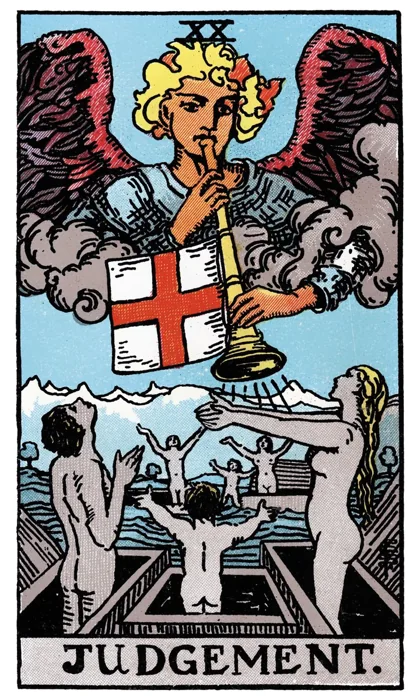
With Judgement
With Judgement, a painful ending can prompt reassessment of the story you have been living by. Let that review identify specific lessons and responsibilities. It need not turn your entire past into an indictment or require you to invent a grand purpose for every loss.
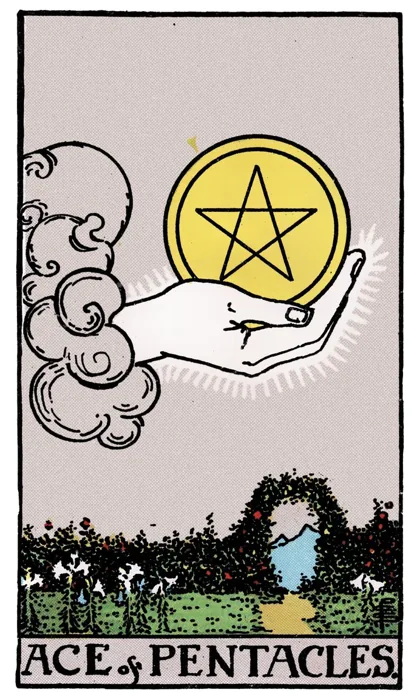
With Ace of Pentacles
With the Ace of Pentacles, a small practical opportunity may appear alongside the aftermath. It need not replace everything that ended. Consider its actual terms and what it would require. A modest foothold can be valuable without being declared the beginning that makes all previous pain worthwhile.
The closed theatre and the saved manuscript
A theatre closes after its final performance. The production is over, but costumes, skills, friendships, and the audience's memories remain. The ending does not make the work unreal. This image helps distinguish the life of a particular arrangement from everything that was created inside it and may continue elsewhere.
A writer saves a manuscript under its old title before beginning a different book. Some pages will never be used again. Others have taught the writer how to make the next thing. The point is not that every failure secretly succeeds, but that an ending need not require destroying the evidence of having worked and cared.
A person stops standing outside a locked door. They may still grieve what is behind it, and the next destination may be uncertain. Yet their body is no longer being asked to wait there indefinitely. The Ten's first movement can be that small: leaving the place where another answer is no longer available.
Give the ending a boundary
Choose a finished or exhausted situation that is manageable to reflect on. Write what has ended, what practical matters remain, and what still belongs to you. Keep the last category concrete: a skill, a friendship, an object, a preference, or the right to make a different choice next time.
Complete one small act of closure or care. Archive a file, settle a remaining question, arrange support, or stop one unnecessary repetition. You do not need to feel transformed afterwards. The purpose is to reduce the part of the ending that keeps happening, so that what follows has a little more room to exist.
Artwork & interpretation
The historical card presents an extreme image of affliction. This original interpretation treats the scene symbolically, exploring endings and their aftermath without predicting death, violence, or another person’s intentions. A. E. Waite, The Pictorial Key to the Tarot: Ten of Swords.
The symbolic associations and examples offer ways to read a situation. They do not establish another person’s thoughts or fix an outcome.
Accepting that something has ended can protect what remains, without making the ending welcome.
Use the cards in a spread →